Osmosis and Diffusion Lab
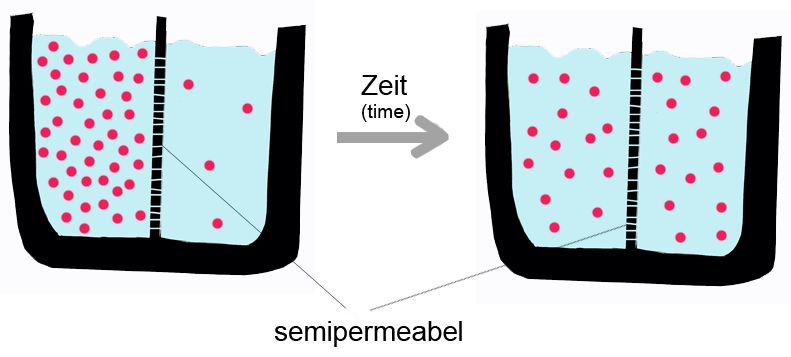
The purpose of this lab was to observe the rate of osmosis and diffusion, as well as the effect of molecular size of the particles on this rate. Part I of the lab was a demonstration of osmosis and diffusion, that dealt with raisins in different liquid environments, each with a different concentration of sugar. Part IV of the lab was using the same idea as the demonstration, by putting objects in different concentrations of a substance; in this case elodea leaves in salt water. In both cases, the objects in a greater concentration of the substance were stripped of their water. However, where there was a little or no concentration of sugar or salt, the objects did not lose their water, and in the case of the raisin, became saturated with excess water. Part II of the lab dealt with the rate of osmosis, and how molecular size was a factor on it. The purpose was to see how easily molecules of smaller diameter, which were starch molecules, would pass through an artificial membrane, as opposed to how difficult it would be to pass through in the case of larger molecules, which were IKI molecules. Results were that the smaller substance passed though the membrane easily and rather quickly, and the larger substance did not penetrate the membrane whatsoever. Part III of the lab was to view the effect of molecular size on the rate of diffusion. Two substances, both being of different molecular size were placed in the same environment. Results were that the substance with the smaller molecules, diffused farther away from where it was placed than did the substance of greater molecular size in the same amount of time.
The title of this lab is 'Osmosis and Diffusion.' Both these terms deal with the transfer of...
Reviews of: "Osmosis and Diffusion Lab"
:
More Biochemistry
essays:
RNA Evolution, RNA Function in RNA viruses and the Origin of Life
... possible and their hydrophilic portions in contact with the water. Amphipathic molecules of appropriate shape spontaneously aggregate to form bilayers, creating small closed vesicles whose aqueous contents are isolated from the external medium. The phenomenon can be demonstrated in ...
Experiment write up, including method and discussion on testing food substances for the presence of lipids (fats)
... of water Clear red layer floating on top of solution Conclusions: 1. All diary products contained lipids, however within an egg the lipids were found to be concentrated in the yolk leaving relatively ...
SDS-PAGE Electrophoresis of Proteins
... a molecule in an electric field is inversely proportional to molecular friction, which is the result of its molecular size and shape, and directly ... system was used. The stacking gel allows protein to be concentrated before they enter the resolving gel, increasing resolution by forming ...
Determinations of the Protein Concentration of a Cell Extract Using the 'Bradford Method'
... composed of 100μl of water and 5cm3 of Bradford reagent and was zeroed. Incubation period 28minsMeasurements were made on a spectrophotometer that had been warmed up for at least 30mins prior to measurements. Protein concentration (mg/cm3) was plotted ...
heavy metals
... air, water, or sediment therefore depend as much on the transport capacity of the cell membrane as on their concentration in the surrounding medium. Several different ions might compete for the same sites on the carrier molecule and the ...
Clinical Chemistry Tests in Medicine
... sodium concentration also largely determines the extracellular osmolarity and volume. The differential concentration of sodium is the principal force for the movement of water across ...
Biochemical processes and strutural attributes of the human respiratory system
... 4), this arrangement produces an enormous surface are for gas exchange; oxygen diffuses through the alveoli and capillary walls and then into the arterial blood, figure 5. CO2 leaves and O2 enters the blood due to the partial pressure gradient between ...
Biochemistry: Fertilizers
... used correctly. As a first advantage, inorganic fertilizers have a concentrated nature, which makes it easy to store and easy to be applicated. Also, they have a well-known ...
Good Job
I have looked at this essay and this would definatly be a B+ to A lab report. The data is very complete and whatever is written is very concise and to the point. But next time the user should post the lab questions with the answers that the report offers.
4 out of 4 people found this comment useful.