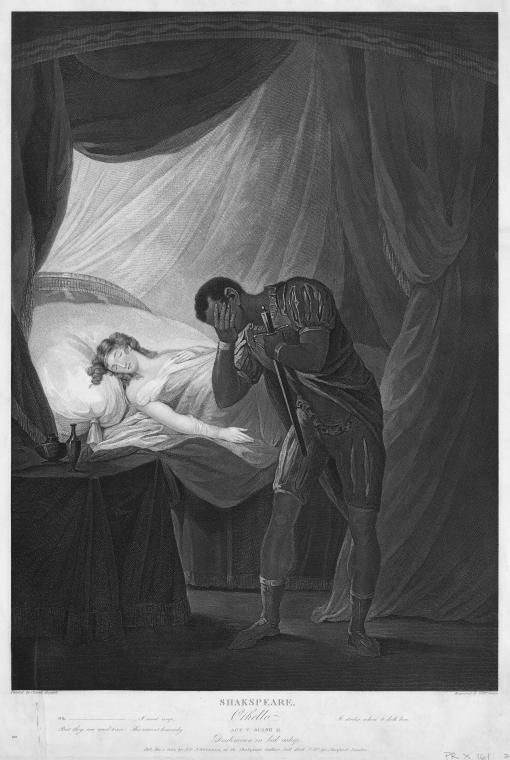
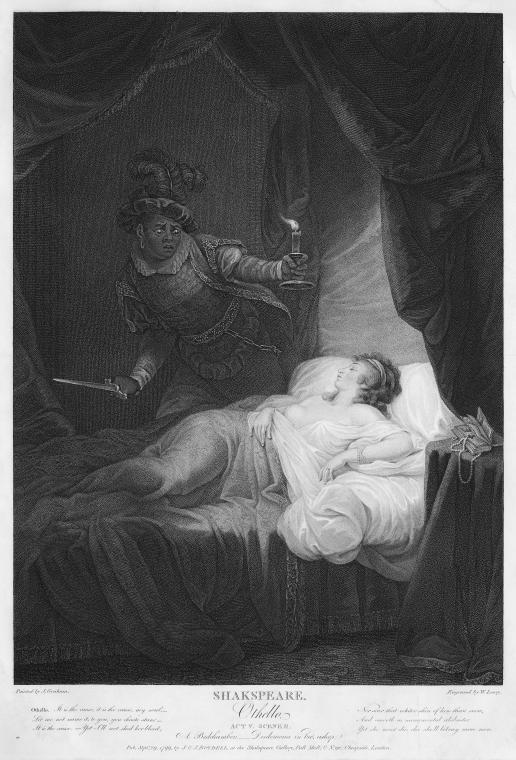
Othello
*Othello is a tense, closely-knit play, with an ever-increasing emotional scene. The
character Iago, Othello's ancient, is the cause of all the tragedy which comes to pass
as the play progresses. He is a manipulator, opposing Othello not directly, but
through other characters whom he tricks. From his actions throughout the play one
sees that Iago was gifted at using other people, to further his own schemes.
*Act One, Scene One is the most important because it foreshadows the whole
drama. Iago gives the reader warning that he is not all that he seems when he says,
'I am not what I am' (I,i). He appears to help Roderigo, a suitor to Desdemona, who
has run off with Othello, the Moorish general of the Venetian army. Iago hates
Othello for another reason. instead of choosing him to be his lieutenant, Othello
chose Cassio. In the end of scene, Iago and Roderigo have informed Brabantio
about his daughter's elopement. Then they went to confront Othello with this
situation.
*At the beginning of Scene Two of Act One, Iago gives advice to Othello and lets him
know what is about to happen. Shortly after their talk Brabantio confronts Othello
about stealing his daughter. Then they all went and saw the Duke. Othello defends
himself and asks if Desdemona can testify on the behalf of him. Othello tells how
that the only 'witchcraft' he used were his stories, and how Brabantio used to invite
him up to tell them. Finally, Brabantio disowns Desdemona and she goes to be with
Othello.
*Near the end of the first scene of the second act, Iago convinces Roderigo, who
was observing Cassio's enthusiastic greeting of Desdemona, that Cassio and
Desdemona have something going on between them. Thus manipulating Roderigo
through his passion for Desdemona, Iago convinces him...
More Shakespeare
essays:
Analysis of Iago's character in Shakespeare's 'Othello'
... that Othello took the advice of others and chose Cassio as lieutenant. In Act 3, Scene 3 Iago uses this knowledge to manipulate Othello into believing that Desdemona has ... their characters to his advantage. For example Iago establishes almost immediately that Othello is ...
Act one of Othello
... and Desdemona, to her father, Brabantio. Secondly, nearly all Roderigo’s conversation consists of subservient comments towards the manipulative Iago. He is constantly agreeing and promoting Iago’s theories on Othello; explaining ...
'Othello' by William Shakespere. Explore the character and role of Iago in 'Othello', focusing particularly on his dramatic impact in Act 3 Scene 3.
... with Othello, Cassio, Roderigo, Desdemona and Emilia vulnerably hanging at the end. Iago is part of a tradition of ?Machiavellian? stage villains. Machiavellian villains glory in their lack of idealism and manipulation skills ... deceit. Iago, one of the main characters, other than Othello, is ...
Iago in Othello.
... evil character Iago should not be simply criticized, but be meditated and analyzed, giving some enlightenment. Bibliography Adamson, Jane. Othello as Tragedy: some ...
A deconstruction of act one, scene one and act two, scene one of 'Macbeth' by William Shakespeare.
... to the witches to some extent. In Line thirty-eight, Act one Scene three, he repeats the witch's previous line but ... arranging their next meeting. Shakespeare describes the scene through the characters, "Fog and filthy air", "In thunder, lightning, or in rain ...
"Shakespeare: A 17th century progressive" (Analysis of Othello)
... the character of Desdemona as the wife of Othello, the Moor General of the Venetian army. Despite ... to cheat on him and in Act V, Scene II speaks out when both Othello and Iago wish ... 91). The senses Emilia is referring to are the sensual ones, the physical and lustful desires that all human beings have ...
What is the dramatic contribution of character of Iago in the play "Othello"
... play, Othello, lies in whether or not Iago's character is without a sufficient motive to act as sadistically and malevolently as he does. In conclusion, By creating the character Iago, Shakespeare ...
How does Shakespeare establish theme, character and plot in Act One of "As You Like It" ?
... physical separation, Orlando's awkwardness, and the looming presence of Oliver and the Duke. Shakespeare elucidates the characters of Rosalind and Celia in Act One to a great extent. The two possess no modest amount of wit, and rejoice in exercising ...