Oxygen and its compounds play a key role in many of the important processes of life and industry. Oxygen in the biosphere is essential in the processes of respiration and metabolism, the means by which animals derive the energy needed to sustain life. Furthermore, oxygen is the most abundant element at the surface of the Earth. In combined form it is found in ores, earths, rocks, and gemstones, as well as in all living organisms.
Oxygen is a gaseous chemical element in Group VA of the periodic table. The chemical symbol for atomic oxygen is O, its atomic number is 8, and its atomic weight is 15.9994. Elemental oxygen is known principally in the gaseous form as the diatomic molecule, which makes up 20.95% of the volume of dry air. Diatomic oxygen is colorless, odorless, and tasteless.
Two 18th-century scientists share the credit for first isolating elemental oxygen: Joseph PRIESTLEY (1733-1804), an English clergyman who was employed as a literary companion to Lord Shelburne at the time of his most significant experimental work, and Carl Wilhelm SCHEELE (1742-86), a Swedish pharmacist and chemist.
 Especially oxygen
 Oxygen ports
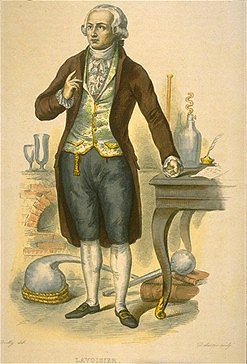 Antoine Lavoisier developed the theory of combusti...
It is generally believed that Scheele was the first to isolate oxygen, but that Priestley, who independently achieved the isolation of oxygen somewhat later, was the first to publicly announce his findings.
The interpretation of the findings of Priestley and the resultant clarification of the nature of oxygen as an element was accomplished by the French scientist Antoine-Laurent LAVOISIER (1743-94). Lavoisier's experimental work, which extended and improved upon Priestley's experiments, was principally responsible for the understanding of COMBUSTION and the establishment of the law of conservation of matter.
Lavoisier gave oxygen its name, which is derived from two Greek words that mean 'acid former.' Lavoisier held the mistaken idea that oxides, when dissolved in water, would form...