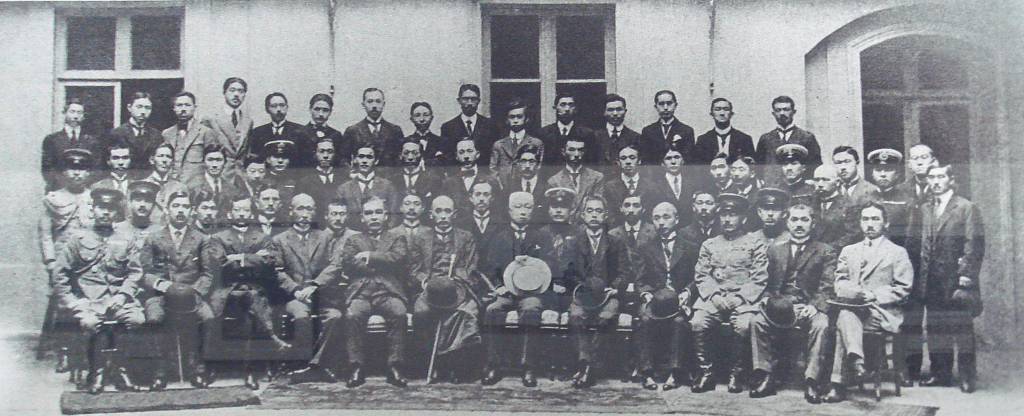
Paris Peace Conference
In January of 1919, delegates from every allied country gathered together in what is known as the Paris Peace Conference to determine the peace terms that were to be imposed on defeated Germany. The Paris Peace Conference had many goals which included the constitution of the League of Nations, the promotion of international collective security and abolishing secret peace alliances. However, the first and foremost goal of the Paris Peace Conference was to ensure that a second world war could not occur. This multi-paragraph response will outline and describe the peace terms which were imposed on Germany to prevent another war.
At the Paris Peace Conference, United States President Woodrow Wilson gave a famous speech which described the measures that Wilson recommended, which are known as the Fourteen Points. From these fourteen recommendations, the Treaty of Versailles was created, which clearly stated the peace terms and restrictions that were to be imposed on Germany. If Germany did not accept these terms, the allied countries threatened to resume hostilities. Germany had no other choice but to sign the treaty.
For many years the Germans fought with the French over the Alsace-Lorraine. This was infact one of the first reasons why the war even began. The allies recognized this, and the first of the peace terms was that the Alsace-Lorraine was to be returned to France. Germany was also forced to give up a strip of land to Poland, so that they were allowed access to the sea. Under the Treaty of Versailles, substantial territorial concessions were required from Germany. This would help to prevent war, due to the fact that Germany had always been an imperialistic country. And the more land under Germanyès rule, the more access the government had to resources. This would give Germany a slight advantage if another...
More World War I
essays:
Causes of World War I
... the Nations The League of Nations as formed by US President Woodrow Wilson had already failed badly. As a long-term cause of War it had failed in both fundamental institutional areas. 1. To maintain peace through collective security: if ...
Play Fairly, an Essay about the harsh terms imposed Germany in the Treaty of Versailles
... The Treaty of Versailles satisfied no one, and enforced unfair conditions on the Germans. The treaty forced Germany to be unarmed while other nations remained fully armed. In addition it gave German populated territory to other countries and ...
World War I: The War to End All Wars
... alike (Fourteen Points). Not everything discussed in the Paris Peace Conference and the Treaty of Versailles actually came to being; The United States Senate, controlled by members of Wilsons own Democratic Party, rejected membership in the League of Nations because ...
The balance of power mechanism and the system of alliances, had saved Europe from major wars for forty-three years, failed to preserve the peace in 1914.
... European alliance systems contributed greatly to the outbreak of world war one. Different nations militaristic, imperialistic, and nationalistic ideals either offended or worried opposing countries to such a point that plots of assassination, militaristic armaments production and territorial ...
The successes and failures of the League of Nations
... from World War I. During the 1920s, the League of Nations was successful in bringing about collective security and peace to the international community. This was done through managing conflicts between countries, initialising treaties and ...
"The peace treaties at the end of World War One sought revenge not reconciliation." How accurate is this statement?
... in World War One did have a significant effect on the home front. Bibliography:How Stuff Works. 04 May 2009. "Locarno Treaties." Wikipedia. 03 May 2009. "Treaty of Versailles." Wikipedia ...
WWWI and its place in European history.
... first war, Germans once again looked for outside sources to blame for their misfortunes. Overall, if one were to look at European history in total from the end of the nineteenth-century up until the Second World War, you ...
How much did the outcomes of the treaties reflect the leadership personalities of France, Germany and Great Britain?
... the League of Nations. Therefore, the three main nations in the lead up to the treaty were far from united on how Germany should be treated. The eventual treaty seemed to satisfy everyone on the sides of the Allies. For France ...