1. The Vietnam war - a short overwiew:
The Vietnam War, also known as the Second Indochina War, military struggle fought in Vietnam from 1959 to 1975, involving the North Vietnamese and the National Liberation Front (NLF) in conflict with United States forces and the South Vietnamese army. From 1946 until 1954, the Vietnamese had struggled for their independence from France during the First Indochina War. At the end of this war, the country was temporarily divided into North and South Vietnam. North Vietnam came under the control of Vietnamese Communists who had opposed France and who aimed for a unified Vietnam under Communist rule. The South was controlled by non-Communist Vietnamese.
The United States became involved in Vietnam because American policymakers believed that if the entire country fell under a Communist government, Communism would spread throughout Southeast Asia. This belief was known as the "domino theory." The U.S.
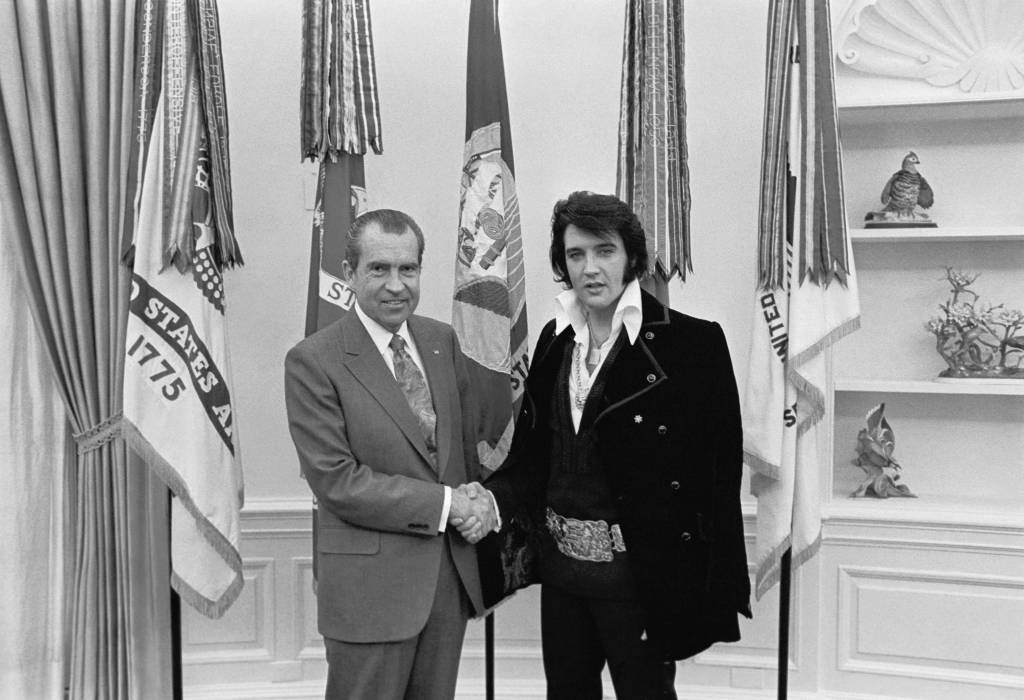 English: Elvis Presley meeting Richard Nixon. On D...
 Richard Milhous Nixon, 37th President of the Unite...
 President Nixon meets with China's Communist Party...
government, therefore, helped to create the anti-Communist South Vietnamese government. This government's repressive policies led to rebellion in the South, and in 1960 the NLF was formed with the aim of overthrowing the government of South Vietnam and reunifying the country.
In 1965 the United States sent in troops to prevent the South Vietnamese government from collapsing. Ultimately, however, the United States failed to achieve its goal, and in 1975 Vietnam was reunified under Communist control; in 1976 it officially became the Socialist Republic of Vietnam. During the conflict, approximately 3.2 million Vietnamese were killed, in addition to another 1.5 million to 2 million Lao and Cambodians who were drawn into the war. Nearly 58,000 Americans lost their lives. (Atwood, Paul, http://encarta.msn.com)
2. "Peace with honor"
During the Presidential campaign of 1968, Nixon understood the key issue was the war in Vietnam. In a low-key campaign, Nixon promised to bring...