1.
Solution to Pipe Corrosion in the Long-term?
"What's the alternative?", found in Consulting-Specifying Engineer, discusses the benefits of plastic piping. In particular, newer types of plastics like CPVC and PEX are the focus. The article is a published transcription of a roundtable discussion. It is well know that corrosion in metal piping causes many economic, environmental, and safety problems. This article proposes that CPVC and PEX are extremely resistant to corrosion and have many other benefits over metals.
David DeAngelis, a plastics sales manager, states that CPVC is not "susceptible to corrosion, pitting or scaling." These are the very problems that plague metal pipes and require their periodic replacement. Most common problems encountered with metal pipes relating to corrosion are leaks and flow restrictions. Matthew Kuwatch comments that many chemicals used in industry aggressively corrode metal piping, but CPVC is inert to mineral acids, bases, salts and aliphatic hydrocarbons.
 English: Crystaline Gold
 Rust and dirt on a baking plate. Français : Rouil...
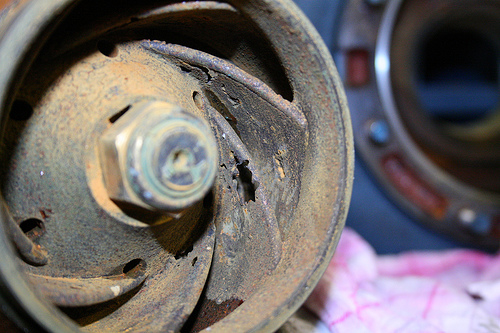 impeller corrosion
John Rattenbury notes that plastic piping is easier to install than metal piping in retrofits and remodeling. They can be easily run through walls "much like electrical cable." Also, Rattenbury states that PEX requires less joints and fittings, thus reducing susceptibility to leaks. The National Fire Protection Association approves of the use of CPVC in sprinkler system for light hazard applications. Additionally, when working on CPVC sprinkler systems it is not necessary to vacate the entire floor as it is with metal systems. Also, plastic piping has better thermal insulating properties so hot water stays hotter and cold water stays colder. Water damage from sweating pipes is reduced.
It is important to note the plastic piping must be selected carefully for its particular application. Different resins and compounds using in the plastic piping can significantly alter the pipes performance in a particular area. CPVC can be optimized for corrosion...