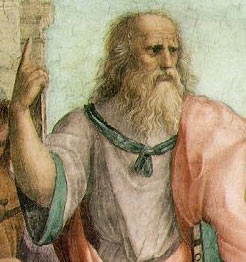
Plato's understanding of what the essence of knowledge.
PLATO AND NIETZSCHE
When people are born, they do not know the difference between right and wrong. Plato is a philosopher who believes that things are inborn. It is to say that, when a human being is born his soul knows everything, but at the beginning, the mind is a tabular rasa (blank state). As he grows day by day, he recollects the knowledge from his soul. Before uniting with the body, this soul is the human mind. After the union of the human body and the mind, the mind contains the knowledge deep in the memory. According to Plato, true knowledge in this world is made up of remembering, in reminiscence or recollection. The essence of knowledge is recollection. This thesis gives a man the ideas that he later becomes conscious of by recollection. The theory of recollection may explain why people often say that they had certain knowledge before they heard it for the first time.
In simple words, Plato's theory states that when people think about something and find an answer to a problem, they are recollecting things that they already knew. The reason why he set up such a theory is that according to him it seems to be an impossible task to be able to come to know something without already knowing it. Meno points out "If we do not know what something is, if we try to find it how will we know when we have? When, for example, we say that we do not currently know what 358721 multiplied by 54 is, how is it that by some means, we can come to discover that it is in fact 19370934? Surely, if we don't already know that 358721x54=19370934 then when someone presents this is to us as a fact we should not have...
More Contemporary Philosophy
essays:
Does Plato succeed in demonstrating that philosophers make the best rulers?
... about philosophers that Plato thinks makes them most suitable for the role. Plato's concept of what politics and government should be is a direct result of his belief in the theory of forms. The theory of forms basically states that ...
Essence of Mind and Body for Descartes
... experienced the world through sensory applications. Second, he states it is very possible that we do not know the difference between ... that the pineal gland served as the interface between the mind and the rest of the brain. This is a dualist theory of the relation between the mind and the body and ...
Plato's Cosmology: The Timaeus
... underlying the elements. Hence, unlike Empedocles, he could explain the transformation of one element into another. Problems and Responses Plato's theory of matter ... unjust soul is reincarnated for a second try (42b-c). Human body (44d-47e) 1. Head and limbs (44d-45b) 2. Eyes ...
It is 300BC, you are a Platonist. Your friend, also a student, has been condemned to death by the Athenian court. Write him a letter preparing him for his last hours.
... his Theory of Numbers? It would be inappropriate to suggest, moreover, that Euclides of Alexandria, who is much respected, has set out in vain to systematize mathematics and to provide lasting proofs for all existing knowledge, which ...
The main argument of the Phaedo for the Theory of Recollection and the Immortality of the Soul
... his theory of recollection served as the universal exemplars of particular things of a given kind. Thus, in Plato's explanation, to have knowledge of those particulars before experiencing them, we only need to know their ...
This essay is about Plato's Allegory of the Cave and what my interpretation is of the images that dwell in the cave.
... seeing the media and confusing the self image of it to reality. The allegory of the cave not only has to do with Plato's beliefs in the human immortality but also realizing the difference between ...
An Analysis of The Republic
... how Plato relates the three parts of the soul to a city the different social classes within that city. Plato supposed that people exhibit the same features, and perform the same functions that city-states do ...
Theory of recollection from Plato's writings about Socrates
... one point. But as Socrates states in the theory of recollection, our souls already knew all knowledge. There had to be some point in time when our souls did not know anything and were given the chance to learn. This negates ...