Thesis Statement:
Politeness can be realized in a number of ways, among which the use of language concerns us most in the present discussion. Politeness is then taken to be the various forms of language structure and usage which allow the members of a socio-cultural group to achieve their conflict-avoiding goals.
Outline
1.0 Introduction of Politeness
1.1 What is Politeness?
Politeness is a kind of socio-cultural phenomenon in human communication. Politeness is seen as the adequacy of linguistic behavior.
1.2 Motives of Being Politeness
The motives of being politeness lies in the consideration of "face". Face is viewed as a positive public self-image that is maintaining in society.
2.0 Culture
2.1 Define Culture
Culture consists of not only language, behavioural norms, which can be observed, but also values and beliefs underlying them.
2.2 Language and Culture
Every language is part of a culture.
3.0 Politeness and Culture
3.1 The Concept of Face In Chinese and English
 Erving Goffman
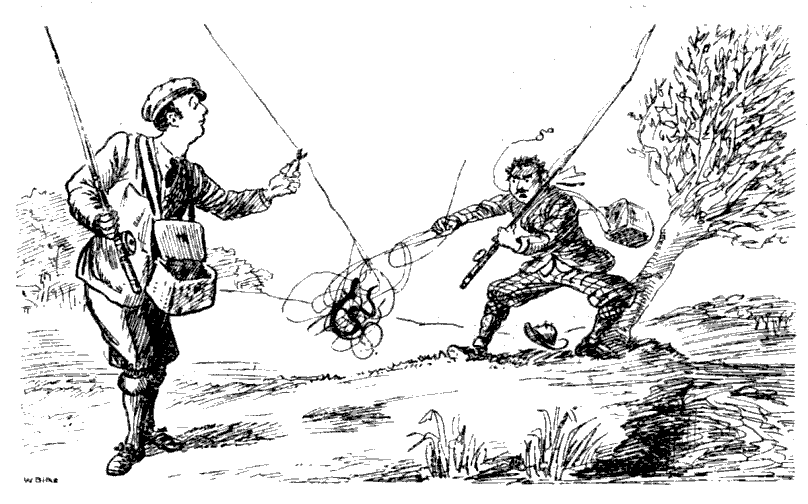 True Politeness. "Your eel, I think, Sir?" ---- Ca...
 Politeness (LOC cph.3g08085)
3.1.1 The Source of B & L's " Face"
B & L characterize face as image that intrinsically belongs to the individual, to the self.
3.1.2 Chinese "Face"
Chinese speakers will be seen as being polite if they know how to attend to each other's and to enact speech acts appropriate to and worthy of such an image.
3.2 Differences between Chinese "face" and B&L's "face"
The differences are related to the conceptualization and the content of "face".
3.3 Cultural Assumption
3.3.1 A Historical Review
3.3.2 Two Construals of the Self: Interdependent and Independent
1.0 Introduction
1.1 What is politeness?
Politeness is a kind of socio-cultural phenomenon in human communication. It has been defined in diverse ways.
For Kochman (1984), politeness has a protective mission exercised in putting things in such a way as to take account of the feelings of others:
Polite conversation is... a way of showing consideration for other people's feelings, that is, not saying or doing anything that might unduly excite or arouse. The 'gentleman's agreement' (though, hardly just confined to adult males) is and was ' you don't do or say anything that might arouse my feelings, and I won't do or say anything that might arouse yours'... (1984:204)
Watts (1992) defines polite behaviour as "socio-culturally determined behavior directed towards the goal of establishing and/or maintaining in a state of equilibrium the personal relationships between the individuals of a social group, whether open or closed, during the ongoing process of interaction" (1992:50)
Therefore, the term "politeness" may be generally defined as adequate social conduct and tactful consideration of others aiming to avoid interactional conflicts.
Politeness can be realized in a number of ways, among which the use of language concerns us most in the present discussion. Politeness is then taken to be the various forms of language structure and usage which allow the members of a socio-cultural group to achieve their conflict-avoiding goals.
If politeness is seen as the adequacy of linguistic behavior, then all speakers of different languages are equally polite, since they all have linguistic means at their disposal, which according to their rules of application are adequate in different situations. The concept of politeness, therefore, is universally valid.
1.2 Motives of Being Polite
Why do people apologize when they have done something wrong? Why do they compliment on their friend's hairstyle? In one word, why do people behave appropriately, hence politely? The explanation of such diverse communicative behaviors lies in the consideration of "face".
Face is thus viewed as a positive public self-image that is maintaining in society. That is, in newly formed contacts the individual engages in establishing a public image for himself. In continued contacts he engages in sustaining and improving the face he has encouraged the others to develop for him.
A fundamental preoccupation of people around the world is maintaining or protecting face. Threats to face, whether intended, accidental, or only imagined, are the basis of most interpersonal conflicts. They arise when people feel that their right to a positive self-image being ignored. One conventional way of avioding threats to face in all cultures is to be linguistically polite.
To secure this public self-image, people engage in what Goffman calls "face work", performing action "to make whatever they are doing consistent with face"(1967:12), while trying to save their own face as well as the other's. Goffman (1967) specifies two kinds of face-work: the avoidance process (avoiding potentially face-threatening) acts and the corrective process (performing a variety of redressive acts). However, he says little about how face can be maintained linguistically while damage is occuring.
As implied above, face wants are reciprocal, i.e. if one wants his face cared for, he should care for other people's face. The reason is that, while the individual is absorbed in developing and maintaining his face, the others also have similar considerations for themselves. It is clear that one way of ensuring the maintenance of their own face is to keep everybody's face undamaged. Normally, the participants during interaction work on the understanding that one will respect the other's face as long as the other respects his. This point is best expressed by the concise rule in Scripture: Do unto all men as you would they should do unto you.
Since face wants are reciprocal, politeness naturally concerns a relationship between two rational participants or interlocutors, whom we may call self and other. In a conversation, self may be identified with speaker or addresser, and other with hearer or addressee. Also it is possible that speakers show politeness to a third party that is related to interlocutor's face.
2.0 Language and Culture
2.1 Defining Culture
Culture is a large and evasive concept. Sapir (1921) holds that culture may be defined as what a society does and thinks, and language is a particular way of thought. Language, in this way, is part of culture. Culture is also interpreted in the sense of Goodenough's definition:
As I see it, a society's culture consists of whatever it is one had to know or believe in order to operate in a manner acceptable to its members... Culture, being what people have to learn as distinct from their biological heritage, must consist of the end-product of learning: knowledge, in a most geneal... sense of the term (Goodenough,1954:167).
Culture is thus whatever a person must know in order to function in a particular society, including language and conventional behavioral norms that a person must follow or that other people in the society expect you to follow, to get through the task of daily living.
When we study a culture, it is not enough to merely learn the knowledge of a language and behavioral norms, as Steinmetz, Bush and Joseph-Goldfare (1994) point out:
Studying culture does not mean looking only at customs, insititution, and artifacts..., but also studying people's values, beliefs, and attitudes and how they influence or are influenced by interaction among people. Culture should be studied as a process as well as a product (1994:12).
As a combination of these views, culture consists of not only language, behavioural norms, which can be observed, but also values and beliefs underlying them. The famous metaphor of the "culture iceberg" (Hall & Hall, 1990) indicates that many aspects of culture, such as certain beliefs, world views, and values, are below the surface of consciousness ( in the submerged part of the iceberg). Other aspects of culture, like language, eating habits, customs, are in the conscious area ( above the waterline). It is often the less conscious cultural aspects that influenced the way people communicate with each other.
2.2 Language and Culture
We are now in a position to see language and culture in a dialectical relationship. Every language is part of a culture. As such, it cannot but serve and reflect cultural needs. This does not necessarily go against Saussure's thesis that the signified of a language are arbitrary and hence derive their exact identity from systems of relationships. What needs to be added, however, is that this arbitrariness is not as absolute as he suggested, but is limited by the particular cultural setting from which a language extracts its signified. Within the broad limits set by the specific needs of a culture, a language is free to make arbitrary selections of signifieds. This element of arbitrariness is brone out by the fact that there is of a speech community and its linguistic resources.
Thus neither linguistic determinism nor cultural determinism can adequately explain why a language should select its unique system of signs, for these selections are made partly in response to cultural needs and partly owing to the inherent ( limited ) arbitrariness of the process.
There is yet another sense in which language is not a passive reflector of culture. Even assuming that culture is in many cases the first cause in the language-culture relationship, language as the effect in the first link of the casual chain will in turn be the cause in the next link, reinforcing and preserving beliefs and customs and conditioning their future course.
3.0 Politeness and Culture
3.1 The Concept of Face In Chinese and English
The central to B & L's politeness theory is the concept of face, and its two concimitant desires----- negative face and positive face, which are defined from the perspective of individual's wants. B & L maintain that notion of face constituted by these two basic desire is universal (1987:13). This section thus aims to examine whether their notion of face is applicable in Chinese culture. Since they acknowledge deriving their formulation of face from Goffman's classic account of face and from the English folk notion of face (1987:61), these two sources will be dealt with first.
3.1.1 The Source of B & L's " Face"
The first source is Goffman's account of face. Goffman characterizes face as "the positive social value a person effectively claims for himself by the line others assume he has taken during a particular contact". He sees face not as a private or an internalized flow of events, supported by other people's judgments, and enclosed by "impersonal agencies in the situation" (1967:7). Seen in this light, face becomes a public image that is on loan to individuals from society, and that will be withdrawn from them if they prove unworthy of it (1967:10).
B & L say that their other sources is the English folk concept of face, which is linked to notions like "being embarrassed of humiliated, or 'losing face'" (1987:61). But in fact, such notions of face seem to be Chinese in origin. The word "face" is a literal translation of the two Chinese characters and ( Hu,1944;Ho,1975).
Presumably informed of these two sources, B & L characterize face as image that intrinsically belongs to the individual, to the self. This seems to part with their first source considerably. Here, the public characteristic that is essential to Goffman's analysis of face seems to become an external modifier rather than an intrinsic constituent of this image.
3.1.2 Chinese "Face"
As pointed out above, two Chinese characters and are used to convey the denotative meaning of the word "face" ( that is, " the front of the head"); they also encode connotative meanings, which have to do with reputable, respectable images that individuals can claim for themselves from communities in which they interact, or to which they belong (Ho,1957). More specifically, stands for prestige or reputation, which is either achieved through getting on in life (Hu, 1944:45), or ascribed by other members of one's own community. refers to " the respect of the group for a man with a good moral reputation"; it embodies " the confidence of society in the integrity of ego's moral character", and it is " both a social sanction for enforcing moral standards and internalized sanction" (Hu, 1944:45). Chinese speakers, therefore, will be seen as being polite if they know how to attend to each other's and and to enact speech acts appropriate to and worthy of such an image.
3.2 Difference Between Chinese "Face" and B & L's "Face"
The first difference is concerned with their overall conceptualization of face----a difference that has been briefly alluded to above. B & L focus their notion of face primarily upon the individual----rather than the communal-aspect of face; that is, the self is the principal constituent that contextualizes the concept of face. The self is "public" only to the extent that it depends on other's face being manifested (B & L, 1987:61). The self depends on the public only to preserve its own interests. In short, the overall composition of this self-image, with its negative and positive aspects, only concerns the individual's wants and desires.
In contrast, Chinese face encodes a reputable image that individuals can claim for themselves as they interact with others in a given community; it is intimately linked to the views of the community and to the community's judgment and perception of the individual's character and behaviour. Chinese face emphasizes not the accommodation of individual "wants" or "desires" but the harmony of individual conduct with the views and judgment of the community. Chinese face, to quote Goffman again, is "on loan...from society" (1967:10); it belongs to the individual or to the self only to the extent that the individual acts in full compliance with that face.
The second difference is related to the content of face. B & L conceive of face as consisting of negative face and positive face. Their negative face refers to, and values, an individual's need to be free of external impositions, a desire to be left alone to enjoy a sense of one's "territorial integrity". "Privacy" is a particular term used to describe this typical value, which is much more treasured in English culture than in Chinese; whereas Chinese face emphasizes one's dependence on society's recognition of one's social standing and of one's "reputable"existence, and subsequently, on society's endorsement of one's attending to it. Relatively speaking, Chinese "face" does not comprise the element of what B & L term "negative face".
3.3 Cultural Assumption
In this section, the differences of politeness in English and Chinese will be elaborated in terms of the different historicity that the concept of politeness can be traced back to, and of the fundamental cultural assumptions underlying the two different notions of English and Chinese "face".
3.3.1 A Historical Review
As we have known, privacy is a value derived from B & L's notion of face. It is a notion embracing at once the freedom, rights, and the independence of action of man. Such a value is closely associated with the emancipation of man from the yokes of the church on the European continent, and with the opening up of the New World on the other side of the Atlantic----North America. Consequently, showing respct to an individual's liberty, his rights, his independence in Anglo-American culture, will be considered polite; lack of it will be improper, hence impolite.
On the contrary, Chinese culture has had a 2000-year-long history of feudalism. Chinese civilization has been established on agriculture, and " Generations of peasants were tied to the land on which they lives and worked. Except in times of war and famine, there was little mobility, either socially and geographically" (Hu & Grove,1991:1). From this historicity resulted the collective (group-oriented) nature of Chinese value, which was reinforced ideologically in the Confucian tradition, a tradition that advocates subordinating the individual to the group or the community, and maintains that the ultimate goal of human behavior is to achieve harmony, which leads the Chinese to pursue a conflict-free and group-oriented system of an ever-expanding circle of human-relatedness (Chen, 1993). Namely, an individual is presumed not to satisfy the desire for freedom, but to gain self-esteem in harmony with group. Just as English culture values privacy, Chinese culture values harmony.
In modern Chinese, the equivalent of politeness is believed to have evolved in history from the notion of Li . The ancient philosopher and thinker Confucius (551---479 B.C.), in order to restore the harmony of society when there were constant wars between feudal states, advocated restoring Li. Derived from this book are four basic elements of politeness, or what count as polite behaviors: respectfulness, modesty, attitudinal warmth, and refinement. "Respectfulness" is the self's positive appreciation of admiration of the other concerning the latter's face, largely identical with the need to maintain the hearer's positive face. "Modesty" can be seen as another way of saying "self-denigration"; though "modesty" varies in the importance attached to it in different cultures, it is to a large extent universal, her to interpret it as self-denigration is uniquely Chinese. "Attitudinal warmth" is the self's demonstration of kindness, consideration, and hospitality, the speaker runs the risk of infringing on the hearer's personal freedom, viz. privacy, thus threatening his negative face. Finally, "refinement" refers to the self's behavior to the other which meets certain moral standards laid by society; it represents the normative character of politeness in addition to the instrumental aspect. These four essential elements of politeness are believed to manifest themselves in many Chinese speech events.
3.3.2 Two Construals of the Self: Interdependent and Independent
If we examine the "deep structure" from which the two different notions of English and Chinese "face" can possibly be derived, them they can be said to have been informed metarphorically by two divergent underlying forces (Mao,1994): the centripetal force, which leads Chinese "face" to gravitate toward social recognition and hierarchical interdependence, and the centrifugal force, which enables English "face" to spiral outward from individual desires or wants with the self as the initiating agent. The centripetal force and centrifugal force represent two different face orientations, which correspond to two distinct construals of the self: an interdependent construal of the self and an independent construal of the self respectively(Markus and Kitayama, 1991).
The independent construal of the self, endorsed by English culture and most Western countries, builds on " a faith in the inherent separateness of distinct persons ". The normative imperative of this culture is to become independent of others and to discover and express one's unique attributes (Miller, 1988). Thus achieving the cultural goal of independent requires construing oneself as an individual whose behavior is made meaningful primarily by reference to one's own internal thoughts, feelings, and actions, rather than by reference to those of others; whereas the interdependent construal of the self, favoured by Chinese culture and most East Asian countries, insists on " the fundamental connectedness of human beings to each other"(Markus and Kitayama, 1991:227). A normative imperative of this culture is to maintain this interdependence, therefore, entails seeing oneself as part of an encompassing social relationship and recongnizing that one's behavior is organized by what the self perceives to be the thoughts, feeling, and actions of others in the relationship, so that the self within such a construal becomes most meaningful and complete.
BIBLIOGRAPHY
Blum-Kulka, S. et al. 1984. Requests and apologies: A cross-cultural study of speech acts realization patterns (CCSARP). Applied Linguistics 5(3):192-212
Brown, R. & S. Levinson. 1987. Politeness: Some Universals in Language Usage. Cambridge:CUP.
Chen, Guoming. 1993. A Chinese perspective of communication competence. Paper presented at the annual convention of the speech communication association, Miami Beach, FL.
Goffman, E. 1967. Interactional Ritual: Essays on Face-to-Face Behavior. New York: Doubleday Anchor Books.
Goffman, E. 1972. Interactional Ritual. London:Penguin.
Goffman, E. 1971. Relations in Public: Macrostudies of the Public Order.
Harmondsworth:Penguin
Goodenough, W. H. 1957. Cultural anthropologh and linguistics. In Garvin, P.L.(ed.)
Report of the 7th Annual Round Table Meeting on Linguistics and Language Study.
Washington: Georgetown University Press
Hall, E. & M. Hall. 1990. Understanding Cultural Differences. Yarmouth, ME: International Press.
Ho, D.1975. On the concept of face. American Journal of Sociology 81(4):867-84
Hu, Wenzhong & C. L. Grove. 1991. Encountering the Chinese: A Guide for Americans Yarmouth, ME: International Press.
Mao, L. R. 1994. Beyond politeness theory: "face" revisited and renewed. Journal of Pragmatics 21:451-86
Markus & Kitayama. 1991. Culture and self. Pshchological Review 98(2):224-53
Miller, J.G. 1988. Bridging the context-structure dichotomy: culture and the self. In M.H. Bond (ed.) The cross-cultural Challenge to Social Psychology. Beverly Hills, CA: Sage. 266-81
Great
I'm studying Goffman at the moment and I am intrugued to look at his other work now I have read your essay. Nice one.
1 out of 1 people found this comment useful.