Political and Economic Changes After the War of 1812
Andrew Jackson looked on toward a new democracy after his victory at New Orleans. The changes in this time period, after the war of 1812, would send America into a troubled future. The Post war political and economic changes would prove to be another stepping stone in America's evolving democracy.
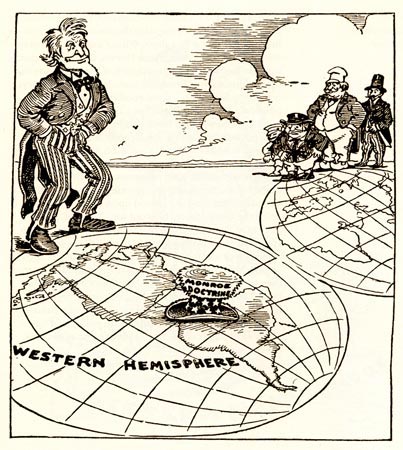
The political changes after the War of 1812 would redefine America's newly founded Democracy and contribute to a greater national government. Andrew Jackson gained America's respect after his victory at New Orleans and was later elected President in 1829. Jackson and his cabinet invested power into an powerful Executive Branch. The Jackson democrats tended to exaggerate the puissance of the lower class poor while decreasing the influence of the rich and potent and aristocracy. Andrew Jackson abolished restrictions on voting and increased active participation in the government by the lower and middle classes. Jackson also made the government more directly responsible to the people without the use of federally funded improvements. After the war of 1812, the federal government not only grew domestically but also internationally. The Monroe Doctrine shifted America's foreign policy. The Monroe Doctrine stated that European nations may not interfere or influence nations or colonies in the Western Hemisphere. Although at the time America lacked the military capacity to enforce this Doctrine, this policy was a major shift away from George Washington's policy of neutrality. The U.S. continued its policy of non involvement in European wars, but Europe now was expected to stay away from the Western Hemisphere. The U.S. continued to enforce this Doctrine to this day, with perhaps the most famous example being President Kennedy's Cuban Blockade. After the War of 1812, America's nationalism and unification began to fade in the face of sectionalism. The North and the South soon began to dispute over controversial...
More North American Wars
essays:
How did America change after the War of 1812? This essay describes the economic and political changes after the War of 1812, including the effects of the cotton gin and Sectionalism.
... Andrew Jackson led the United States victory at New Orleans, nationalism increased and Americans looked forward with confidence to a future filled with changes. They would not be disappointed. The years after the War of 1812 produced great economic and political ...
To what extent did economic, political, and social change effect the lives of colonists after the American Revolution?
... economic pressure added to a feeling of the way things were being run limited the colonists' fiscal activity. The Revolution provided the means necessary to give the most support to merchants' interests - budding commerce, the free market, and trade. Political change ...
The Vietnam War & the 1960's Fthe political changes to the Civil Rights Movement.
... socially changing time in the United States. From the political changes, brought about by the assassination of John F. Kennedy, the Vietnam War, the Counterculture movement and to the Civil Rights Movement. In 1960 Kennedy was one of the many Democratic ...
The Reconstruction of the United States after the Civil War. Radical reconstruction vs. presidential reconstruction. The affects on blacks. Compromise of 1877.
... its new image, the United States follows these steps to create the both successful and failed restoration. New concepts were introduced after the Civil War, of these came new Amendments ...
"The Killer Angels" by Michael Shaara
... eventually elected President of Bowdoin College. He dies from his wounds in June 1914 at the age of eighty-three. General Longstreet asks to be relieved of command after the Battle of Gettysburg, but Lee makes him stay. After the war ...
Southern Women's Roles and how they Change as a Result of the Civil War
... from New Orleans, Sarah Morgan Dawson felt this way. "No glory awaits the Southern Confederacy, even if it does achieve its independence; it would be a mere speck in the world with no weight or authority." Before the war started ...
Brief Analysis of industrial work, politics, law, and foreign relations from the Civil War to World War I.
... involvement of individuals in politics, but strengthened the executive branch and expanded government bureaucracy (TS 853). Changes in law during this period were similar to Progressivism. Much of the ... gained national attention in the 1896 election. Farmers became dissatisfied with the Democratic and ...
Reconstruction and the affects of it after the civil war.
... Civil War the United States government was forced to make changes in order to successfully embrace the South and reunite the Union. This interval of change was called the period of Reconstruction. President Lincoln ...