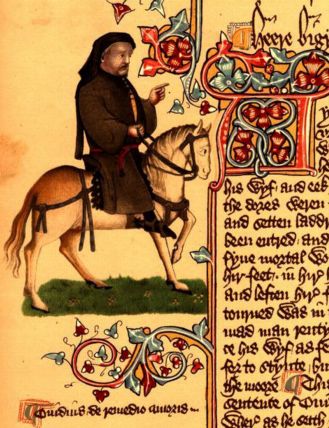
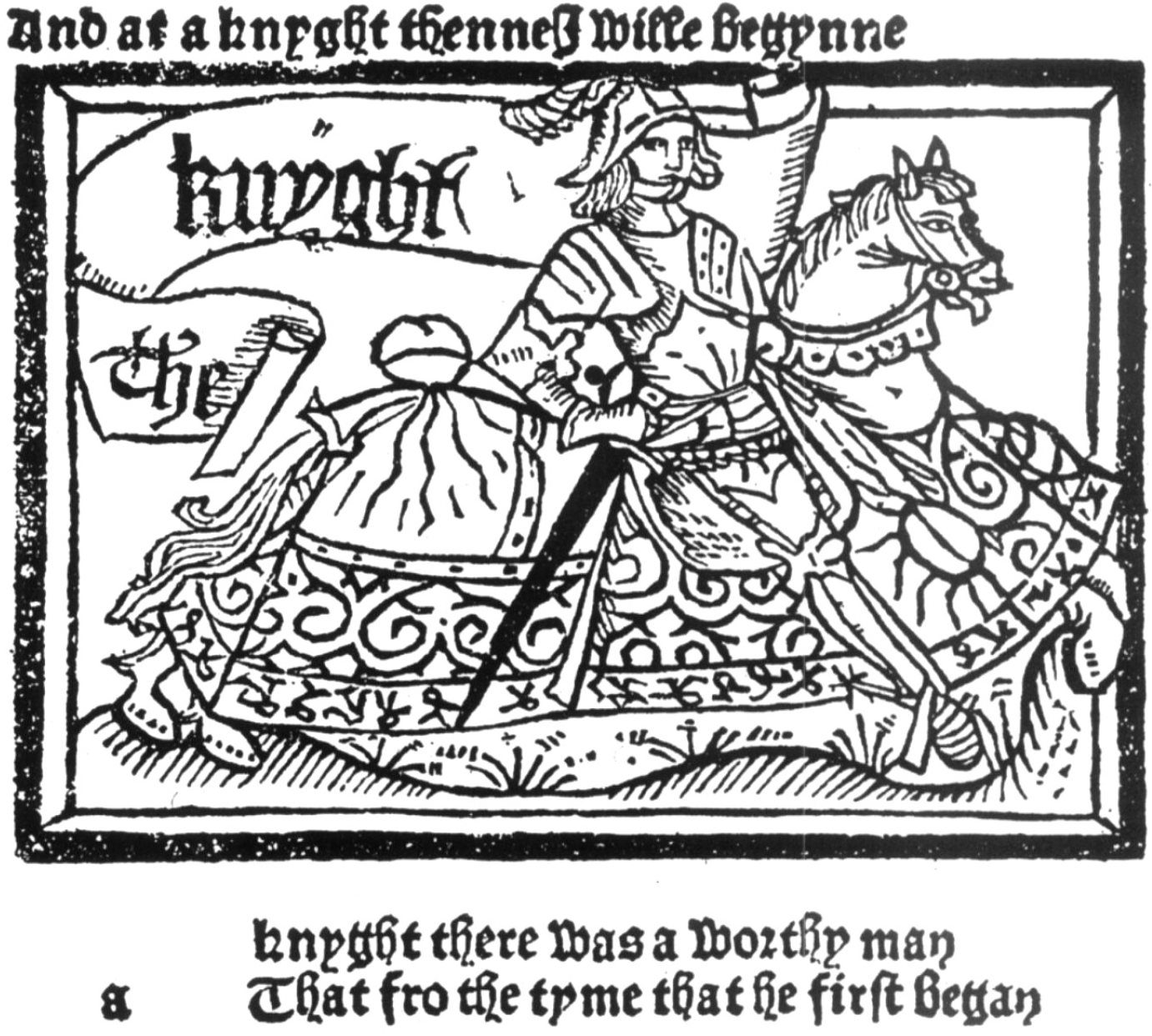
Portrait of medieval society in "General Prologue" of Geoffrey Chaucer's "The Canterbury Tales"
On the 21. September 1066 the history of England changed forever. On that day William, who will be later know as "the Conqueror", set his foot on the coast of Britain. The campaign was short and effective. Great victory at Hastings enabled William to quickly take control over the country and coronate himself in Westminster. With new king, the society, customs and culture started to change, to fit to French ideals. Among the other things, but probably most important one, was introduction of estates society.
Let's now jump in time to year 1387. Retired Clerk of Works Geoffrey Chaucer finishes prologue of his masterpiece "The Canterbury Tales". Chaucer was born around 1340 and lived through a time of incredible tension in the English social sphere. The Black Death, which ravaged England during Chaucer's childhood and remained widespread afterward, wiped out an estimated thirty to fifty percent of the population. Consequently, the labour force gained increased leverage and was able to bargain for better wages, which led to resentment from the nobles and propertied classes. These classes received another blow in 1381, when the peasantry, helped by the artisan class, revolted against them. The merchants were also wielding increasing power over the legal establishment, as the Hundred Years War created profit for England and, consequently, appetite for luxury was growing. The merchants capitalized on the demand for luxury goods, and when Chaucer was growing up, London was pretty much run by a merchant oligarchy, which attempted to control both the aristocracy and the lesser artisan classes. This observations and knowledge of literature gained during the travels around Europe allowed Chaucer to create the greatest portrait of medieval society in history. That was achieved in "The Canterbury Tales". I...
More Poetry
essays:
Chaucer and the "House of Fame". Discusses the cultural nature of fame and its textual expression with reference to oral heroic poetry and the modern construction of the canon of English literary trad
... constantly changing murmurings in The House of Rumour. However, although Chaucer is himself a scholarly and academic man like Geffrey, he is still rather mocking of the academic society and ...
Women in Ancient Times based on Ovid's "The Art of Love" and Paul's Corinthians.
... promote love just with different ides and. In looking at these texts we can see how love changed from first century Rome where it was based of wealth and class to early Christianity where it was viewed as shameful and sinful ...
Critical Analysis of Coleridge's "The Rime of the Ancient Mariner"
... a tale at sea, the poem stands as a remarkable one with its continuous simple rhyme scheme and easy flow of speech. And if one reads deeper into the intricate symbolism, themes and significant subject matter, Coleridge's masterpiece becomes ...
Geoffrey Chaucer's "The Prologue To The Canterbury
... Ages. Chaucer uses vivid charaterizations to represent these changes in society. He introduces these characters as "pilgrims" onn their way to the Cathedral in Canterbury. Through his depictions of the Knight and the Squire, Chaucer reveals ...
Beowulf and the Song of Roland, the theme of Father/Son Relationship
... the death of Roland sparks his energy, and makes him take the war up as a revenge for Roland and the others. The emphasis on revenging Roland is also representational of Medieval society, and ...
Influence of Personal Experience in Emily Dickinson's poetry- literary criticism. Includes excerpts of some of her poems
... but moor - Tonight - In Thee! This gives so much evidence of Emily's capacity for passion that for a while (now passed) "...critics generally supposed that the principle reason for her art lay in ...
An analysis of Johann Wolfgang von Goethe's Faust and various poetic works.
... constantly changing at any given time. (Large, 63). During the era of Goethe, the general municipal believed that the illumination of Reason would enable them to live in an utopian society. During ...
A comparison of Blake's treatment of his subject in "Songs of Innocence" with that in "Songs of Experience".
... sordidness of society. Blake criticises psychological indisposition, which accepts social injustice. In the ... set of thematically related lyrics organised by a general principle of wishing to show the juxtaposition between the state of Innocence (seen from the eyes of youth) and that of Experience ...