"The Power of Words: Pablo Neruda"
The Power of Words: Pablo Neruda
Neftali Ricardo Reyes de Basoalto, later known as Pablo Neruda, was a contemporary poet from Chile, as well as a diplomat, communist party leader, and one of the few men responsible for shaping Latin America literature into what it is today. Neruda was a surrealist who revitalized everyday language and employed bold metaphors in free verse. He was greatly impressed with nature and natural phenomena such as death and regeneration. Intuition and the forces of instinct characterize and animate Neruda's highly personal style. He also had a fascination with the Chilean landscape, and it has been conjectured that Neruda's love and erotic prose is written with the countryside of his beloved homeland as an underlying theme. For these reasons many aspects of Pablo Neruda's life, but especially the rainforest and rural landscapes of Chile, affect and connect his poetic views of passion and love, in many different ways.
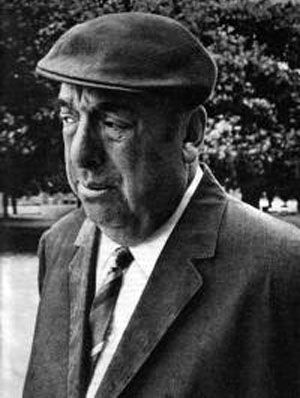
Neftali Ricardo Reyes de Basoalto was born on July 12, 1904, in Parral, a small village on the outskirts of the rainforest. His mother died one month after his birth, and soon after his father remarried and they moved to Temuco. Neftali loved his new home and his new 'mamadre', whom he later referred to as, "The Guardian angel of my childhood"(Neruda, Memoirs 2). Neftali's move profoundly affected his writing. In his autobiographical collection of poetry, Memorial de Isla Negre, he wrote of his feelings on this change:
From the ax and the rain it grew
the wooden town
freshly cut like
a new star with beads of resin
and the saw and the sierra
made love day and night
singing
working
and the shrill sound of the cicada
raising a lament
in the stubborn solitude comes back
as my song. (1-12)
Pablo began reading and...
More World Literature
essays:
"Fugitive Pieces" by Anne Michaels, "The Power of One" by Bryce Courtenay and "Empire of the Sun" by J.G. Ballard
... nothing more than to gain his approval. "Jim noticed how different Basie was from his father in this respect. For the first time in his life Jim felt free" (Ballard 90). Through Jim's attempts to gain Basie's ...
The Power Of Perspective.
... our difference in culture. Being brought up with different value and morals we learn to see life in different ways. To ...
"The Power of One" by Bryce Courtenay. Answers question, "What have you learned about he predominant culture of the book?"
... that he truly discovers who he is. This is an extraordinary story about meeting and overcoming the expectations that a person places on himself, that others place on him, and that society places on him. It is an inspiring historical fiction ...
Consider the power of the Inner Journey to challenge your thinking in Morgans 'My Place', Conrad's 'Heart of Darkness' and Attwood's poem 'Journey to the interior.'
... direct nature of the journey is illustrated. This elicits a sense of empathy from the responder's point of view and also enables the composer to express her feelings more creatively and openly. My Places' tone and style is extremely personal ...
While some people find reading poetry challenging, others find it inspiring and enjoyable. What to you is the 'appeal' of poetry?
... shared. That is why poetry has evolved and taken so many different linguistic forms over the centuries. Originally an oral tradition, poetry ...
Identity is a very important facet in our world.
... are many texts that explore the aspects of identity, which create various identities in many different ways. Such texts that will be examined include "Homeland", "The ...
Dignity and the Ability to Survive: Covers The True Story of Ah Q by Lu Hsun. It describes and relates Ah Q to all the people of China. He has the ability to survive every hardship he encounters.
... very different than the society we know in America. They all show how different their culture is from our own. So many things are different; from the way they ... She believes she is meant to be back in her homeland but at the same time it hurts to leave her ...
The role of literature in defining and describing self-identity
... personality manifests itself as a ghost to the other characters in the play, and of course is never around when her host character is around. These two dramas both have unusual ways of engaging the reader. There are many different ways ...