Racial segregation in the South by the end of the 1890's.
During the Reconstruction African Americans began to enjoy several right's that had been granted to them by the addition of the Thirteenth Amendment, Fourteenth Amendment and Fifteenth Amendment. After the Reconstruction came to an end in 1877, the African's American's hopes for equality were destroyed. The 1880's brought about a push towards racial inequality, and by 1890 whites in both the North and the South were becoming unsupportive of civil rights. By the end of the 1890's the more rigid system of racial segregation emerged with the problems between the Populists and the Democrats in the 1892 election and also with the Supreme Court's decision in the case Plessy v. Ferguson.
Before the election of 1892, the blacks had broken away from the Democrats and followed the evolving Populist Party. During the election though, the Democrats were very deceitful in order to gain back the votes of the black community. They used money, control of those in local power, and their paternalistic relationship with them to achieve this. They ended up gaining a victory in the election because of large number of votes from the blacks. However, many of those who had "voted" were dead already. This brought about many struggles for the Democrats so they decided to disfranchise the blacks to end the struggles. This became a nationwide movement to take away the rights of blacks, which resulted in a literacy test in Mississippi that basically ended the black participation in politics for the state.
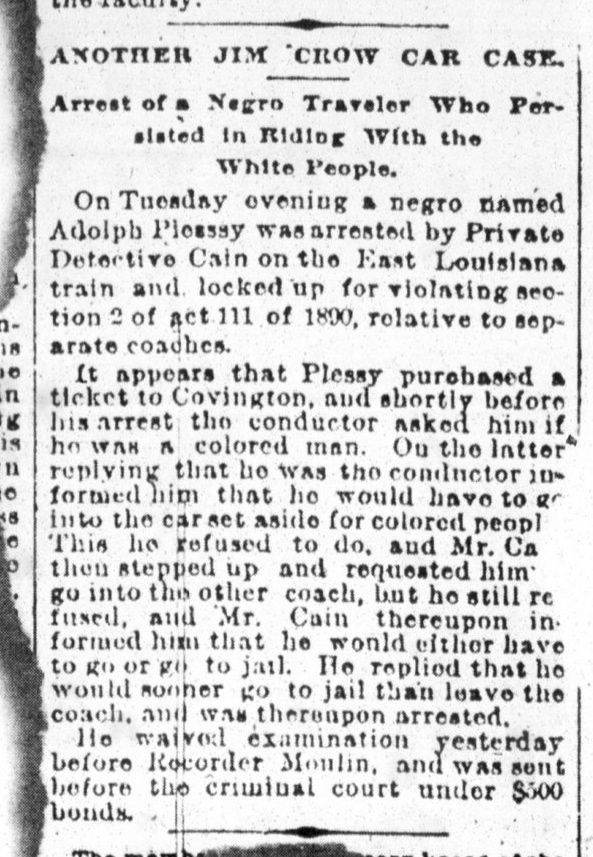
In 1890, Louisiana had passed the Separate Car Act that required blacks to ride in separate railroad cars than whites. Many blacks protested against this and some even began to challenge the law. Homer Plessy, who was considered black even though he was seven-eighths white, was one of them. Plessy boarded a train on...
Reviews of: "Racial segregation in the South by the end of the 1890's."
:
The spelling and grammar in this needs work if it is to be understood clearly.
This is a great summary of the things going on...
But I don't see where you really prove that your chosen causes created the rigid system of racism.
Also, you never link backwards to pre-civil war society, which would provide the necessary *intent* of a racist society.
Finally, the populist/democrat link is weak. You really only assert it, and the linkage for your remaining 'no black political power' could be summed down even farther through a simple summary of the Rdeemer government's.
Overall a good summary, but does not prove what it sets out to.
More Black Awareness & Racism
essays:
The Civil War and the Progress of African Americans
... protect African Americans, a series of constitutional amendments were passed to protect blacks. This period of progression ... for African Americans. Soon after the Civil War, there was Reconstruction, a period of recovery from the war. Many organizations were formed to hinder the freedom of blacks ...
The Case of Plessy v. Ferguson
... 2.Justice Harlan believed that the true intent and meaning of the thirteenth and fourteenth amendments combined was to protect the civil rights that pertain to ...
Difficulties of African American's lives in this countries.
... become Democrats. Today, many blacks are very supportive of the Democratic Party. There are a number of reasons that prove African Americans have ...
Brown Vs. Board Of Education
... Brown v. Board mandated the end of desegregation, prejudice and inequitable treatment still existed. The NAACP and Thurgood Marshall were successful in overturning Plessy v. Ferguson, but that did not keep African Americans from ...
"To what extent had african americans acheived equal civil rights by 1940?" A reviw of the civil rights and treatment of blacks in pre-civil-war America.
... s reconstruction period began. The year 1868 brought the 14th amendment, which stated that all blacks were citizens entitled to the same human rights as white citizens; and the 15th amendment, which gave blacks voting rights (The African American Almanac, V ...
Thurgood Marshall was probably the only black leader in American History who can argue that he defeated segregation where it really counts, in the courts.
... additions of these two particular Amendments, it was another one hundred years before the Court eliminated the segregation that existed. Even though African Americans had not received all of the ...
Institutionally constructed racism and its ongoing effects in modern America.
... pieces of literature by American authors, such as, 'Notes on Virginia,' by Thomas Jefferson, the Declaration of Independence, the Thirteenth, Fourteenth and Fifteenth Amendments, the Supreme Court rulings of 1956 ...
Montgomery Bus Boycott. This paper is about the bus boycoot concentrating on Martin L. King.
... s segregation law was "unconstitutional as a denial of the Thirteenth Amendment and equal protection clause of the Fourteenth Amendment. " The Plessy v. Ferguson case ... for American Negroes. The states relied on primarily Plessy v. Ferguson in arguing for the continuation of segregation in ...
Describe
This essay describes pretty well in the shortest way possible how Blacks were segregated from the whites. Except for a few mistakes this is a good essay, showing the problems we had so early in our country's history.
15 out of 15 people found this comment useful.