Ralph Ellison in his essay, "An Extravagance of Laughter" demonstrated the living condition of black life in the segregated 1930's. Ellison grew up in Oklahoma City, Oklahoma. Unfortunately, His father past away when he was only three. He lived with his mother and brother in absolute poverty, but always believe that he could overcome the limits of racial prejudice. Throughout the years, Ellison fell in love with Africa-American music (Jazz). He played Trumpet and thought himself Louis Armstrong solos.
For Ellison and many other blacks in the south, personal choice (privileges) was something they were lacking. He states, "you lived in a Negro neighborhood because you were forced to do so, and because you preferred living among those of your own background. Which was easy to answer, because having to experience life in a mixed neighborhood as a child, I preferred to live where people spoke my own version of the American Language; and where misreading of the tone or gesture were less likely to ignite literal conflict" (Ellison 145).
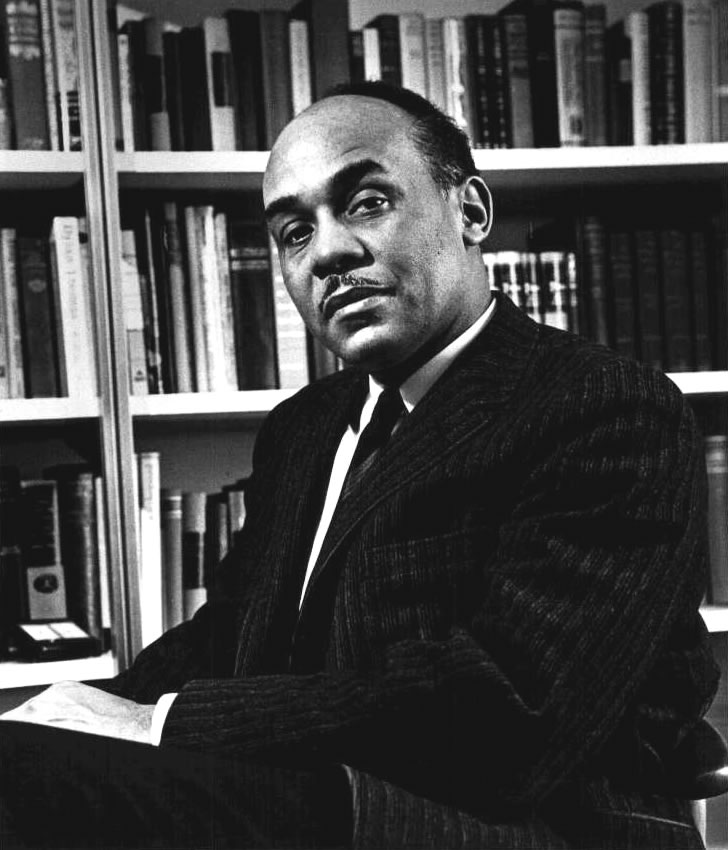 Ralph Ellison, noted author and professor.
 Ralph Ellison
 Ellison Bluff
By this, people did not have any choice about where they live. At times, They preferred to live among those of their own background just because they did not want to deal with inferiority. Imagine living in a place were you were not wanted, and where people were aggravating you and your family from day to day. People really do not want to deal with negative attitudes and they certainly will not live around it. Many people believe it's more comfortable to live around people with the same background as they are. By doing so, it's easier to understand each other's view about a certain point.
Not only they were forced to live in places they did not want to live; public transportation was places of hallucinations for Negroes. Once their fares were deposited, they were sent straight to the rear. During such time, both the driver and white folks tormented them. Imagine the type of pushing and shoveling that occurred. Such dramatic and inconsiderate attitude can cause horrible effects on a pregnant woman. Getting push on a moving bus is very dangerous. After all the disappointments in the south, an old hero and friend, Langston Hughes invited Ellison, to be his guest at a Broadway theater. The play, "Jack Kirkland's dramatization of Erskine Caldwell's famous novel Tobacco Road" left a great impression on him.
The comedy and the "extravagance of laughter" told Ellison many things about himself. "I couldn't have put it into words at the time, but by forcing me to see the comedy in Jeeter Lester's Condition and allowing me to react to it in an interracial situation without the threat of physical violence, Caldwell told me something important about who I was" (Ellison 171). As we can see, the author was in a "safe house" and he mentioned how the play made him a better person, and how he became a more tolerant American. The play helped him to deal with the horrible experiences that he encountered in the south. In the south, there were no contests because the white man always won; where as in the north, survival of the fittest was the issue. It gave him a chance to redeem his self-dignity. The moment of laughter was the point when a change occurred in Ellison's life. He produced a new drama in the theater when he started laughing. Once his laughing got going, it was a germ that affected many people. This play allowed Ellison to understand his role in the American society. By doing so, it helped him to remember the important part, which is not to think about racism, but to think about race in conjunction to the south, and New York.
Ellison's experience in learning to be a New Yorker was something he never forgets. He states, "Madam, all you had to do was risk the slight possibility that I just might be a gentleman. Because if you had, I would have been compelled to step aside" (Ellison 144). From this quote, we can all see the meaning into the author's words. In the south, it would be required for a black person to get up and offer their seat to a white one. Nevertheless, They were in New York, and Laws did not recommend such thing. The lady got herself into a shuffle with him and fortunately he won.
It's that aggressiveness that caused Ellison to retaliate and not offer her the seat.
For Ellison, The notion of "imagined communities" (Benedict Anderson) as Pratt says came about his experiences. This illustrated the inner self-esteem that he had to reach within himself to bring out to society. He gathered up all his experiences from the south and those he acquired from New York to stand up for himself and not to let society destroy it.
One way to connect Pratt's observation about the "contact zone" and "safe houses" with Ellison's feeling that he was on a journey without a map is to connect both authors' points of view, and how they tried to persuade their readers. Ellison States, "This made for a constant struggle over the nature of reality, in which each group probed and sparred as they tried to determined the other's true motives and opinions" (Ellison 160). This quote indicates that people should drop their mask and try to put their differences aside to connect with one another. We must retrieve our logical inspiration, and break the barriers of stupidity.
In her essay, "Arts of the Contact Zone," Pratt observed how society must get rid of racism, and destroys the shadow of ignorance. She states, "meanwhile, our job in the American course remains to figure out how to make that crossroad the best site for learning that it can be" (Pratt 541). She demonstrated many ways to develop social and intellectual differences. She stressed the importance of what we came to call "safe house," which are places that groups can constitute as communities.
Pratt stated the way to comprehend communication and behavior is through common rules that must be shared. She mentioned how different personalities interpret a common rule. In her essay, Guaman Poma's unread masterpiece and Benedict Anderson's theory of "imagine communities" demonstrated her argument. These examples are part of what someone should strongly focus on to understand their cultures as well as others.
As both authors Stated, Our position in relation to the issue of "contact," "safety," "mapping" and "community is very important. First, Ellison mentioned, "And just as Henry James felt it prudent to warn Americans against a "superstitious elevation of Europe," Negro folklore with its arrays of survival strategies warned me against an overvaluation of white pretensions. And despite their dominance and low opinion of Negro intelligence, white suspected the presence of profound reservations even when Negroes were far less assertive than they are today" (Ellison 160). Throughout this essay, It's clear that racism played a big part throughout society. The above statement mentioned how whites were looking down at Negroes. Even with their greatest efforts, Negroes were still underestimated.