What representations of disability are offered in "The Elephant Man" (1980)?
"The Elephant Man" is set in 1980, in the Victorian era where circus shows containing circus 'freaks' were common. The text begins with a montage of disturbing and provocative images, coupled with pounding and eerie music creating an unnerving atmosphere connoting the horror and thriller genres. The soundtrack is mainly non-diagetic, with exceptions of Merrick's diagetic breathing to show his nervousness, further creating a sinister image of the film in the minds of the audience. Adding to this image is the shock and horror of the audience of the circus show, causing the elephant man's section to be closed. The police presence creates a dark image, indicating danger. This could reflect the audiences views of physically and mentally disabled people at the time the film was made, as most people at the time would have viewed them as dangerous and as outcasts.
An enigma code is created throughout the first half of the film, as the audience do not see 'the Elephant Man' (John Merrick) directly. The film being shot in black and white reflects the Victorian era the film is set in, and it reflects the 'black and white' views of disabled people of the era.
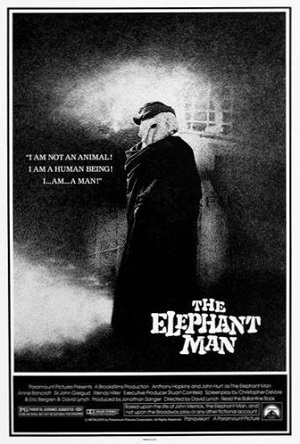
The audience are positioned to empathize with John Merrick, and to take note of how he is treated by those in his life. Before Treeves takes Merrick on as his 'project', Merrick is always shown in the dark, and covered up, whereas Treeves is shown in light and is a very successful doctor. David Lynch has used Barthes' theory of Binary Opposition throughout the film, with the black and white film, the dark and light of John Merrick and Dr Treeves and the views of good and evil in the film.
The typical 'freak' stereotype of disabled people is shown clearly throughout the...
More Film Review and Analysis
essays:
An analysis of the cinematic techniques that are used in the portrayal of the 'outsider' in films. Why are such films popular and what do they tell us about society as a whole? GCSE A grade.
... freak show the music is typical fairground music and when Treves' is going to see the Elephant Man the music is low and waiting- possibly a tuba and the music is always subtle. Every time we see the back of Merrick ...
"The Riches": A representation of Americans' desperation
... disabling alarm systems. While his sister Di Di seems to be more loyal to their father, Cael is more supportive of their mother and the ...
"There is no spoon". How the illusion of reality is deconstructed in The Matrix by the codes of cinematography?
... moving images, 2.graphic traces e.g. all written material read off the screen, 3. recorded speech, 4. recorded music, 5. recorded noise or sound effects. (Andrew, The Major Film Theories 218). Codes are ...
The Big Heat analysis - expressionistic lighting, use of sets and decor, and costuming sharply reflected the personality traits of the film's major characters.
... to the window, so that the plane of the image is parallel to the plane of the window. Sometimes Lang positions people so that they are standing in the zone ... near the door. When evil Mrs. Duncan talks to the police, there ...
Seeing beyond stereotypes enables a person to have healthier relationships.
... any man, with or without sight. As the husband learns more about the blind man, his negative stereotypes of blind people begin to dissolve, allowing the husband to see the blind man in ... he didn’t wear dark glasses. I’d always thought dark glasses were a must for the blind." (292) The husband's ...
Representation of female character: To what extent can Disney be said to have moved with the times?
... factor is that these gender stereotypes are not aimed at audiences who can evaluate them thoroughly but at younger children who absorb the information and use these stereotypes to reflect upon society in ...
Baz Lurhman describes 'Moulin Rouge' as "Audience Participation Cinema". Analyse the techniques he uses in the opening of the film, to remind us that "we are watching a movie"
... to the colour scheme of the shot the audience sees of her, the fact that she is barely moving and is looking away from the camera gives the impression ...
The representation of homosexuals in the media
... us see them as bad people like the film wants us to. The anchorage also plays a big part on how we see these men, the music is very eerie and ... many legal constraints like age certification, it is for an audience of over 15 years of age. When Andy is attacked ...