REPTILIA: SQUAMATA: IGUANIDAE CROTAPHYTUS COLLARIS ______________________________________________________________________________________________________________________
�
Catalogue of American Amphibians and Reptiles.
Amelingmeier, Amber. 2008. Crotaphytus collaris.
Crotaphytus collaris
Mountain boomer, Eastern collared lizard, Common collared lizard.
Crotaphytus collaris . Say, 1823.
Content. Six subspecies are recognized (Arbor, 1928).
Synonyms:
Agama collaris Say in James, 1823 Crotaphytus baileyi Stejneger, 1890 Crotaphytus collaris auriceps Fitch and Tanner, 1951 Crotaphytus collaris baileyi Stejneger, 1890 Crotaphytus collaris collaris (Say in James, 1823) Crotaphytus collaris fuscus Ingram and Tanner, 1971
Definition. Colors and markings are diverse within the Crotaphytuscollaris. They are sexually dimorphic. C. collaris is a medium sized (8-12 inches), plump-bodied lizard which is characterized by a long, round tail and a large head with a blunt snout. The dorsal colorations within this specie varies greatly, the C. collaris can have a black oral melanin, green or a bright blue to turquoise color. Some of the males have bright yellow bands across the back.
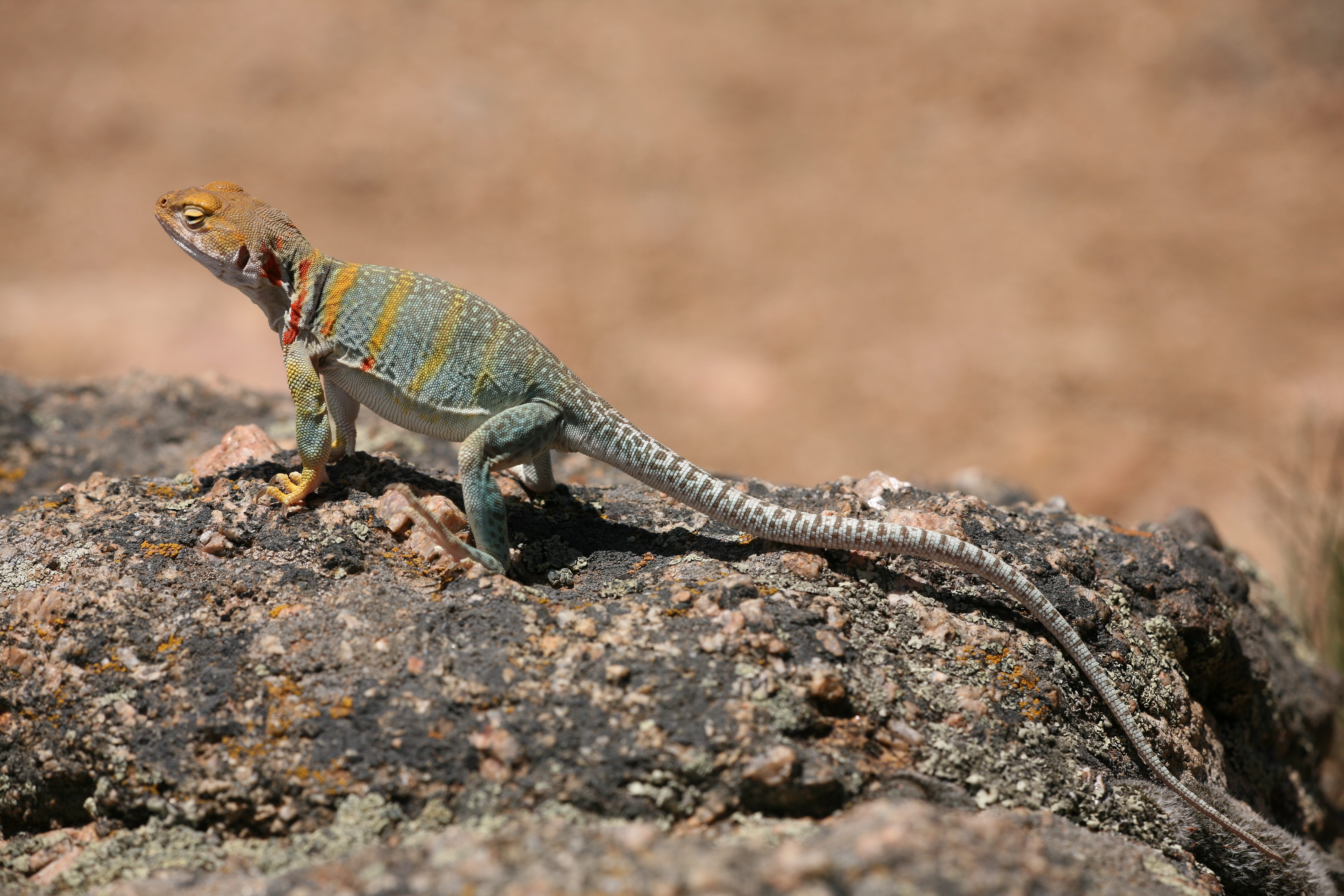 Collared Lizard (Crotaphytus collaris) in Black Ca...
 Figure 3
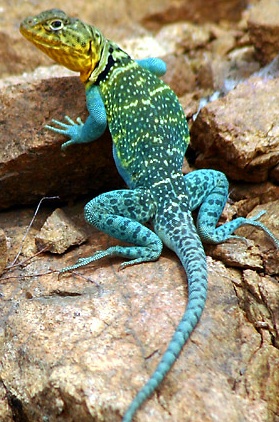 Figure 2
The females are more dully, having more of a greenish to brown color. The gular colorations also vary. The western populations have green to blue dewlaps, compared to the eastern populations that have yellow to orange (Conant and Collins, 1998). The females typically have a plain white dewlap, but in a few females the dewlap has been seen with tiny spots. The head and feet are often colored with yellow and the back is usually marked with several light dots. The tail and hind limbs have the reverse pattern, becoming dark gray to blue-green dots on a light background. The front limbs don't usually contain any spots, as well as the underside which is plain and pale. The males contain enlarged postanal scales and the females will either have a small dark spot or a pair of spots, on each side of the vent (Jones, 1993).
FIGURE. Distribution of the Crotaphytus collaris, which inhabit North America. Link: http://www.danys-reptilien.ch/karte05.jpg
Behavior. Crotaphytuscollaris hibernate during the colder months of winter and fall. When not hibernating males will have certain areas in which he will protect, very aggressive to the other males who trespass.
FIGURE: A male Eastern collared Lizard taken in Comanche county, Oklahoma. Photograph taken by Gary Nafis. Link: http://www.californiaherps.com/noncal/southwest/swlizards/images/ccollarisok406.jpg
The adult males are known to defend several female lizards which are within his territory. The males will guard their area by high rates of displays. If a male lizard comes into another male's territory, the defending male will arch his back and compress its sides trying to appear fierce. He then will do a succession of pushups, sometimes causing their front feet to come off the ground. If the intruder doesn't move, the Crotaphytuscollaris will then chase the trespasser off. The young males often have orange bars across their back, which is similar to the females. Giving the younger males a chance to inherit both territories and mates (Baird, Acree, and Sloan, 1996).
Breeding. The male Crotaphytuscollar will approach a female doing a sequence of rapid head bobs. The lizards then begin to circle each other, both bobbing their heads. The male then grabs the female by the back of her neck and attempts to mate. If the female is ready to mate, she will submit but if she isn't ready or carrying developing young or eggs, she will then twist her body rolling off him. The female may even climb on the males back to subdue his advances. The breeding season usually lasts until June. Once the female has laid her eggs she will aggressively protect the nesting site (Yedlin and Ferguson, 1973). The breeding coloration on the females fade but then become vibrant again if there is another clutch. In the northern part of their range, female Crotaphytuscollar produce only one clutch. As for in the south, they can produce two to four clutches. The average clutch size is around six. Interesting enough, the females' body size has a positive relationship within the clutch size (Ballinger and Hipp, 1985). Eggs tend to be deposited beneath rocks and will hatch in about 40 to 60 days. The hatchlings begin to appear around July to September. The adult lizards usually start their hibernation late August to early September, leaving the younger lizards with more resources. Collared lizards tend to be sexually mature during their first spring, but sometimes the females usually won't breed with the year old males (Baird, Acree, and Sloan, 1996). Depending on the temperatures, some collared lizards within colder areas might not mate until their second season.
Diet. Eastern Collared Lizards are mostly carnivorous, with the young starting on freshly molted worms, beetles, spiders, grasshoppers and crickets, as for the larger C. collaris feed on small rodents from pinks to small mice. They are aggressive feeders; happily devouring any small vertebrate, as well as other lizards (the Horned lizards) and snakes. The Crotaphytuscollaris will also occasionally eat plant material such as berries, leaves, collard greens, mustard greens, figs, raspberries, flowers, papaya, and mango (John. 1974).
FIGURE: A male (brighter colored) and a female (browner) Crotaphytus collaris. Photographer unknown. Link: http://www.biology.wustl.edu/faculty/chase/Images/Crotaphytus_collaris_2.jpg
Distribution. This lizard is distributed from Kansas and Missouri south to central Texas, and as far as eastern New Mexico (Morris, 1959).
Habitat. This specie can be found within hilly, rocky, and often extremely dry with very little annual rainfall regions. Rarely found on the plains, unless on rocky hills or in gullies passing through them. Limestone ledges or rock piles, both offering a large quantity of hiding places (Morris, 1959).
Fossil Record. Miocene epoch.
Comments. The Crotaphytuscollaris has no voice. The name "mountain boomer" is an misapplied name, possibly coming from someone having seen an Eastern Collard Lizard on a rock while some other animal, probably the Barking Frog had called from underneath that same rock (Conant and Collins 1998).
Nomenclatural History. This species has been under discussion due to some taxonomic confusion for several decades. McGuire (1996) modified the taxonomy of the Crotaphytidae basing it on morphological and genetic data; moving Crotaphytusbicinctores to a more specific status, which is separate from Crotaphytusvestigium and Crotaphytuscollaris (McGuire, 1996).
Etymology. The genus Crotaphytus is from the Greek word krotaphos meaning "temple" or "side of the head" and phyton meaning "creature" or "animal. "Crotaphytus can then be taken to mean "a creature with impressive temples" (Breen, 1974).
Literature Cited
Arbor, Ann (1928). The synonymy, variation, and distribution of the collared lizard, Crotaphytus collaris (Say). Michigan: University of Michigan Museum of Zoology.
Baird, T. A., Acree, A. A., and Sloan, C. L. 1996. Age and gender-related differences in the social behavior and mating success of free-living collared lizards, C. collaris. Copeia, 1996 (2), pp. 336-347.
Ballinger, R. E., and T. G. Hipp. 1985. Reproduction in the collared lizard, Crotaphytus collaris, in west central Texas. Copeia 1985 (4): 976-80.
Banta, B. H. 1960. Notes on the feeding of the western collared lizard, Crotaphytus collaris baileyi, Stejneger. Wasmann J. Biol. 18: 309-311.
Breen, John. 1974. Encyclopedia of Reptiles and Amphibians. TFH Publishing, Neptune City, NJ. 575 p.
Brennan, T. C., & A. T. Holycross. 2005. A Field Guide to Amphibians and Reptiles of Maricopa County. Arizona Game and Fish Department. Phoenix, AZ
Conant, R., & Collins, J. (1998). Reptiles and Amphibians.New York: Houghton Mifflin Company.
Ferguson, G. W. 1976. Color change and reproductive cycling in female collared lizards (Crotaphytus collaris). Copeia 1976 (3).
Fitch, H. S. 1956. An ecological study of the collared lizard. University of Kansas Publications of the Museum of Natural History 8:213-274.
Grismer, L. L. 1994. The evolutionary and ecological biography of the herpetofauna of Baja California and the Sea of Cortez, Mexico. Unpubl. Ph.D. Diss. Loma Linda Unversity, Loma Linda, California.
Jones, T. A. 1993. Collared lizards (Genus Crotaphytus). San Diego Herp. Soc. Newsletter 15 (9): 1-2.
Jones, T. 1997. "Captive Care and Breeding of Collared Lizards" (On-line). Accessed Nov. 16, 1999 at http://www.collaredlizard.com/articles.htm.
Klein, T. 1951. Notes on the feeding habits of Crotaphytus reticulatus. Herpetologica 7 (4): 200.
Legler, J. M., and H. S. Fitch. 1957. Observations on hibernation and nests of the collared lizard, Crotaphytus collaris. Copeia 1957 (4): 305-307.
McAllister, C. T. and S. E. Trauth 1985. Endoparasites of Crotaphytus collaris (Sauria: Iguanidae) from Arkansas. The Southwestern Nat. 30(3): 363-370.
McGuire, J. A. 1996. Phylogenetic systematics of crotaphytid lizards (Reptilia: Iguania: Crotaphytidae). Bulletin of Carnegie Museum of Natural History 32:1-120.
Morris, Percy A. (1959). Boy's Book of Turtles and Lizards. New York: The Ronald Press Company.
Sexton, O. J., R. M. Andrews, and J. E. Bramble. 1992. Size and growth rate characteristics of a population of Crotphytus collaris. (Sauria: Crotphytidae). Copeia 1992 (4): 968-980.
Stebbins, Robert C. 1985. Peterson Field Guides: Western Reptiles And Amphibians. Houghton Mifflin Co., Boston, MA. 322 p
Stebbins, R.C. 2003. A Field Guide to Western Reptiles and Amphibians, Third Edition. Houghton Mifflin Company, Boston, MA.
Yedlin, I. W., and G. W. Ferguson. 1973. Variations in aggressiveness of free-living male and female collared lizards, Crotaphytus collaris. Herpetologica 29 (3): 268-275.
________________________________________________
Amber Amelingmeier, undergrad at Messiah College, Grantham PA. Working on bachelor's degree in Biology and a minor in Environmental Science.
_________________________________________________
�
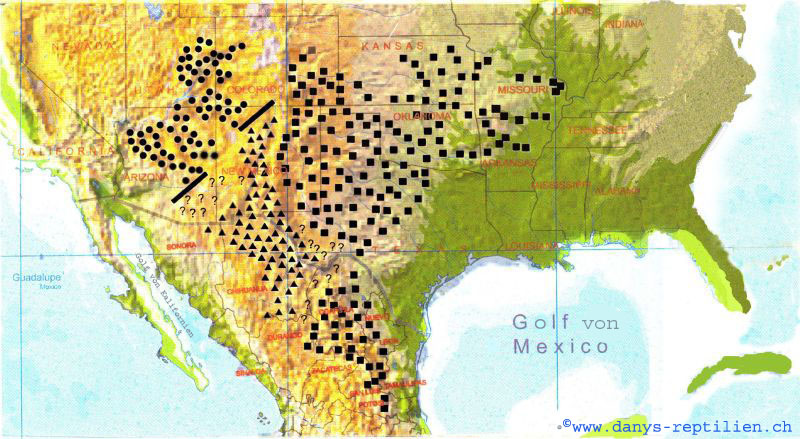 Figure 1