A research oral on the existence and nature of chamber music before 1750.
During my many hours of research for this task, I found some very helpful resources on the subject of chamber music. Most of these books and web sites were arranged very carefully and neatly in, mainly two different ways - in periods, classical, romantic and contemporary and by composer. I found this organization very helpful and convenient but what struck me was that when the resources were listed by period, they had always seemed to skip the baroque period and when they were listed by composer, they always seemed to skip composers before 1750. I wanted to know why there was such a giant gap at the beginning of such a large discipline as "chamber music". I then discovered that chamber music ensembles almost never choose works older than 1750. This raised a completely new set of questions.
Is music earlier then 1750 unworthy of performance? Are the instruments that they were written for obsolete? Did chamber music exist before 1750? When did the music that we now refer to as 'Chamber-Music' begin - when did composers start writing for ensembles in a manner that we now call chamber music? Did the String Quartet simply appear out of no-where or are there ancestors of it?
Firstly, what is chamber music anyway?
Chamber music is music meant for a small room, using a small ensemble - usually consisting of less than 10 performers. According to modern conceptions, chamber music is instrumental music of an intimate, carefully balanced type, written for one or more instruments, one of which is usually a melodic instrument and each part is performed by only one player.
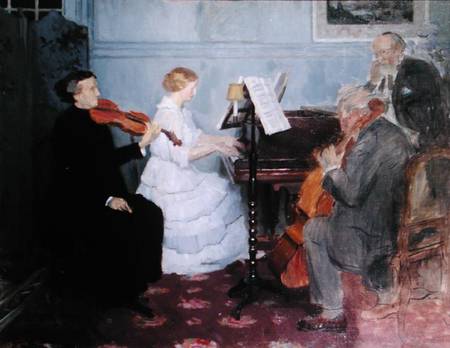
Did chamber music exist before 1750?
Essentially, chamber music began in the 16th century with vocal and instrumental madrigals, however today vocal music in any form is not considered chamber...
More Music History & Studies
essays:
Summaries of the greatest composers in MUsic (Sebastian Bach, Mozart, Beethoven, Joseph Haydn, Handel, Monteverdi, Brahms)
... greatest composer of the Baroque period. At the age of 10 he was orphaned and taken in by his brother. In his teen years Bach was thought music by ...
The History of Music
... renaissance composers were William Byrd, Robert Carver and Roy Henry. The Baroque period was approximately between 1600 and 1720. This was where other instruments start to have more of a role in music particularly ...
Beethoven - Living in the two different music periods
... changed music from the Classical period to the Romanic, but it is for sure that even before the romantic era began Beethoven was composing music using different musical elements ...
The Development of Music Theory: A Comparison between the Medieval and Renaissance Periods
... much different way of looking at the structure of different voices. The polyphonic music during the medieval period grew ... the two. In the grand scope of the history of music, this shift was dramatic and rapid. It influenced the way musicians played and the way composers wrote ...
In every way Baroque music is like a teen-ager. Ok,
... way," another important characteristic of Baroque music was the improvisational technique. To show how good they (thought they) were, many singers and musicians embellished, improvised, or just plain ad-libbed their music during a performance. Far from being offended, the composers ...
Periods of Musical Movements
... the music of other composers. Thus Handel had among the widest acquaintance of other styles of any composer. Classical periodJoseph HaydnHaydn sourced his ideas from the Baroque period and ... national music of Poland.Chopin further promoted the romantic style of music but introduced a different way of ...
Classical Music
... main composers. Hayden, Mozart, and Beethoven were the three brilliant minds that are credited for the classical music period. Some musical characteristics of classical music are: the use of energetic and orchestral color in a thematic way, the ...
Analyzing Music.
... symphonies, chamber music, opera, and other serious, artistic music. More narrowly, the "classical" style refers to the work of the Viennese classical school, a group of 18th-century composers that ...