Research paper on Kurt Vonnegut's use of satirical atrocities in his novels
The Humorous Atrocities
He [Vonnegut] had no taste for war; and even less for being a survivor of it. (Blieler 553)
When a person faces the hardships of life, he must develop a way of dealing with the dark situation set before him. Kurt Vonnegut, one of America's outstanding modern authors, certainly dealt with the atrocities of life himself. His experiences during the Great Depression, his childhood, and World War II helped mold his perspective on humanity. Vonnegut's means of coping with these horrific difficulties was to see the humor in the midst of tragedy. Born in 1922, into a family who emigrated from Germany in 1848, Kurt Vonnegut was one of three children of Kurt and Edith Vonnegut who settled in Indianapolis, Indiana. The Vonnegut family prospered in a flourishing German-American society. In his early teens, however, Vonnegut dealt with the first major setback of his life. During the Great Depression, his affluent lifestyle became a meager one. His family was forced to move to a smaller, less flamboyant house built by his father, a successful architect (Litz 754). The new economic circumstances formed by this Depression traumatized his parents. His father later gave up on life, and after Kurt Jr.'s enlistment, his mother committed suicide in 1944 by taking an overdose of sleeping pills. In a later interview Vonnegut confessed: "I learned a bone-deep sadness from them [his parents]" (Allen 2-3).
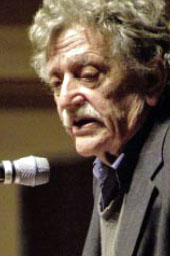
In addition to the influences of his adolescence, Vonnegut faced the brutality of war. In 1944, Vonnegut was serving infantry duty in Europe, when he was caught behind German lines at the Battle of the Bulge and sent to Dresden, Germany, as a prisoner. In February, 1945, the Allies unleashed a firestorm that essentially annihilated the historic city of Dresden, killing nearly 135,000 thousand people. Luckily Vonnegut...
More Authors
essays:
"Of Mice and Men" A review of the novel and information about the author, Steinbeck
... better life during the Great Depression in the 1930's. Steinbeck adequately demonstrated how the struggles of a family reflected the hardship of the entire nation. Through the labor the organizer ...
The "Falseness" of the American Dream in Arthur Miller's Writing
... of the American Dream in the post-World War II society. The origin of the AmericanDream was immigrants coming from Europe in search of a better life where ...
Thornton Wilder
... that the great world catastrophe in Act III of The Skin of Our Teeth represents World War II. Wilder ...
"The grapes of Wrath" by John Steinbeck. The author and his time
... with the coming of the Great Depression. As many people around the country ... find the power to claim their rightful place in American society. Once in California, the Joads discover the truth of the rumors ...
These study notes help prove the theory of collectivism throughout the novella Anthem.
... After the Unmentionable Times, society was "reborn." Great Truth- "all men are one and there is no will save the will of all men together." Unmentionable Times- The times before the Great Rebirth ...
The life of Ernest Hemingway.
... these three divorces, he eventually married Mary Welsh. At the same time, Hemingway involved himself as a correspondent on the Loyalist side in the Spanish Civil War and with the First Army in World War II. In ...
The Accuracy of the Portrayal of the 1920s Woman in "The Great Gatsby".
... in The Great Gatsby, women during the decade of the 1920's gained many new social freedoms that brought about various expressions of a new sense of freedom (Todd and Curti 637). The American woman after World War I ...
"The Grapes of Wrath" by John Steinbeck. Report (designed orally) that covers main characters and the different parts of the book, such as the exposition and climax, main themes and conflicts.
... view. The setting began in Dustbowl Oklahoma in the early 1930s and varies as the Joads travel west. Oklahoma in the 1930s was the center of attention because of the Great Depression. The mood ... After World War II, Steinbeck's work became more sentimental in novels like Cannery Row and The Pearl ...