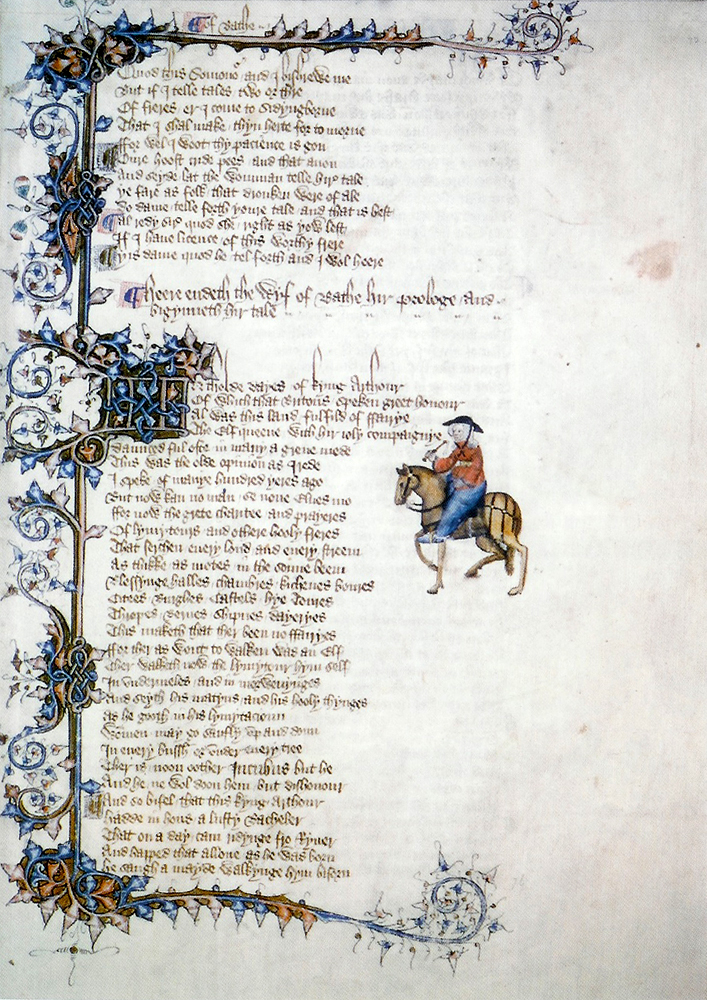
Right Roles? "The Wife of Bath" Speaks Out: Analysis of the prologue of "The Wife of Bath" from "The Canterbury Tales" by Geoffrey Chaucer.
Alison, the Wife of Bath, was a radical thinker of her time and was probably considered by Chaucer's readers to be promiscuous and even blasphemous. She establishes herself as an authority on all matters of marriage. Women, in the time of Chaucer, were cast into very specific roles. In her prologue, the Wife of Bath addresses the general code of conduct and other commonly accepted behaviors of women and dismisses them to justify and rationalize her own life style of being married many times.
Women at that time were expected to live lives of purity, holiness, and service to others. Many of these gender-based expectations stemmed from the church and biblical history, as modeled by the Virgin Mary; these ideas about marriage had been in place since the time of St. Jerome. The Wife of Bath challenged these beliefs that were blindly accepted around her, and did so without a second thought (http://jade...).
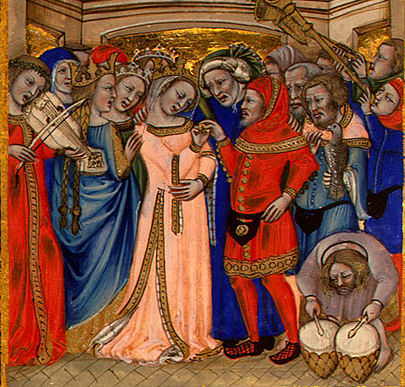
The first argument of the church against her that she mentions is the wedding at Cana as recorded in John 2:11; this is the only wedding that Jesus ever attended in His recorded life. Though saying nothing of the commitment and sacrament of marriage, the medieval interpretation of this passage is that since Christ only went to one wedding, one should be married only one time. The next argument she mentions in her prologue is about the time when Jesus encountered the Samaritan adulteress at the well as told in John 4:4-42, and how the woman, having been married five times, had no true husband anymore. This is the argument that the church used against having more than one husband; that any more than one being an invalid marriage in the eyes of Christ.
These two instances fail to have a basis in our modern understanding of...
More "Canterbury Tales" by Geoffrey Chaucher
essays:
The Canterbury Tales - by Geoffrey Chaucer
... the time: vain, lustful, and overbearing. Chaucer portrays her in a very detailed and humane manner. Through the characters in her tales, one can see the person that she really is. The Wife of Bath considers herself an authority on marriage ...
Marriage in Canterbury Tales
... the Wife of Bath's Prologue are all stories about the domination that exists within marriage. Chaucer's scornful and ridiculing descriptions of these ...
"Canterbury tales" by Geoffrey Chaucer
... and thought she deserved to be 'whipped and crushed' because of what she did. The Wife of Bath and Tess D'Urberville are almost exactly opposite and represent both sides of the qualities that women should ... seem promiscuous. Their appearance is different because the Wife of Bath is ...
The Canterbury Tales: The Humanity of The Wife of Bath and The Pardoner
... his life, but he seems to have absolutely no remorse in him. The Wife of Bath begins her prologue by telling everyone that she is non-compassionate and parasitical. She says that she married only ... the Wife of Bath's prologue that she was 'sold' into marriage at the early age of twelve ...
The Pefect love. Love as one of the most important themes in "The Canterbury tales" by Geoffrey Chaucer
... Geoffrey Chaucer around 1386, is a collection of tale told by pilgrims on a religious pilgrimage. Three of these tales; 'The Knight's Tale', 'The Wife of Bath's ...
Canterbury Tales - The Wife of Bath
... Chaucer's "Canterbury Tales," I found that of the Wife of Bath, including her prologue, to be the most thought-provoking. The pilgrim who narrates this tale, Alison, is a gap-toothed, partially deaf seamstress and widow who has been married ...
Consider the Relationship Between Experience and Authority in the Wife of Bath's Prologue (Geoffrey Chaucer: The Canterbury Tales: The Wife of Bath's Prologue)
... The second part of the Wife of Bath's Prologue begins after this by the Pardoner interruption and tells of her first three marriages from a practical day-to-day point of view, dispensing advice, an 'Ars Matrimonia based on ...
"Canterbury Tales" by Chauncer.
... a holy life?' in so many different ways. Beginning with "The Pardoner's Tale", the theme of salvation is truly paramount. Chaucer, being one of the most important medieval authors, uses this prologue and ...