What role did the Nazi Party play in the revolutionising of German State and society between 1933 and 1939? With full Bibliography
It cannot be argued that the Nazi Party did not make drastic changes within the German State and within German Society. What is arguable is whether the Nazi Party could be deemed responsible for revolutionising Germany. This essay will look to see if there was any transformation within German society and if so what role did the Nazi Party play. To ascertain the role played by the Nazi Party this essay will explore the political, economical, and social changes made during the period of 1933 - 1939 and see what the direct consequences were for the German people.
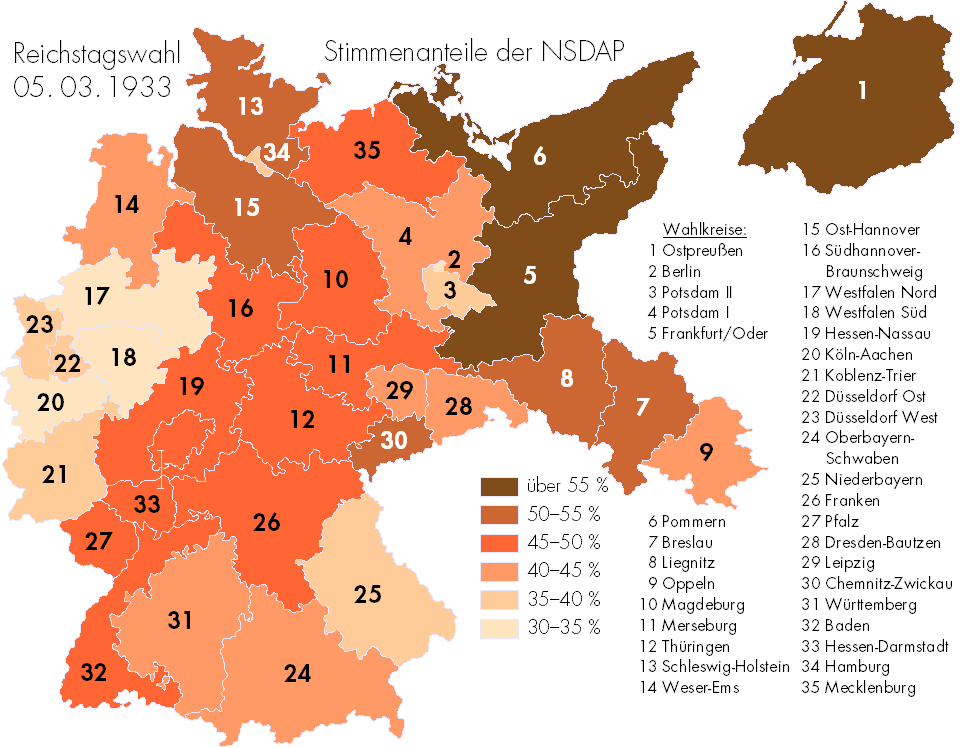
The popularity of the NSDAP was inexplicably high with members numbering 850,000 in 1933. It would seem that although many NSDAP members joined initially as opportunists thinking that they would benefit their careers, some believed in the ideologies of the Party and others felt by joining they could help to improve the economic conditions of the State. The fact that in July 1933 saw the Law against the Formation of Parties whereby The Nazi Party became the only political party in Germany, would account for many of its members. All other parties were banned and their leaders imprisoned. Hitler was less concerned with the formation of new political parties but more concerned with the reformation of old parties such as the 'socialist or communist parties under other names'. Nazi Party members were given better jobs, better houses and special privileges. There were certainly good incentives for people to join. The shear numbers of members whom most of which gained privileges would in itself dictate that the Nazi Party was responsible for revolutionising society purely on the basis of vast numbers of people gaining a better quality of lifestyle.
It could be argued however, that because Hitler was offering incentives to encourage people...
Reviews of: "What role did the Nazi Party play in the revolutionising of German State and society between 1933 and 1939? With full Bibliography"
:
More German History
essays:
The Impact of the Nazi Party on the German society up to and including 1933
... own. Germany had become a dictatorship. Before 1933, the Nazi Party offered German society hope for rehabilitation and a homeland (lebensraum). This was meant to be done with the ideals of Socialism and ...
Critically assess the role of terror and violence in the establishment of the Nazi dictatorship between 1933 and 1939
... and German Society. Enforcing Racial Policy, 1933 - 1945 (Oxford, 1990) 3. Robert Gellatley, Backing Hitler. Consent and Coercion in Nazi Germany (Oxford, 2001) 4. Robert Gellatley, 'Situating the ''SS-State'' in a Social-Historical ...
What role did charisma play in Hitler's rise to power?
... adverse social, political and economic conditions of late 20s and early 30s Germany to ... Socialist German Workers Party (Nationalsozialistische Deutsche Arbeiterpartei) commonly known as the Nazi Party. Hitlers former Free Corps comrades formed the nucleus of the Nazi Brown ...
"Assess the impact of Nazism on the Army in the years 1918 - 1945."
... upon Germany under the signing of the Treaty of Versailles, the Army undertook significant restructure. Throughout both the National Socialist German Labour Party, known as the Nazi Party, and ...
Assess the significance of German Naval Expansion during the period 1897-1905 in the World in 1900.
... The Germany Naval expansion was the principal cause of the deterioration of Anglo-German relations. The changes in ...
Describe the development of the Nazi Party in Germany (1922-1939), and analyse Hitler's role in this.
... The Nazi Party's growing support from the industrialists and landowner classes was a direct result of the continued fear of communism. Hitler was also seen by the German people as strong and charismatic. A man able to revitalise Germany. This ...
Martin Bormann's role in the Nazi Party.
... the Nazi party than any other member. Most of his work however was done in secret, and it is only in the aftermath of Nazi Germany that ... identification of a skeleton unearthed in West Berlin, the West German government declared him dead. Recent DNA testing carried out in ...
Assess the impact by 1939 of Nazi social and economic policies on the mass of the German people
... the German state was completely transformed within a matter of months. Hitler's Gleichschaltung was extremely successful in altering the cultural and economic landscape of Germany in ... in German society, which were initiated by the Nazi regime ...
Wow
This essay definitely has wow factor. I learned a lot from reading it. Any essay where I learn something has to be a good one. Awesome job. Good sources too.
1 out of 1 people found this comment useful.