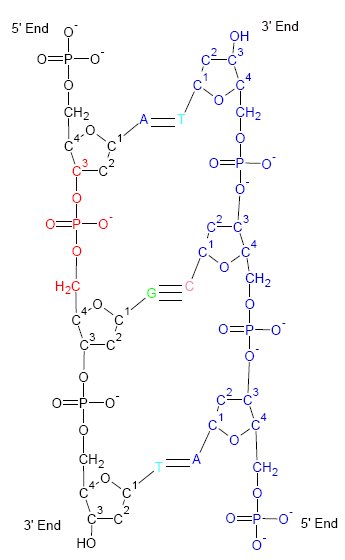
The role James Watson, Francis Crick, Maurice Wilkins and Rosalind Franklin had in finding the structure of DNA
In 1962 James Watson (1928-today), Francis Crick (1916-2004), and Maurice Wilkins (1916-2004) jointly received the Nobel Prize in medicine or physiology for their determination in 1953 of the structure of deoxyribonucleic acid (DNA). Because the Nobel Prize can be awarded only to the living, Wilkins's colleague Rosalind Franklin (1920-1958), who died of cancer at the age of 37, could not be honored.
The background for the work of the four scientists was formed by several scientific breakthroughs: the progress made by X-ray crystallographers in studying organic macromolecules; the growing evidence supplied by geneticists that it was DNA, not protein, in chromosomes that was responsible for heredity; Erwin Chargaff's experimental finding that there are equal numbers of A and T bases and of G and C bases in DNA; and Linus Pauling's discovery that the molecules of some proteins have helical shapes--arrived at through the use of atomic models and a keen knowledge of the possible disposition of various atoms.
Of the four DNA researchers only Rosalind Franklin had any degrees in chemistry. The daughter of a prominent London banking family, where all children--girls and boys--were encouraged to develop their individual aptitudes, she held her undergraduate and graduate degrees from Cambridge University. During World War II she gave up her research scholarship to contribute to the war effort at the British Coal Utilization Research Association, where she performed fundamental investigations on the properties of coal and graphite. After the war she joined the Laboratoire Centrale des Services Chimiques de l'Etat in Paris, where she was introduced to the technique of X-ray crystallography and rapidly became a respected authority in this field. In 1951 she returned to England to King's College, London, where her charge was to upgrade the X-ray crystallographic laboratory there for work with DNA.
Already at work at King's...
Reviews of: "The role James Watson, Francis Crick, Maurice Wilkins and Rosalind Franklin had in finding the structure of DNA"
:
More Genetics & Genome Projects
essays:
History and Discovery of DNA
... T). The people responsible for the discovery of the double-helical structure of DNA were Francis Crick, Rosalind Franklin, Linus Pauling, James Watson and Maurice Wilkins. To solve the structure of DNA ...
Gene Therapy
... of scientific query. The idea was first proposed back in the 1950's when James Watson and Frances Crick described a model of the double-stranded helix of DNA and basically discovered the structure of deoxyribonucleic acid. At ...
Our Health and Genetically Modified Organisms
... of scientific progresses, including the discovery of DNA and the creation of the first recombinant bacteria in 1973. In 1953, James Watson and Francis Crick discovered ... Smith received the Nobel Prize in Medicine in 1978 when they discovered restriction endonucleases, making recombinant DNA technology ...
"research paper on cloning."
... for the structure of the organism. He was awarded the Nobel Prize in 1935 for his discovery of what he called the ... would prevent the cloning of human beings but would allow scientific research to continue. Researches that will allow scientists to further ...
Cloning, the thing of the future or the start of a new generation? Speaks of what it is and what it so good about it.
... Paul Segall. He is the coauthor of Living Longer, Growing Younger. He says this ' The aging surgeon's dexterity, the athlete's wind, the construction worker's muscles, the fashion model ...
Has molecular data replaced morphological data in phylogeny reconstruction
... be changed through substitution events. Furthermore, we have a detailed knowledge of the mechanism of molecular evolution and can model for differential substitution rates and different rates of transition and ...
Notes explaining the structure of DNA, replication process of DNA, how mutations work in DNA, and the Polymerase chain reaction process
... of the helix -Replication is explained by the Semiconservative model -When a double helix replicates, each of the two daughter molecules will have one old strand derived from the parent molecule and one newly made strand -DNA replication involves unzipping the ...
The Biotech Century: Harnessing the Gene and Remaking the World By.
... manufacturing living materials." The Nobel Prize-winning chemist Robert F. Curl of Rice University spoke for many of his colleagues in science ... propagate, mutate, proliferate and migrate. This is, in fact, the radical scientific and commercial experiment now underway. Global Powers at Play. Typical ...
GEEZE
This is wonderful. You musta had to do some studying.
0 out of 0 people found this comment useful.