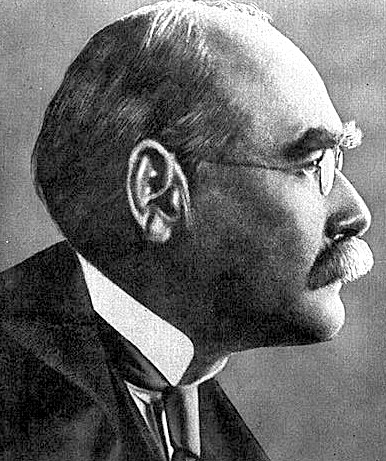
Rudyard Kipling
Rudyard Kipling was born in Bombay, however he was educated in England at the United Services College. Then in 1882 he returned to Bombay where he started to work for the Anglo-Indian newspapers. His literary career started with Departmental Ditties, which was published in 1886. He was a prolific writer and he achieved fame rather quickly with his writing. He was the poet of the British Empire and the common solider, whom he glorified in many of his works and especially in his short stories. In 1894 he wrote "The Jungle Book" which became a children's classic all over the world. However one of his more in-depth and better writings was the book "Kim" which was done in 1901 and was about this man Kimball O'Hara and his adventures in the Himalayas. Some of his other works include: The Second Jungle Book (1895), Seven Seas (1896), The Day's Work (1898), Actions and Reactions (1909), and Thy Servant a Dog (1930).
He lived in England during the late 1800's and into the 1900's. He lived in England during the First World War and this influenced his writings. He wrote about the soldiers and how they felt and what they did but he also wrote what he thought about the war and that the war should not be happening. In last decade of the nineteenth century he was becoming very successful in writing his short stories and poems and was even seen as a successor to Charles Dickens.
The book "Kim" was one of Rudyard Kipling's better works. In this book he tries to give a longing view of India as well as give details about the different cultures. In "Kim" race plays a crucial role and this is why the white blood of Kimball is often referred to. It is referred...
Reviews of: "Rudyard Kipling"
:
More Authors
essays:
Rudyard Kipling
... England at the United Services College. Then in 1882 he returned to Bombay where he started to work for the Anglo-Indian newspapers. His literary career started with Departmental Ditties, which was published in 1886. He was a prolific writer and ...
"The Journey of Crazy Horse" by Joseph M Marshall III The book report was a summary and response/reaction paper to the Lakota History of Crazy Horse.
... Man was beginning to intrude on the land of the Indians and the Indians knew they had to do something. Many enemies became friends ... lose Light Hair had felt as a child again, teased and hurt by their actions of leaving him behind. After that raid Crazy Horse gave ...
Mohandas Ghandi's Defending Non Violent Resistance speech and George Orwell's "shooting and elephant"
... a servant to the British government, comes to a conclusion that the system can no longer oppress his people. Gandhi turns into a political, spiritual leader in the cause to gain Indian freedom and independence ...
Testing The Limits of Fiction
... the imagination of the characters and the readers. The actions and thoughts of the villagers seem to be absurd. This absurdity of the ... Drowned Man" displaying the inclination of people to create myths. Writers like Borges and Marquez demonstrate that the traditional limits of fiction can be ...
Golden Slumbers Essay is about Vargas Llosa's book Aunt Julia and the Scriptwriter. Essay incorporates historical information as well as biographical.
... Peru and are employed by the Mestizo people as servants and laborers. The Indians are hard working and are ...
J.R.R. Tolkien - On Matters of Style and Audience
... of Anglo-Saxon at Pembroke College. In 1945, he moved to Merton College, becoming the Merton Professor of English Language and Literature ... Tolkien wrote the battles of Middle Earth. Tolkien's earliest literary ambition was to be a poet, but his primary creative ...
Indian Literature
... desires and aspirations of her women characters. Ashapurna Devi was a prolific writer and has ... of Indian rulers. England grew very wealthy, but the people of India did not benefit, farmers were forced to grow cash crops and were poorly paid for them. Many Indians viewed the British negatively ...
Discuss the following statement: "Quiroga does not glorify Nature; he simply shows how it works"
... the jungle. He began his literary career under the aegis of Modernism, but soon began to feel it to be artificial and immoral ... about this man, nor do we need to. Everything we know of him we learn through his actions. Nature is a dynamic force in this story ...
Good overview!
Good overview of best Kipling's wokrs, find them helpful.
0 out of 0 people found this comment useful.