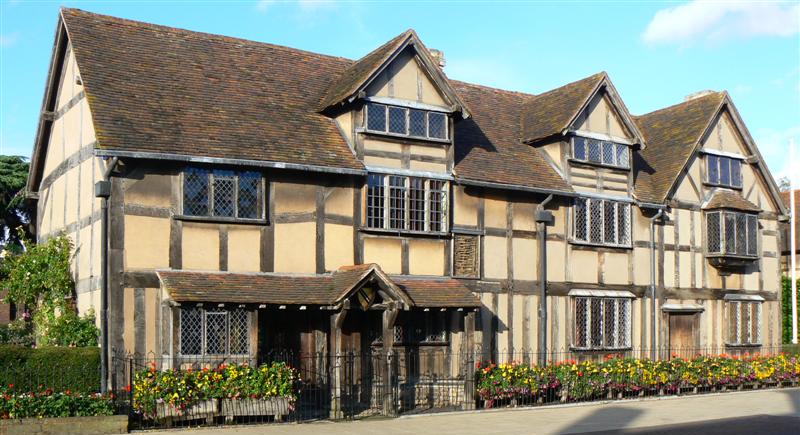
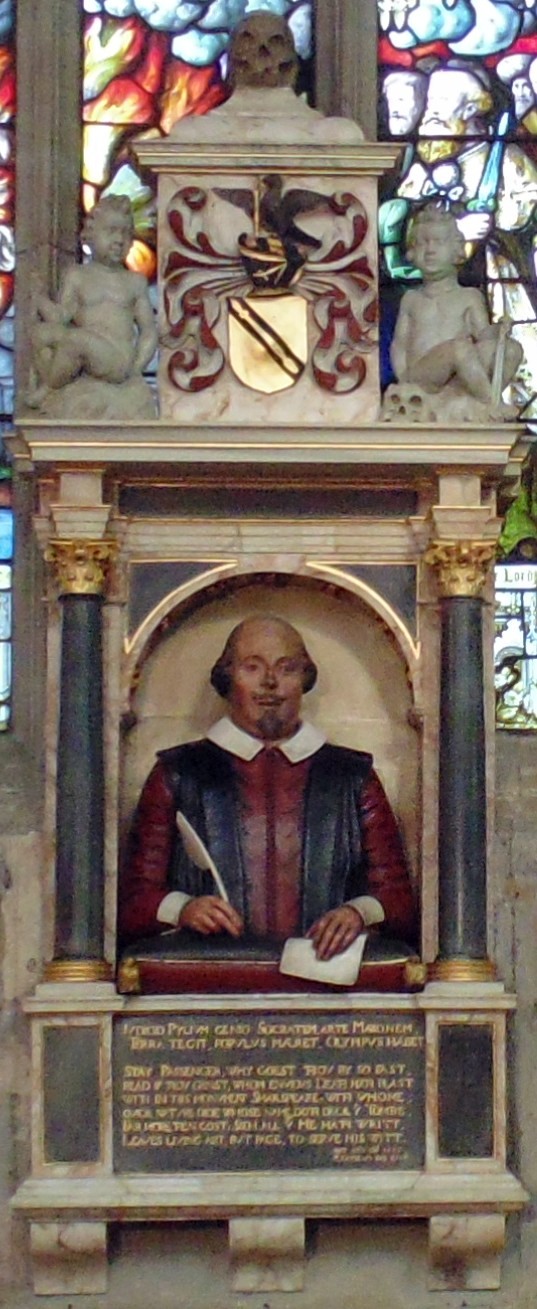
Shakespeare's Scenes:A Glimpse into the Life of an Artist as exemplified in and . By Andrew Scott
Shakespeare's Scenes:
A Glimpse into the Life of an Artist
If one is to uncover a common thread between art and life, it can only be that of impermanence. The impact of constant change becomes as compelling as it is irreversible, and, thus, burrows itself deep within the mind and soul of the artist. One, then, cannot fully understand the art without, first, understanding the artist. Such is the case if one is to truly comprehend Shakespearean themes.

Though precious little is certain as to the daily idiosyncrasies and inner-workings of the life of William Shakespeare (1564-1614), a great deal is known as to the whole of the playwright's life, comprised, namely, in a single timeline of recorded events. Various methods of documentation, such as marriage and birth certificates, court summonses, land deeds, and other scholarly accepted items of record speak on the poet's behalf. Shakespeare's lineage, baptism, marriage, fostering of children, and death, for example, are all dutifully recorded in the parish registers and histories of the quaint, English village of Stratford-upon-Avon, Warwickshire. Additionally, what is known of 1ate-16th and early-17th century English life aids in the reconstruction of the playwright's experiences. What lies between the infant Shakespeare's baptism in late April of 1564 and the renowned poet and playwright's death in 1614 allows one a glimpse into the inner-workings of one of the most prevalent Shakespearean themes, that of the divergences and contrasts of separate worlds.
William Shakespeare was no stranger to separate and divergent worlds. There is sufficient documentation to conclude that, during the mid- to late-1580's, Shakespeare left behind both his home and family to find an alternate life in the city. Though some argue that young William had found himself in a bit of disrepute with a local landholder and was forced to relocate, others...
More A Midsummer Night's Dream
essays:
The Comic view of Love in "A Midsummers Night's Dream" by William Shakespeare.
... by William Shakespeare, to the characters, their dreams are reality. Shakespeare focuses on comic love scenes to portray dreams within reality and reality within dreams. The funniest part of this ...
An explication of William Shakespeare's "A Midsummer Night's Dream"
... Dream, William Shakespeare presents a comedic but romantic interpretation of love in its various forms. The play focuses on the idea of lovers finding one another and being ...
A Midsummer Night's Dream' by William Shakespeare. This is an essay about how Shakespeare enables to convey theme through the characters of Hermia, Helena, Demetrius and Lysander.
... Dream', Shakespeare uses his characters, as well as plot to convey theme. The characters of Hermia, Lysander, Demetrius and Helena all portray the theme of love ... Duke of Athens that he is of equal wealth and birth right ...
"A Midsummer night's Dream" by William Shakespeare Essay -Describe one of the main characters and explain he or she was important in the play.
... by William Shakespeare there was a beautiful and attractive girl called Hermia. Lysander and Demetrius, both strong and fierce ...
Analysis of Puck from Shakespear's "A Midsummer Night's Dream" in the Form of a Letter to a Play Director
... and J.J.M. Tobin. Boston: Houghton Mifflin, 1997. 256-283. Slights, William W. E. "The Changeling in A Dream". Studies in English Literature, 1500-1900. Rice University Press, 1998. 259-272. Tennenhouse, Leonard. Power on Display: the Politics of Shakespeare ...
This essay talks about how fairies help people to explain the unexplainable and how plays help bring fairies to life using a "Midsummer Night's Dream"
... mindset. Shakespeare attempts to draw a relationship between plays and real life. For example, in the first few lines of a passage from the play Shakespeare wrote ...
"Midsummer Night's Dream", a journal on the Play by William Shakespear.
... thoughtful and I think will be appreciated. When first reading this, it closely resembles the play by William Shakespeare, "Romeo and Juliet ... perfectly with each other. This play shows yet another example of Shakespearean humor when Titania realizes she was in love with a ...
In a production of 'A Midsummer Night's Dream', how would you highlight the difference between the mortal and immortal worlds? Refer particularly to Act 3 scene 1 and 2 and the film.
... portrayal of the Mechanicals' performance of 'Pyramus and Thisbe'. Some plays were written purely about aristocratic characters, but Shakespeare made ... verse and iambic pentameter. "Out of this wood do not desire to go: Thou shalt remain here, whether wilt or no. I am a spirit of no common rate ...