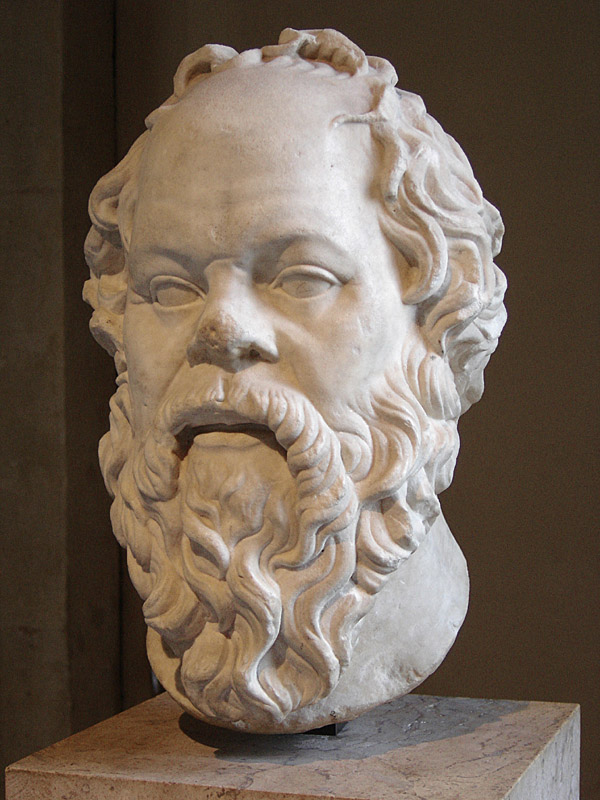
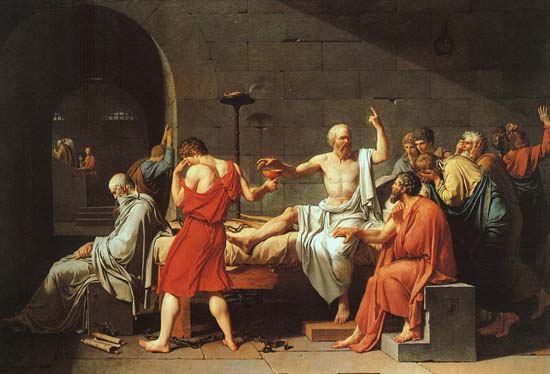
Short essay discusses why Socrates did not fear death.
Socrates has valid reasons to not fear death. He says, "Whether life or death is better is known to God, and God only" (CPQ 28). Since God has not told Socrates which is better, he decides that what the Athenians believe will suffice. When Crito suggests that Socrates escape and avoid death, Socrates asks Crito if the Athenians hold to living well, honourably and justly. Crito replies that they do and Socrates explains it is not just for him to escape prison and he must carry out his just agreements so he does not hurt the Athenian people. He wants to set an example and he cares far more for living an honourable life as part of the community, than setting a bad example and doing the citizens an injustice by not abiding by their laws. Socrates' personal reasons for not fearing death are reasonable and moral. Only a person who abides to the laws of the community with such dedication could be so fearless in the face of death. Socrates does not even worry about the world losing a great mind when he is dead. He only has concerns for the overall well-being of Athens. Socrates is a very honourable man in sacrificing his life to better serve his city and it is enough to say that in being honourable and knowing that he is doing the right thing, he has no reason to fear death.

When one has no reason to contemplate death because their life is not at risk, it is hard to determine if they will fear death when the time comes. Generally speaking, people fear what they do not understand. If one does not understand why their life is endangered or must be sacrificed it is likely that they will fear death. If a person...
More Classical Philosophy
essays:
Evaluation of Socrates' Argument that he is Not Afraid of Death
... the face of death, is admirable, his reasoning behind his decision is far from "wise." Like all humans, Socrates seems ...
Socrates' opinion of death and the afterlife.
... the reasons behind contemporary fears of death? In The Apology, Socrates refuses to adhere to the idea of death as an evil or punishment; for Socrates, death is less to be feared than committing an injustice. Though Socrates claims ...
What according to Socrates is a just city
... The reason the city came into existence was for justice, not pleasure and happiness. Wisdom and good judgment are based upon knowledge. Also, Socrates examines the effect of wealth ...
Socrates on Athenian law and obedience
... any agreements that he deemed to be coerced or that require injustice according to the rule of law, even if it meant his death (Apology 32a). There were two situations in which Socrates disobeyed ...
Socrates' Moral Decision to Not Escape
... obey" (Crito 51b). Socrates believed this argument for the following reasons. For one as a member of a society, each citizen had ...
Socrates-not perfect- I got a A- at UC Berkeley on it Essay on how Socrates arguments are contradictory and can be proven faulty. This essay proves a few of Socrates arguments faulty.
... one person's advice in order to get a different perspective concerning the same matter. Which advice is best? Whose advice out of the many should one listen to? Socrates addresses these same questions in Plato's dialogue The Crito. In ... Furthermore, Socrates argues that, "life is not worth living with ...
Flaws in Socrates' Third Argument
... sufficiency of justice for living well and happily. Socrates' claims go astray a little bit at each step of the argument, and when these little bits are added up at the end, they amount to a good reason to ...
Sophists to Socrates.
... beliefs of morality, but may very well not be believed as right to everyone in that culture. "For this reason, it ... any good at all should take into account the risk of life or death; he should look to this only in his actions, whether ...