You have all seen her. She has appeared on television, in newspapers and magazines. She is famous. When her creators looked into her eyes for the first time, they saw a glimmer of intelligence. Though she only survived for half of her life expectancy, we will always wonder: Where did Dolly the sheep come from?
During the last few years, biotechnology has made huge strides, bringing us closer to a better quality of life. The scientists in this field work to offer potential breakthrough treatments and remedies for incurable diseases. Hundreds of thousands of Canadians suffer from incapacitating illnesses and conditions such as Parkinson's, Alzheimer's, diabetes, heart disease and cancer. We have been searching for cures for these diseases for many years and with the discovery of cloning, we finally have the technology that has the potential to end the suffering of millions of people.
There are two basic types of cloning: The more widely known, reproductive cloning, and the more obscure therapeutic cloning.
 Clone Trooper vs. Spider-Man Clone (93/365)
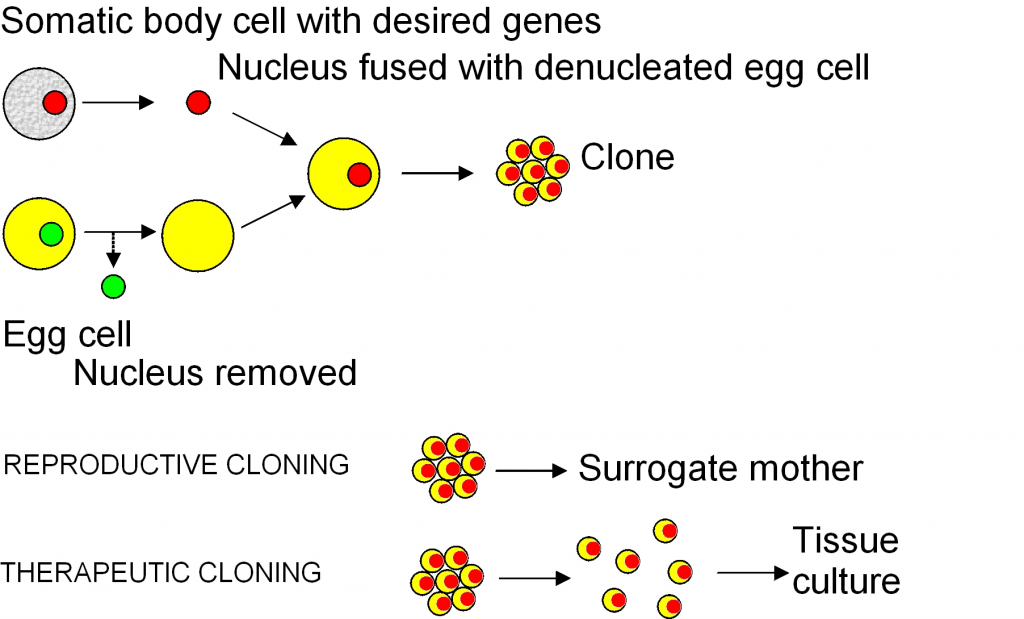 en: Reproductive and therapeutic cloning english d...
 English: small decription of the diagram
Reproductive cloning uses biotechnology to make a copy of a molecule, cell, tissue, plant, animal or perhaps someday a human. The idea that humans might someday be cloned moved further away from science fiction towards genuine scientific possibility on July 5th, 1996. On this day, the first cloned mammal, Dolly the sheep, was born. On February 27th, 1997, Doctor Ian Wilmut, a Scottish scientist with his colleagues at the Roslin Institute announced their great success. It has since captured the world's attention and spurred great debate all around the globe.
Many people are repelled by the idea of producing children who would be genetically identical to an existing human. It is viewed as completely unnecessary, as there are many other ways to have children, even for infertile couples. Many professionals feel that human clones would...