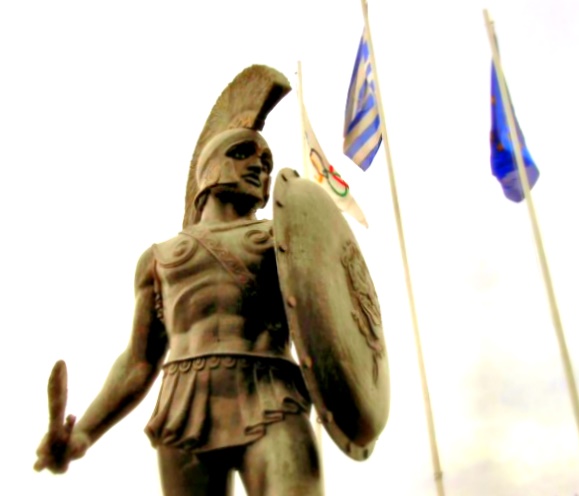
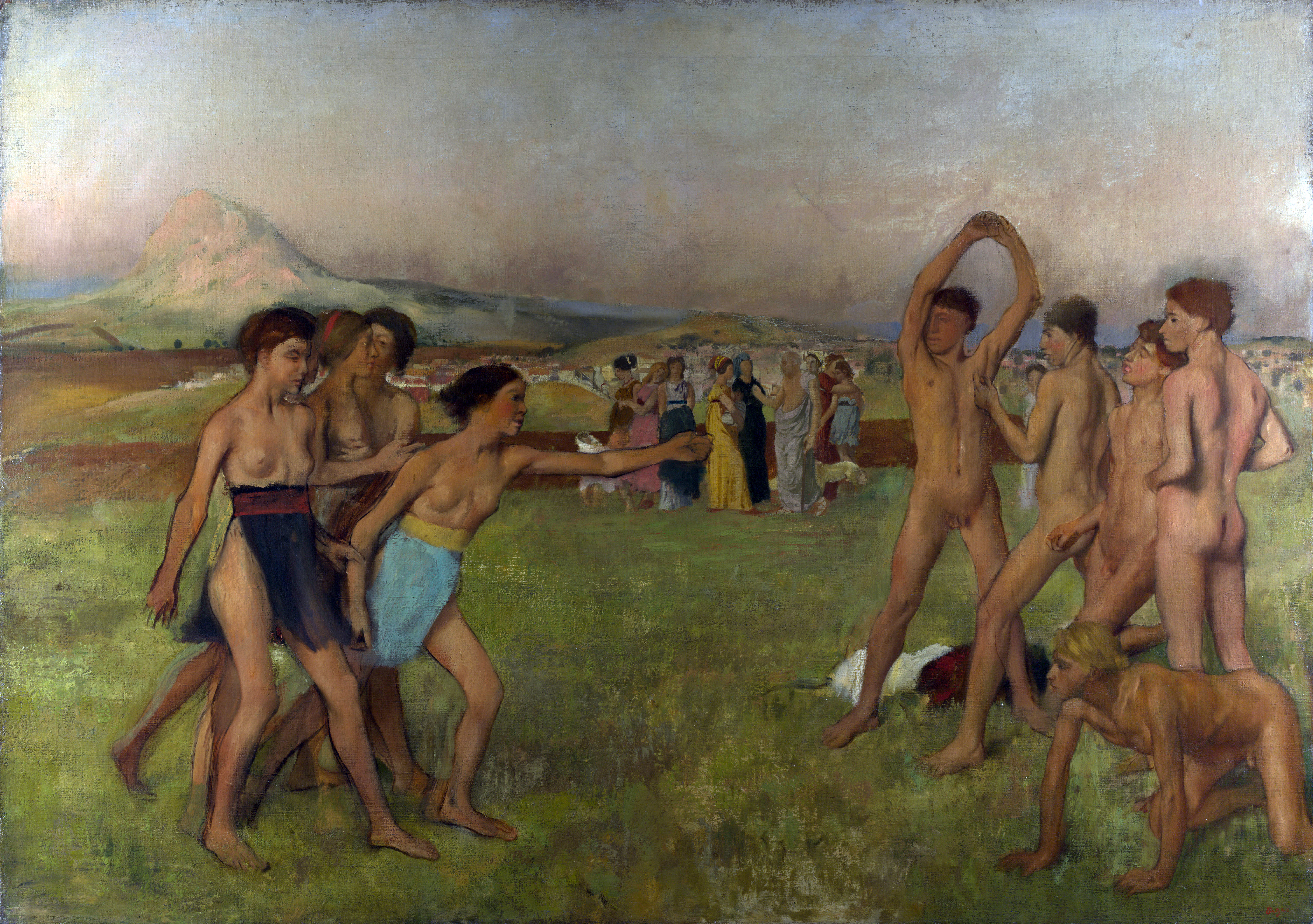
"The Spartan life was Spartan indeed"
"The Spartan life was Spartan indeed" At first examination of Spartan life it may seem quite sparse. Upon a more detailed examination of Spartan life Sparta is found to have a very rich religious and cultural life, serfs to attend to menial tasks and in theory a democratic government.
Sparta was made up of three main social groups. At the top of the group was the Spartans that were a society that was almost entirely geared for war. Below the Spartiates (or Spartans) were the Perioikoi, or "dwellers around or about." The Perioikoi were foreign people who served as a kind of buffer population between the Spartans and the helots. Because of this vital function, they were accorded a great deal of freedom. Most of the trade and commerce carried out in Sparta were performed by the perioikoi. At the bottom were the helots.
The Messenians were turned into agricultural slaves called helots. Their lives are best described as the life of a serf. They worked small plots of land on estates owned by Spartans, Large part of their produce went to the master of the estate and the barracks, and the remainder went to the helot farmer and his family , Tyrtaeus (Spartan poet) compared helots to "asses exhausted under great loads: under painful necessity to bring their masters full half the fruit their ploughed land produced." There is no question that the life of the helots was a miserable life. Labour was long and hard and the helots always lived right on the border of subsistence. "The Spartans believed themselves to be superior to the helots and showed no hesitation in exploiting them in order to maintain their own unique lifestyle"
Spartiates no longer had to worry about money; this economic independence freed the Spartiates to concentrate all...
More History Term Papers
essays:
Evaluations of the Oraibi Split. The 'Oraibi' was a pueblo of a Native American culture called the Hopi. This essay examines why the Oraibi split from four different anthropologists views.
... fabrication of a 20-year-long drama" (Clemmer 1995: 38). Culture contact, tensions and pressures, and ideological disputes resulted in disintegration of the pueblo. Clemmer proposes that the split resulted from tensions and conflicts caused by government interference in Hopi life ...
Two Of A Kind: This is an essay comparing the atrocities of Adolf Hitler and Chairman Mao.
... lower life forms. To Chairman Mao, it was the bourgeois, the rentiers and the "kulaks"--people in social classes outside the proletariat--who bore the brunt of his "class warfare". He, like Hitler, believed that "the enemy" (land owners ...
"Sparta: Historically Unique" -explains lifestyle/social structure/government of Spartans -explains why Sparta is unique -Bibliography and incorrect in-text citation included (should be fixed)
... backbone of Sparta. They made the Spartan system possible. The Helots were foreign people that had been conquered by the Spartan army and forced into slavery and servitude to the Spartan state. The life of a Helot was ...
A Tale of Two Civilizations: Question was to explain the similarities and differences between the two Greek Empires of Athens and Sparta.
... one of the nine thousand plots of land to it; but if it was mean-looking or misshapen, they sent it away to a place called the Exposure" (Plutarch). The Spartans believed if a child ...
Trace how Sparta developed into the most militarily effective state in Greece (800- 550BC).
... groups for training were important in Spartan life for the benefit of Hoplite production. Furthermore the balance that the hoplite army created while satisfying its political aspirations coupled with the success of the system, allowed for the expansionistic ability of Sparta ...
'The Victorian prison was a more 'civilized' method of punishment than hanging'
... forging a better life. Victorian sensibilities would also have been better satisfied with a 'prisoner society' to that of a 'hanging society'. Victorian Britain was very much the time of social reformers and of those ...
The Agoge - Educational System of Sparta
... them a higher chance of survival if they ever ended up lost or away from their squadron. The significance that the agoge educational system had to Sparta was obviously highly important. It affected the life of every Spartan, either ...
The Battle of Louisburg The fall of Louisburg, a Frecnch fort on the coast Nova Scotia, to the English Navy was a turning piont in the Seven Years War in North America.
... make a living away from the social class system which existed in Britain. With the influx of people, more land was needed to accommodate them. By 1740, the colonies had a population of 906 ...