Sports in Society
Sports Psychology:
Self -- Confidence in Sport Activity
(1)
Sports Psychology is one of the most up and coming sciences of the present time. This practice focuses on training athletes to use their mental capacities along with their physical talent to reach what is known as peak performance. Sports Psychologists analyze the performance of athletes and use motivational, cognitive, and behavioral principles to teach them peak performance levels. Sixty to ninety percent of success in sports is due to mental factors and psychological mastery. Sensing the importance of mental training in recent years, scientists have developed mental training programs. These programs all vary in technique, however, they all include skills focused on mastering the art of self-confidence. There are considerable amounts of evidence in sports literature that there is a direct correlation between self-confidence and peak performance.
Self-confidence exists in all walks of life. It is defined as: the strong relationships between a person's thoughts, feelings, and behavior which if motivated correctly can help an individual excel with confidence in anything they try to do.
 For You I Will (Confidence)
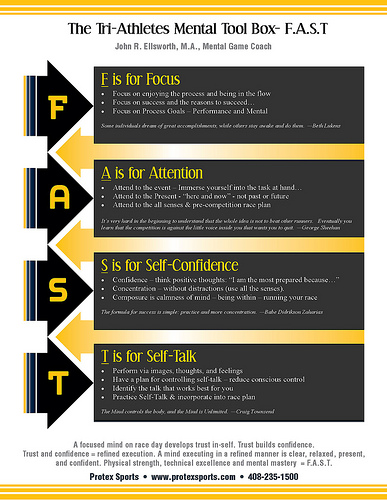 Tri-Athletes Mental Tool Box -- F.A.S.T.
 English: Looking northwest at Englewood Cliffs, Ne...
Most of the time self-confidence is viewed in accordance with how well an athlete performs at a certain sport activity. To examine this further one must look at how an athlete prepares themselves before the task in order to understand how their self-confidence reigns so high when it comes time for them to actually compete. An athlete must trust what enables them to build their self-confidence.
(2)
To start, an athlete needs to know themselves and what their limitations are. Through personal experience an athlete will know what they are capable of doing,
and also what challenges them. From such personal experiences an athlete can recall past success as well as past failures. Therefore, an athlete must strive off that...