Spread of Islam
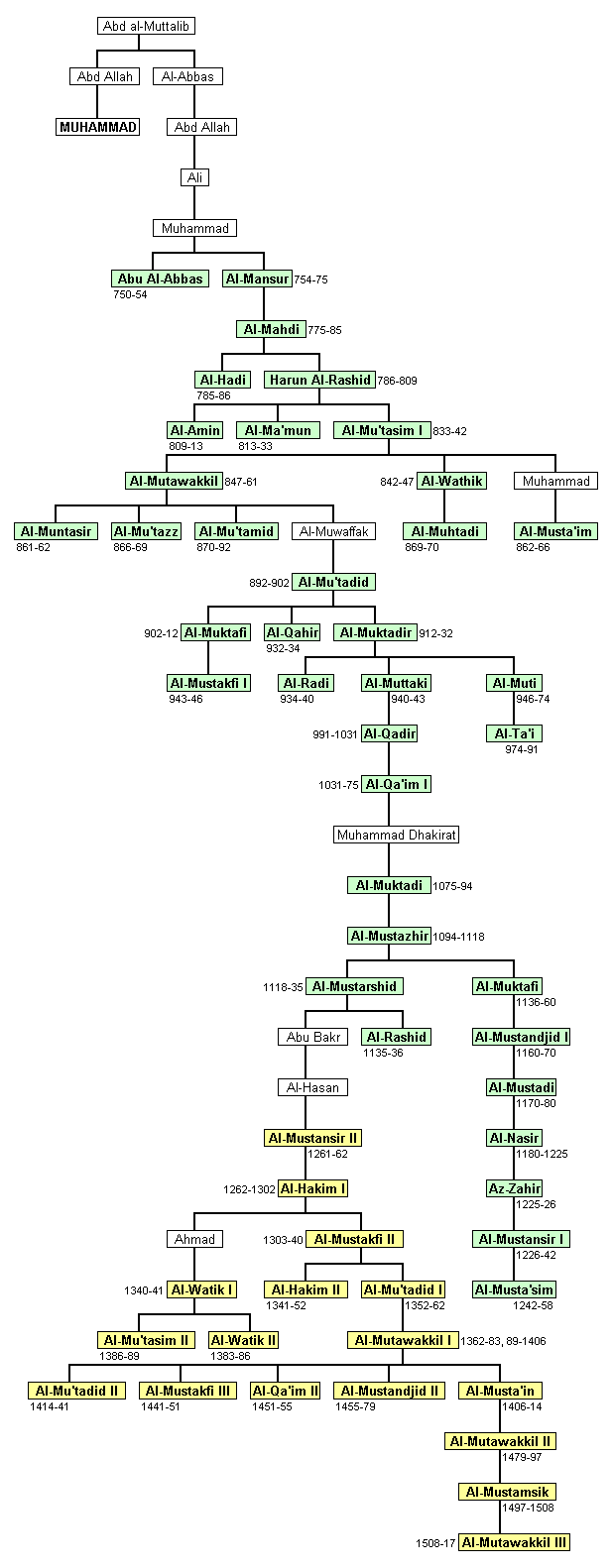
Throughout the vastness of various Muslim empires, Muslims were able to successfully rule very diverse populations and contribute to cultural innovation and trade. Many factors helped them during their rule, such as their geography, development of law, and preservation of Greek and Roman culture. The Arabs were the first to rule for the Muslims, they were highly religious and followed Muhammad. They later fell to the Umayyad, who stressed the political aspect of their office, instead of religious. They, in turn, fell to the Abbasids. The Abbasids established diversity in their rule. During these periods of rule, many achievements were made in the fields of Mathematics, Astronomy, Geography, Chemistry, Medicine, Art, Architecture, Literature, Philosophy, and History. Many of these were made in the House of Wisdom, which was a research center established by the Abbasids. These new ideas and laws were spread throughout the culture of Islam.
The Diverse populations of the Muslims were successful because the Muslims gave an equal part of their culture to everyone. Persians were the dominant group in the government bureaucracy, while Turks were the leading group in the army. Arabs continued to control religious life and administration of law. Also, 1.5 million people populated the main city Baghdad. It lay at the crossroads of the land and water trade routes. This brought in many Muslims from outside cities and countries to become part of the equality shared in the Muslim's diverse population.

Muslims were also very successful at trade because of many reasons.
One reason was their geographic placement. The Muslim civilization was based in Arabia, which is a connection point between Africa, Asia, and Europe. It is also surrounded by the Red Sea, Persian Gulf, and the Mediterranean Sea. This enabled Muslims to trade across the waters to many other countries on different...
Reviews of: "Spread of Islam"
:
More Middle Eastern History
essays:
What do you think were the main features of the Arab Islamic civilisation of the Abbasid Period, and what made that civilisation so vibrant?
... Mathematics, Medicine, and Geography were made. Advances that much of the West of today owes its heritage to. Lombard states the advent of the Muslim Empire, meant ... the Abbasid period is remembered as vibrant because of the amazing achievements accomplished by Islamic scholars ...
Israel-Arabs Conflict
... an Arab merchant named Muhammad became enlightened and brought to the world the rules and symbols of Islam; he was the prophet of Islam and a descendant of Ishmael. (Goldschmidt, 43) In 132 AD, when Israel was under Roman rule ...
Israeli-Arab Conflict
... Prophet Muhammad are evidence of the truth of Islam for people who believe in the Bible. Muslims believe ... was able to learn alone only small portion of that wisdom(http://kabbalah.info). In that point in time the hatred between Hebrews and Arabs began, and since then they are considered to be eternal ...
Islam, The Byzantine Empire, and Germanic Tribes
... considerable political influence in some Muslim societies. Islamic social philosophy is ... Holy Wisdom) in Constantinople, they overstrained the empire's resources, while plagues reduced its population. Germanic ... 632 Muhammad was the leader of an Arab state growing rapidly in power. Muhammad's ...
Discussion on the Secularism of Turkey in it's politics, culture and international relations.
... a population around 67.3 million people, 99.8% of which are Muslim. Unlike its Islamic-state neighbors, the Republic of Turkey has gone to great lengths to secularize, and it has felt the ramifications in its culture, political agenda ...
Spread of Islam in the 7th CE to12th CE
... The cultural and political achievements of Islam drew people eager to advance their societies in a verity of ways, including religious ones. The main factors that contributed in spreading Islam in seventh to the twelfth were: the conquests by Muslim forces ...
Sassanid aka Persian Empire history
... and philosophy. The medical knowledge of India, Persia, Syria, and Greece mingled to create a school of medicine and therapy. Later, much of what was considered Muslim culture were actually Sassanid achievements. The culture was wide reaching as the Sassanid empire ...
Jordan an the Middle East
... non-Muslim empire against the Ottomans. Arab Nationalism ... prophet Muhammad, thus giving Jordan's ruling family a place of respect and honor in Arab and Islamic circles ...
Good
A short but descriptive and informative essay
1 out of 3 people found this comment useful.