St. Augustine in the Dante's Inferno
Augustine in the Inferno
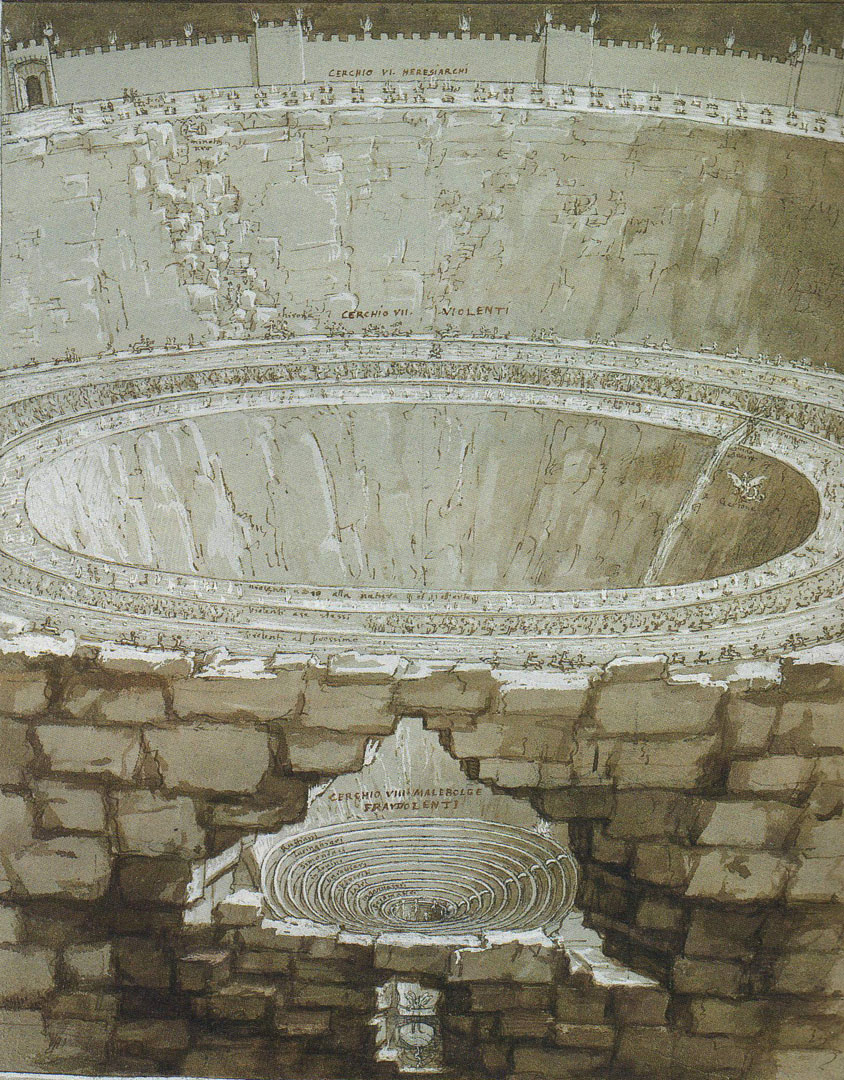
It is hard to place St. Augustine within just one of the levels of Dante's hell for his sins were varied and not great. Today many of his sins are common place. For example, most people attempt to better their own lives without regard of others. They attempt to increase their standard of living and gain more worldly possessions. They are neither good nor evil but are just trying to make a living and keep up in today's fend-for-yourself society. Before Augustine's conversion, this was his goal. He was continually searching for "honors, money, (and) marriage" (Confessions, 991). This allows Augustine to be placed in the first area of hell, the Vestibule. It is a place for opportunists such as Augustine was before his conversion. It is a place for the "nearly soulless. . . who were neither for God nor Satan, but only for themselves" (Inferno, 1295). Augustine never intentionally hurt anyone, but his actions were led by his instincts to succeed and gain praise. These actions included kissing up to the Emperor, his study of law and the art of persuasion, and the mocking of newcomers to his profession. Since each of these sins also falls within a different realm of Dante's hell, they will be discussed later in this paper.
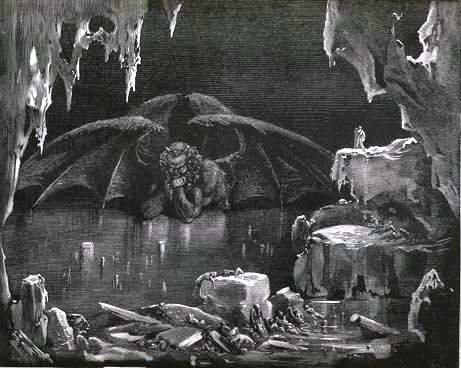
The second level of Dante's hell, Limbo, does not apply to Augustine because he was baptized and was blessed with the knowledge of Jesus Christ's existence. Therefore, Augustine can not be placed within this first circle of hell.
The second circle of hell, a realm for those who fell victim of their carnal desires, is another level at which to place Augustine's soul for he was consumed by lust in his pre-conversion days. He was encouraged by his family to learn the art...
Reviews of: "St. Augustine in the Dante's Inferno"
:
More Poetry
essays:
The Liberation of Holland
... the continuous repetition of the same kind of touch and feeling when living such a boring a predictable lifestyle. 8)The nuclear family in a well-to-do neighborhood with a high standard of living is ... rest in terms of division of social class. In this case, the distinction is made by money and wealth. ...
Portrait of medieval society in "General Prologue" of Geoffrey Chaucer's "The Canterbury Tales"
... giving money is a sure sign of penitence. His white neck is a conventional sign of lecherousness. The Friar's portrait is so complex because his estate reveals more clearly than any other the gulf between the standards of an ...
"Inferno": A Presentation of God's Justice or a Mere Tool of Dante for His Revenge?
... episode intentionally creates a dichotomy between reason and feeling in the reader, who is compelled to accept the pilgrim's conduct as a reflection of Divine Justice despite its falling short of earthly standards of humane behavior" (115). In summary, Dante ...
Influence of Personal Experience in Emily Dickinson's poetry- literary criticism. Includes excerpts of some of her poems
... this regard she was not unusual by Amherst's standards" (72). The most prominent figure of religious ... Emily Dickinson with such wrenching choices as the demand for conversion. Her doubts tempted her to rebel against God, but her ...
John Keats and the Individual - Soul Making How does Keats explore the concept of the individual through his writing?
... as soulless, as an 'object' than as a product of complete experience in order to ensure that he does not become an object himself; a 'football' to be kicked to and fro from happiness to misery. He continues in ...
To what extent will man go to ensure his survival? Explore with references to 'If this is a man' by Primo Levi.
... standards, his morality and his behavior, even though he utilizes his skills so well and uses them as survival tools. Even though whilst in the camp the two would converse ... most adaptable, the human type most suited to this way of living'. When Elias is called a thief and yet is described ...
Emily dickinsons private world
... and lively. Her poetry reflects her communion with the natural world around her as well as her disconnectedness from society. Because she did not subject herself to the standards of Victorian ...
Oscar Wilde's Life and Works
... bourgeois standardization of life, the extreme practicality, militant hypocrisy “of the clay-legged empire”, vulgar tastes, trite feelings cause “minutes of despair ... Prison confession” he writes: “Suffering and everything that it can teach is my new world. Earlier I lived only ...
Impressive
i like your sytle, and i really didnt think of some of your references that way. you make a good point
2 out of 2 people found this comment useful.