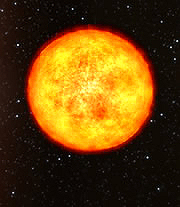
How Stars Are Formed
IntroductionPeople have always been fascinated with the stars above. One can see this fascination in poetry or even in the astronomy class that is dedicated to stars. A star is defined as a ball of gas composed of hydrogen and helium (The Astrophysics Spectator 2004).The formation of stars is a question that fascinates many.
No one has ever witnessed the formation of a star so only theories can be formed. One theory is found in the religious scriptures of the Bible and the other is scientific explanation. The background section gives a brief description about both. The findings section provides further detail for better understanding. In the discussion section, the group members will give a personal opinion of the information found. In the last section, the conclusion summarizes theories discussed throughout the paper.
BackgroundThe first theory of how the stars were formed is found in religion. No matter what religion one chooses there is always a part dedicated in their scriptures on how the stars and earth came to be. These religions have scriptures to help answer questions that cant be found through scientific theory. Christianity, for example, has an explanation of how the stars came to be found in the book of Genesis in the Bible (De Young, 2000).

The second theory is found in science. Because the birth of a star has never been observed, scientist can only make theories on how they believe a star is formed. Although there are different theories, the basics of each theory are the same. These scientific theories state that stars are formed from gas and dust clouds that are collapsing in space. The temperature and the density of the cloud increase as the collapsing occurs. The star will form in the middle of this cloud (IPAC, NASA, n.d.).
FindingsLooking at the...
More Astronomy
essays:
Theories of the Origin of the Universe.
... the scientific theories. This is the time where there was no advance technology like telescopes or satellites like we do in present days. They had to make reasons or explanation for the things I didn't understand. Cultural theory God's ...
Birth of a Star The process a star goes through in birth and the thing that happen to and around it.
... pushing of gravity. It gives off gases (gassy) and energy and glows. NASA. "A Star is Born." NASA Jet Propulsion Laboratory California Institute of Technology. 26 Nov. 2001. NASA Jet ...
Basic Information about the sun Since the birth of mankind,
... the birth of mankind, the Earth has been lit by the vibrant light of our closest star, The Sun. The sun, which is roughly 1 au from the earth, is a giant ball of burning ... mostly of hydrogen with some helium, as well as a few ... s formation in a huge cloud of gases ...
"The Largest Planet" This is a research essay about Jupiter. It includes unmanned missions to Jupiter and the general characteristics of the planet. It has 6 references.
... red star Aldebaran: A journey that will take about two million years. Pioneer 10 carried out 15 experiments. It studied interplanetary and planetary magnetic fields; solar wind parameters; cosmic rays; transition region of the heliosphere; neutral hydrogen abundance ...
Beta Pictoris
... 5) Birth Of A Solar System?; Tim Folger; Discover; volume 13; page 27. (6) Inhibition Of Giant-planet formation By Rapid Gas Depletion Around Young Stars; B ... BIBLIOGRAPHY A Closer Look At Beta Pictoris; Astronomy; volume 21; Page 18. Birth Announcements; Scientific American ...
Black Holes
... the star start to burn continuously. The Hydrogen gas is usually the first type of gas consumed in a star and then other gas elements such as Carbon, Oxygen, and Helium are ...
The Sun
... fusing hydrogen into helium in its core. Without the power that this conversion process generates, a star would collapse under its own immense weight. The heavier the star is, the faster it consumes its hydrogen and ...
The Hubble Space Telescope: A Window to Space. A six page scientific essay entireley about the Hubble Space Telescope. Includes citations from a variety of sources and Bibliography.
... detailed births and deaths of stars. From these documents it is "visually demonstrated that protoplanetary dust disks around young stars are common, suggesting that at least the raw materials for planet formation are ...