A Statistical Account of Hurricane Katrina and it's Effect on the Gulf Coast, Posed Question: Would this natural disaster have occured the same way if the politicans in command had been different?
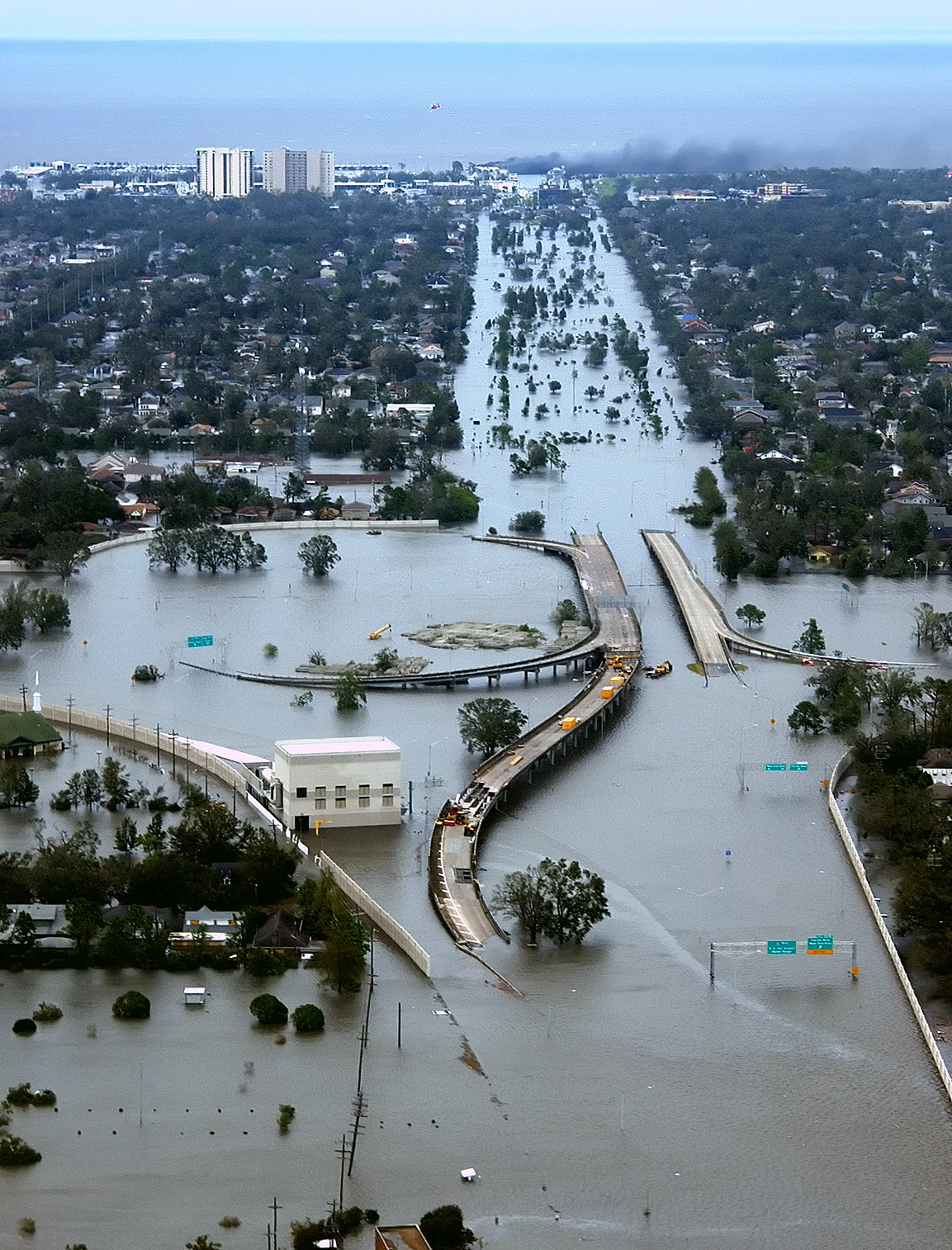

"Hurricane Katrina was one of the strongest storms to impact the coast of the United States during the last 100 years. With sustained winds during landfall of 140 mph (a strong category 4 hurricane on the Saffir-Simpson scale) and minimum central pressure the third lowest on record at landfall (920 mb), Katrina caused widespread devastation along the central Gulf Coast states of the US. Cities such as New Orleans, LA, Mobile, AL, and Gulfport, MS bore the brunt of Katrina's force and will need weeks and months of recovery efforts to restore normality." (http://www.ncdc.noaa.gov/oa/climate/research/2005/katrina.html)
There is an argument as to whether or not decisions made by four important figures prior to the hurricane could have lessened its devastation and destruction. President Bush, LA Governor Blanco, New Orleans Mayor Nagin, and ex-FEMA director Michael Brown were all key decision makers in the preparation and evacuation efforts of New Orleans and other areas in its path. The amount of destruction caused by this hurricane has not been seen for almost a hundred years - since the Galveston Hurricane in 1900 and Hurricane Camille in 1969 which both hit this area of the country. We have decided to look into three different regions of the hurricane that could have changed the decisions made by these four people. We have investigated scientific hurricane research and whether or not we could have prepared better for Katrina from past information. Also, we are considering whether or not the relief efforts could have been faster and more efficient had a majority of the suffering popular not have been African American; which also turns this into an issue of racial discrimination. We are also taking into account the natural landscape of Louisiana and could New Orleans have improved any of the man made protections before the hurricane to...
More Meteorology
essays:
Disasters, speaks of the study of hurricanes
... four hurricanes including one of the big ones during the time period my research covered. Gilbert reached a pressure of 888mb. It was a category 5. There were two other storms that were category 4. This ...
What are "concentric eyewall cycles" (or "eyewall replacement cycles") and why do they cause a hurricane's maximum winds to weaken?
... major hurricanes (winds: 50 m/s, 100 kt, 115 mph) or Catories 3, 4, and 5 on the Saffir-Simpson scale. As ... maximum winds die off a bit and the central pressure goes ...
Hurricane Andrew - The Facts and The Experience
... A category four hurricane has the power to completely destroy a mobile home and to cause severe flooding, and this was proved when hurricane Andrew hit Florida. The winds were ... south central part of Louisiana. At this point the winds were going at about 120 mph. One day later the hurricane became ...
The Ozone Layer: What Does It Do And What Happens When It's Gone?
... the ozone layer actually began in the 1930s as an effort to understand the ozone layer's potential benefit to weather forecasting. This research was increased in the 1980s when decreases in ozone levels ...
What Are the Effects of Acid Rain?
... 30 June, 2009. Hare, Sue. Acid Rain 36-38 Atmosphere, Climate & Environment. Manchester Metropolitan University. Manchester.30 June, 2009Mason, B.J. Acid Rain: Its Causes and its Effects on Inland Waters. New ...
Credit: NASA/JPL-Caltech/E. Churchwell (University of Wisconsin-Madison) and the GLIMPSE Team Black Widow Nebula Hiding in the Dust
... to create multiple clusters of massive star formation. The combined winds from these groups of large stars probably blew out bubbles ... end part Victorian phase the scientific imagination developed to a new height. More complex theories of scientific causes were beginning to ...
The Day After Tomorrow Research Essay. An essay comparing and disproving scientific events in the movie, with similar scientific events in the real world.
... 3."Climate Change: Will it look anything like "The Day After Tomorrow"? - Tip Sheet." University Corporation for Atmospheric Research - UCAR/NCAR/UOP - Home Page. 24 May 2004. 28 Mar. 2008 . 4."FAQ : HURRICANES, TYPHOONS, AND TROPICAL CYCLONES." DOC/NOAA/OAR ...
Historical Weather Patterns of Michigan
... association between regional temperature trends and the risk of extreme minimum daily temperature events has not been widely examined. Some efforts have focused on documenting recent changes in the length of ...