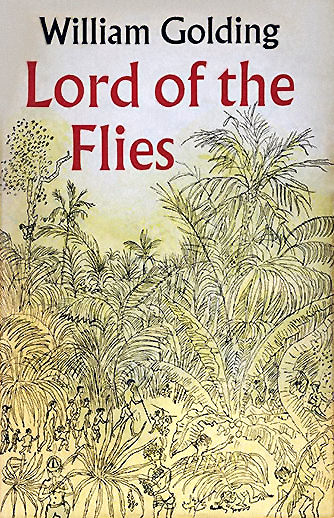
Symbolism in "Lord of the Flies"
In "Lord of the Flies" by William Golding a group of young British boys are stranded on an uninhabited island after their plane crashes. At first a paradise, the island eventually becomes a seemingly inescapable hell for some of the newcomers. There are various symbolic items present on the island for the majority of the boys stay, and by examining these symbols we can trace their decline of civilization.
The most obvious of these symbolic items is the conch. Ralph first blows the conch on the beach with Piggy after they discover it in the lagoon to call the other boys from whom theyre separated, and being used in this capacity it becomes a strong symbol of civilization and order. Ralph is even distinguished from the rest as a suitable leader because hes the being that [blows the shell], waiting for them on the platform with that delicate thing balancing on his knees(19). He uses the conch shell to govern meetings, and give a sense of power by allowing whoever holds the shell the right to speak. As time passes on the island this rule for talking in turn is respected less and less, certainly by members such as Jack, who constantly tells Piggy to shut up despite the fact that he clearly has the right to speak. Ralph even realizes at one pivotal point that this is happening, and fears to blow the conch: If I blow the conch and they dont come back[,] then weve had it(99).
Chaos ensues of course, leading to the death of Piggy and the destruction of the conch when Roger pushes a rock onto him, which represents the full transition to savagery of the boys: From here on theyre a bloodthirsty pack of painted little monsters, attempting to hunt and murder Ralph.
Similar...
More "Lord of the Flies" by Sir William Gerald Golding
essays:
biblical illusions in "Lord of the Flies" by William Golding
... help the author illustrate to the reader the situation in which he has placed his characters. In The Lord of the Flies, William Golding uses biblical allusion to enhance the reader ...
"The Lord of the Flies" by Golding. An epic tale that depicts the different facets of the human spirit
... natrue." -William Golding. In the novel, The Lord of the Flies, the main conflict was between Ralph and Jack. The two boyks comkpletely differed in their approach on what to do while stranded on the island. This ...
Perceptiveness on civilization and savagery of human nature reflected from william golding's lord of the flies
... island, he will take them back to the "civilized" world, which will presently be hunting its enemy in the same implacable way. William Golding uses Lord of the Flies to teach us that the most dangerous enemy is not the savagery ...
The Lord of the Flies by Sir William Gerald Golding
... tell the officer what happened. I hope that Ralph tells the truth and doesnt leave out that Jack started it all. Golding, William. Lord of the flies a ...
Religious persecution, an underlying theme in "Lord of the Flies" by Golding
... works, William Golding's novel, The Lord of the Flies can be read on many different levels. It is possible to read the book literally, as a mere story about boys marooned on an island. It ...
William Golding's thesis of evil on the basis of "Lord of the Flies" as a reflection of the 1950's and Thomas Hobbes
... how the boys on the island refer to their old school system, how the theory of the political philosopher Thomas Hobbes can be compared to the ideas of the "Lord of the Flies" author William Golding and ...
"Lord Of the Flies" Notes.
... plane. Although the war remains in the background of Lord of the Flies, it is nevertheless an important extension of the main themes of the novel. Just as the boys struggle with the conflict between civilization and savagery on the island ...
"Lord Of The Flies" by William Golding
... Source : 'Lord of the flies' by William Gerald Golding. 'Alt om bøker' by Tiden Norsk Forlag. Proudly made by Raymond ...