The Temple of Athena and the Temple of Fortuna Virilis
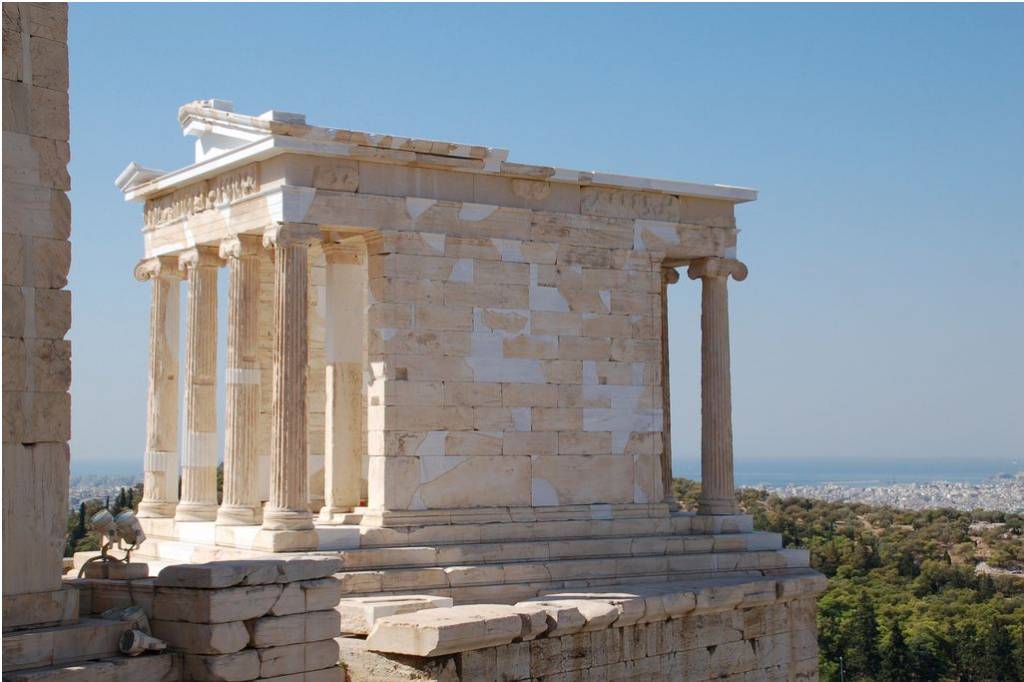
This paper will compare and contrast the Temple of Athena Nike (a Greek building) with the Temple of Fortuna Virilis (a Roman building). The Temple of Athena Nike was built in the late fifth century BC, and it is one of the buildings on the Acropolis of Athens. Although it is much smaller than the surrounding structures, the temple has a sense of prominence, because it is the first thing visitors see when they arrive at the Acropolis (Tansey and Kleiner 156). The plan for the temple was created by the architect Kallikrates. It is rectangular in shape, and it contains a small room, known as a cella, with an open doorway at its front. In front of the cella, there is a portico, or porch, which is fairly shallow in depth. The temple as a whole is raised on a three-tiered platform, which is extended in front in order to form steps leading up to the portico. The original roof is now missing, but it was probably sloped and triangular-shaped, as seen in other Greek temples of the time. There is a row of four columns along the front of the temple, and another row of four columns along the back. A temple having this features (columns on the front and back of the structure, but not on the sides) is referred to as an amphiprostyle temple (Kimball and Edgell 76).
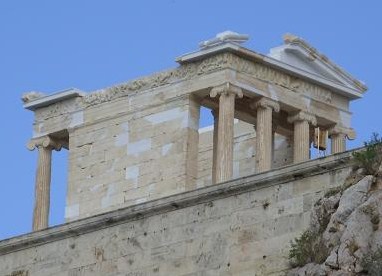
The columns of the Temple of Athena Nike are of the Ionic order. As described by Watterson, the principle decoration of the Ionic order is a double volute or scroll which sweeps across the top of the column with a graceful dip and then curves down on each side and around in an ever diminishing spiral (Watterson 31). With its distinctive spiral scroll shape on its capital tops,
More Works of Art
essays:
The Walls Came Tumbling Down in Victory: A Comparison of the Greek Parthenon and the marble statue "Nike Adjusting Her Sandal"
... the Temple of Athena Nike (so named because Athena and Nike were one and the same) at the Acropolis in Athens, this work of art ...
San Fransisco City Hall Describes layout and motivations behind the building.
... combination of the Roman Basilica and the pantheon with elements of Greek temple architecture ... to Roman building trends, the City Hall of San Francisco uses Greek structural elements for decoration; the exterior of the walls are decorated with engaged, Doric columns ...
Pillars of Eternity: Comparing the Ashoka Pillars of India to the Column of Trajan by the Romans (Complete w/Works Cited and Endnotes)
... cosmic order was impressed upon the terrestrial world. Traveling eastward and forward in time the immense city-states of the Romans, another ...
Ancient Greek Paintings
... Micon of Athens and Panainos, brother of the sculptor Phidias. Micon and Panainos decorated a building in Athens, known as the Painted Stoa, with a painting of a celebrated encounter between Persians and Greeks, the ... scraps of paintings by unknown artists that decorated the walls of a temple at ...
This is an Essay on triumphal arches, describing the the purpose of them and how this was achieved. Helpful for anyone studying history of Art AS.
... of the Ionic or Corinthian order and only gave slight structural support. You then came to ... versions of the porta triumphalis with the Greek and the Roman ones as the most characteristic of all. The Greek porta ...
Gothic Architecture and sculpture: An in depth analysis of the gothic style from the early archaeic period up to the flamboyant
... of order and symmetry, allowing figures to stand separate and apart from one another. Especially intriguing is the move to separate sculpture from its architectural setting. Although most sculpture continue to appear as an architectural component until after the 13th century ...
Buddhist art--two periods of b
... Hellenistic, Roman, and other western influences” (Huntington 134). This example of a Gandharan Bodhisattva probably once stood in a stupa or temple. This ...
Themes of Italian Renaissance Art
... rediscovery of the values of Greco-Roman civilization. An example of architectural revival is Bramante's Tempietto, a small temple built where St. Peter is said to have been crucified. Bramante later got a chance to build on ...