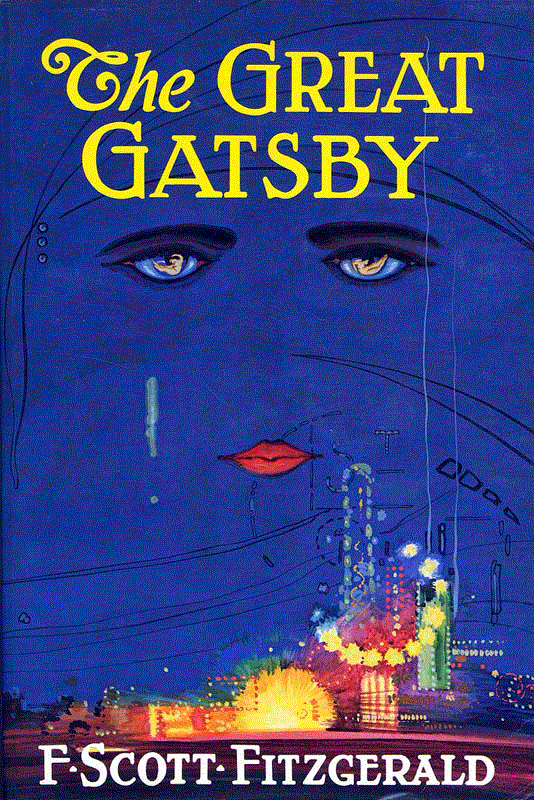
Term Paper; Hemingway (Sun Also Rises) and Fitzgerald (Great Gatsby) author comparison and how well they represented the Roaring 20's.
F. Scott Fitzgerald's The Great Gatsby and Ernest Hemingway's The Sun Also Rises both define the culture of the 1920s through the behaviors and thoughts of their characters. The characters in both novels have a sense of sadness and emptiness, which they resolve through sex and alcohol. This can be attributed to the disillusionment surrounding the Great War, better known as World War I. Jay Gatsby in The Great Gatsby represents the Jazz Age and high life of the 1920s, in contrast to Brett Ashley as the New Woman of the 1920s and Jake Barnes's embodiment of the Lost Generation in Hemingway's The Sun Also Rises. The Great Gatsby illustrated people reaching for the "American Dream." The Sun Also Rises instills a "permanent emotion," what many members of the "Lost Generation" searched for, into the reader by presenting a sense of nostalgia for the better past.
Fitzgerald's 1920s was full of life, flappers, money, alcohol and jazz. It was a time of happy spirits, never ending wealth and the American Dream. Many believed that through hard work and perseverance one could be as rich as they wanted. One could own a mansion and a car and the latest fashions and live the high life. The flapper, a major symbol of the 1920s, wore their hair short and bobbed, make-up that was applied in public, and baggy short dresses that exposed skin. She thought fast, talked fast and was perhaps even a bit brazen. "They're all desperadoes, these kids, all of them with any life in their veins; the girls as well as the boys; maybe more than the boys."(Fabian) Money encompassed the spirit of the times. It represented the pop life, modern days, happiness and the American Dream and everybody wanted it. It seemed that there was not a soul...
More Ernest Hemingway
essays:
The Sun Also Rises by Ernest Hemingway - A Look At The Characters' Lives
... American woman named Gertrude Stein, who had established a famous salon where painters and writers such as James Joyce, F. Scott Fitzgerald, and Ernest Hemingway met and exchanged ideas. Hemingway's characters find life in Paris exciting, but also empty ...
"The Old Man and the Sea" by Ernest Hemingway
... great fight. Two Hearted River: Part II þ Summary and Analysis. Another story regarding life and death and the struggle for life was Ernest Hemingway's short story Two Hearted River: Part II. he warmth and life-giving quality of the sun ...
Santiago's losing struggles in Ernest Hemingway's The Old Man and the Sea. Santiago loses an apocalyptic struggle to nature, society, and even himself.
... has lost a struggle with himself as he is not able to do what he wishes. Santiago's losing struggles between nature, society, and himself in The Old Man and the Sea, by Ernest Hemingway, are ...
The Mask, an essay on the war aspect of Ernest Hemingway's "A Farewell To Arms."
... them." (Tolstoy). We see this from the very beginning of Ernest Hemingway's A Farewell to Arms. And through the eyes of ... cause. And as Tolstoy said, inactivity, cruelty, debauchery and drunkenness also play a great part in keeping men under the thumb of commanders. They ...
Ernest Hemingway's underlying attitude towards Gertrude Stein in "A Moveable Feast"
... s "lost generation"; calling them criminals and perverts who only partake in "the pleasure of corruption" and striving towards leading everyone around them to the hedonistic lifestyle of drinking and drugs. She also declared other "inaccrochable" writers of Hemingway's age ...
The Strengths of the Female Characters in "A Farewell to Arms" and "For Whom the Bell Tolls": Books written by Ernest Hemingway
... Tolls. New York: Simon and Shuster, 1995. Hewson, Marc. "A Matter of Love or Death: Hemingway's Developing Psychosexuality in For Whom the Bell Tolls." Twentieth Century Liturature Vol44. (2004): 170. Hewson Marc. "The Real Story of Ernest Hemingway: Cixous ...
The Importance of Elements:Ernest Hemingway's "A Clean, Well-Lighted Place."
... Ernest Hemingway's short story "A Clean, Well-Lighted Place" is one ... However, in this case, the customers needed the café a great deal more than the café needed them. It was a ... deaf man is indirectly described as a "drunk" and an "alcoholic". He is a very solitary soul who, outwardly, seems content ...
Essay on "The Sun Also Rises" by Ernest Hemingway, includes the literary element of characterization of Hemingway's "Ideal Man"
... the "Hemingway hero", an ideal character readily accepted by American readers as a "man's man". In The Sun Also Rises, four different men are compared and contrasted as they engage in some form of relationship with Lady Brett Ashley, a ...