Lawrence Kohlberg (1927-1987), a professor at Harvard University, began his research as a developmental psychologist in the early 1970s. Kohlberg is most famous for his Theory of Moral Development -based on six stages of moral reasoning. These stages are classified into three levels: Pre-conventional, Conventional and Post-Conventional. Kohlberg aimed to describe the process in which people learn to discriminate from right and wrong and increasingly appreciate moral values.
The Pre-Conventional level of moral reasoning is focused on children whose understanding of morality is driven by its direct consequences. An action that produces a reward is considered "right" as in an action that results in a punishment is considered "wrong". Towards the end of this stage, individuals begin to understand what is socially acceptable and deliberately conform to society's rules in order to receive rewards. Individuals, particularly adolescents and adults, in the Conventional level act morally 'right' because they believe meeting society's expectations is necessary in promoting good personal relationships and a healthy environment.
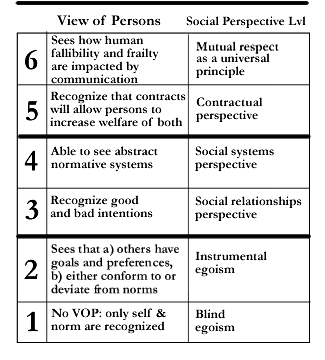 Lawrence Kohlberg's stages of moral development
 Yaron Kohlberg
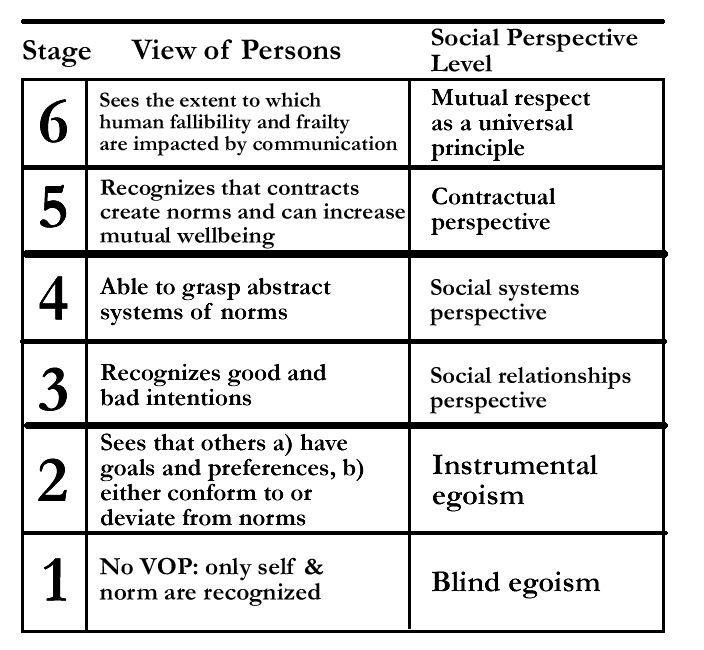 Kohlberg stages - large
In Stage 3, the self enters society by embracing social roles and acknowledging the approval and disapproval of others in accordance with social standards. Their actions are evaluated in terms of their intentions. In Stage 4, an individual recognizes the importance of laws and social conventions in maintaining a functioning society. Kohlberg believes the final Post-Conventional level will not be achieved by many adults. In stage 5, the individual is concerned with the interests of others and their society through democratically decided rights. In stage 6, morality transcends the laws of society and focuses on abstract reasoning through universal ethical principles.
Kohlberg believes that adolescence occurs in the Conventional level of moral development. Adolescence is described as the transitional change from childhood to adulthood where an individual matures physically, emotionally and socially. Kohlberg states that as...
Yeah
Fantastic
0 out of 3 people found this comment useful.