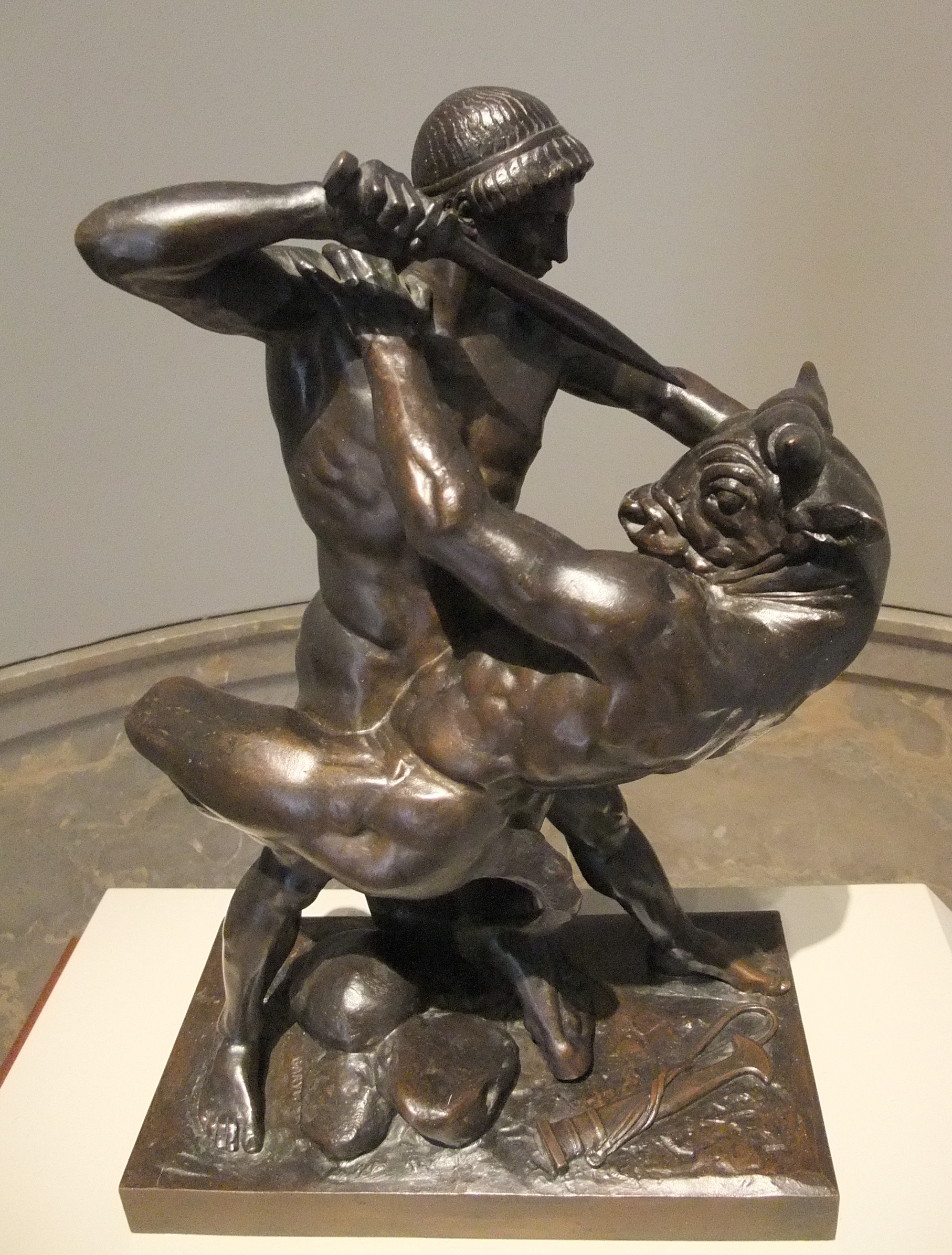
"Theseus and the Minotaur" by Antoine-Louis Barye
Theseus and the Minotaur
The idea of Theseus fighting the Minotaur was a popular neo-classical subject among sculptors. Although, Antoine-Louis Barye (1796-1875) finished his sculpture about 1850 that is in the late part of what is meant by neo-classicism, Barye's modelling of the surfaces has a vibrancy and movement characteristic of the French romantic sculpture. Barye is well-known for his animal production and Theseus and the Minotaur is only one of a series produced by Barye from the early 1830s onwards.
The sculpture reproduces King Aigeus' and the god Poseidon's son, Theseus, - they both visited princess Aithra the very same night, that is Theseus had two fathers - holding his knife over Minotaur, a monster having the head of a bull and the rest of the body human, devouring human flesh. However, according to tradition Theseus killed Minotaur by means of King Minos' daughter Ariadne. Add to this that Minotaur's mother was King Minos' wife - his father a bull. CONFUSED!!! However, tradition says that Minotaur was locked up in a maze in Knossos on Crete. He was nourished by a compulsory tribute of young men and women from Athens. Therefore Theseus and Ariadne decided to kill him.
Now, why did I choose to write about Theseus and the Minotaur? Well, first of all Victoria and Albert Museum is big - very big! - I therefore had to decide by which department I wanted to improve my knowledge. In many ways the 19th century was a time of unrest and upheaval: a neo-Platonic philosophy of life arose, an interest for classical antiquity penetrated, citizens acquired a considerable place in society etc. Consequently I darted into the department containing subjects from America and Europe in the period 1800-1890. Though I had now reduced my options I still didn't know exactly...
More Art Essays
essays:
Development of Art Throughout History
... for the first time since classical antiquity and in striking contrast to medieval art, the human body is rendered as a self-activating, functional organism, and the human personality ...
Consider how the monster is portrayed In Mary Shelley's Frankenstein and the Two film versions of Frankenstein
... that animal down. Therefore Whale makes us want the monster to be killed also. A further clip in the 1931 version involves the village folk of Ingolstadt, Frankenstein, the Mayor and the monster. Whale ... read and write and understand things while watching the little daughter do the same ...
Art History "Oath Of The Horatii"
... get the Neo-Classical movement off the ground. I enjoyed this artwork because of the clean lines, gesture clarity, dramatic use of light, and ancient gladiator style theme. I also enjoyed his portrayal of human drama ...
"The Human in Captivity" A juxtaposition between the art within the Cloisters in New York City and the architecture of the Cloisters itself
... is the subject of Anthony Vidler's introduction to his book The Architectural Uncanny. I felt very alone and secluded in the halls of the Cloisters, and indeed ...
Art History research paper
... objects humans make and the structures humans build, as opposed to art critics who study the visual quality and tangible aspects of art.(Gardner 4) They traditionally have classified such works as architecture, sculpture, pictorial ...
The Dynamic from Conceptions to Experiences in Early Art and the Characterization of Greek Art in the Classical Era.
... their gods as another opportunity to study the human form. It is this focus on the beauties of the human body and the shift to an experiential, optical worldview that characterize the art of Greece's Classical Period. The classical Greeks ...
Lord of the Rings.
... masterpiece (The Fellowship of the Ring, The Two Towers and The Return of the King) written back in 1948. This classic sold over 50 million copies worldwide and was ... to humans, but they're about four feet tall and have hairy, padded feet), wizards, humans, orcs, elves, goblins, dwarves, and the evil ...
Masaccio, Donatello, and Brunelleschi - Renaissance Pioneers
... from classical influences and emphasized realism and the portrayal of character and dramatic action in his work. A notable example of his sculpture of this period is the wood sculpture of ...