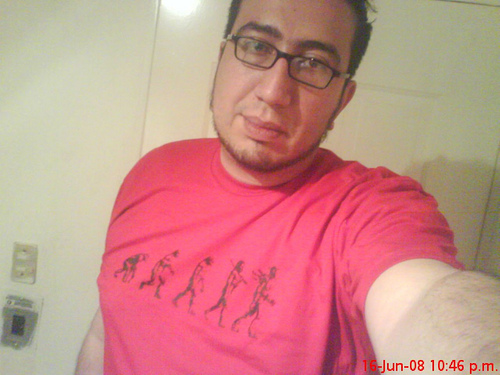
Thoughts on Human Origins. Assignment: Describe your personal views on how modern humans came into existence. Provide justification for your beliefs.
Thoughts on Human Origins
When considering the origins of human life on this planet, I must rely on the observations of others to draw my conclusions. I was not there when the world began, when humans appeared, or when religious texts were written. Furthermore, I have not conducted my own scientific research on the subject, nor have I studied in great detail the research that has been done. Yet, I have come to believe in what I know as "evolution." To understand why I hold this belief, I must consider my religious and intellectual background and my experience with various theories on the origins of human life.
Though I am vaguely aware of the myriad of origin tales recognized by the world's people, I am only truly familiar with two, both of them Western. So my choices, and my perspective, are rather limited. The first explanation I encountered for the origins of my species was that of Creation as described by the Book of Genesis in the Bible. I don't remember where or how I first heard this story - perhaps it was from a cartoon or a friend - but, living in a largely Christian culture, I know that I heard it so often and from so many sources that it eventually became something that I just knew, like the story of Cinderella or The Three Little Bears. As I came to understand it, the tale goes something like this:
In the beginning, God created Heaven and Earth, and over the course of six days, He created everything exactly as it is now - plants, animals, day, night, rocks, trees, mountains, rivers, EVERYTHING. He saved his most wonderful, special creation, one to be made in His Image, for last - man. But man was lonely, so God made him...
More Anthropology
essays:
Braindance: New Discoveries about Human Origins and Brain Evolution (Revised and Updated) by Dean Falk
... Mammals." Scientific American 240 (1979): 130-39. Print. Falk, Dean. Braindance: New Discoveries about Human Origins and Brain Evolution. Gainesville: University Press of Florida ...
The Leakey Family
... perspective on our primitive ancestors. Louis Leakey corroborated that humans originated from Africa, and drove back the dates of existence for a range of species. He also suggested that the human family might have evolved in parallel lines, and inspired research ...
Social and Cultural anthropology: What defines and justifies the study of the discipline.
... universal human trait, curiosity, evolved through the centuries into intellectual speculation and philosophical theories about "the other" and later still, became the scientific study of mankind. Although the roots of anthropology ...
The Evolution of Primate Intelligence
... evolution. New York: SOHO Press. Kavanagh, M. & Morris, D. (1983). Complete guide to monkeys, apes and other primates. London: Viking Press. Napier, J. & Napier, P. (1976). Monkeys & apes. New York: Vineyards Books. Schwartz, J. (1987). Red ape: Orang-utans & human origins ...
In what sense can it be said that people in different cultures 'think differently'?
... trouble originated, and also the fact that people have no choice in the position they hold in a society, which therefore leads to a high number of social misfits (2). These stressful conditions mean the belief that ...
An essay on human adaptability. it talks about evolution of the human person.
... Linda D. Biological Anthropologt: The state of the science. Bend, Oregon: International Institute for Human evolutionary Research, 1995 Comas, Juan. Manual of Physical Anthropology. ... about Lamarck's theory is how it makes adaptation and evolution into a deliberate process. Its not dumb luck doing the ...
Multiculturalism
... 2001)CONCLUSION: THE FUTURE OF MULTICULTURAL AUSTRALIAImmigration has irreversibly altered Australian society, resulting in diversity of race, ethnic origin, religious beliefs, lifestyle ...
Sexology and Sex Research
... sex researchers John Gagnon and William Simon published their book Sexual Conduct: The Social Sources of Human Sexuality ... the world's first gay rights organization in 1897, the Scientific Humanitarian Committee, and in 1928, he established the World League ...