Tragedy Writing - Donnie Darko as an illustation of the tragic mode.
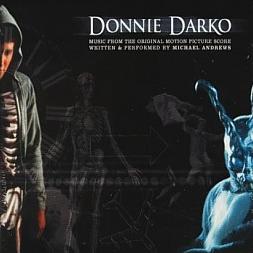
Donnie Darko, starring Jake Gyllenhaal, Jena Malone and Patrick Swayze is an edgy,complex, psychological thriller about a suburban American teen dealing with the pressures of modern life and psychosis inducing anti-depressants. As well as being a masterpiece of modern cinema, Donnie Darko is also an excellent example of modern tragedy, as defined by Northrop Frye's Modal theory.
Firstly, the movie takes place in the month of October, a subtle (though not necessarily intentional) link to the Modal theory in which Tragedy is connected to autumn. Secondly, Donnie Darko fits perfectly into the modern "tragic hero" description, he is a regular, upper-middle class teenager who is intelligent and relatively personable, if somewhat antisocial. His only weakness (or "tragic flaw" if you will...) is his dependence on anti-depressants, which make him moody and distant from his family. It is assumed that his medication is what causes him to see "Frank", his imaginary friend in a bunny costume that eventually leads him to his downfall. The real main conflict in the film is that between Donnie and his psychosis (though there are many other antagonistic characters throughout the story), or between Donnie and fate (depending on one's interpretation). It is this conflict that Donnie cannot emerge from victorious, as proven by his alternate-reality death at the end of the film. It is also this conflict that makes the film tragic, Donnie cannot escape the fate prophesized by Frank, who tells him that his world will end in 28 days.
Donnie Darko certainly questions the nature of human existence, in its exploration of reality versus perception, time travel and destiny. The convoluted parallel universe structure can be interpreted as entirely invented by the chemically-scarred Donnie or as an actual tear in the space-time continuum that allows Donnie to actually change the past and alter...
Reviews of: "Tragedy Writing - Donnie Darko as an illustation of the tragic mode."
:
More Genre Study
essays:
What do you think makes Indian film Indian? Write an essay on the distinctive narrative traits in Indian cinema which distinguishes it from European or American films you have seen.
... of costumes and elaborate sets used within the Indian film industry. First I will briefly consider some traits associated with American and European cinema as to see how these cinema types ... Indian woman. The Vamp The vamp in Indian film is modern and imitates western women and is usually more of an ...
Analysis of the Psycho-Thriller genre with particular reference to Basic Instinct, Fatal Attraction and Single White Female
... the modern Psycho Thriller. Hitchcock works on the aspects of delaying what we know is going to happen. Thriller films are mainly sadomasochistic; a psychological thriller bases ...
An indepth analysis of the Gothic Film's Saw, Nosferatu and Young Frankenstein. Analysing context, technique and form.
... that the following characteristically Gothic elements can be extrapolated: The Psychological Gothic, Physical isolation and entrapment, the tragic antagonist, moral messages, withholding of information, and use of the ...
Why Spaghetti Westerns Should Simply Be Westerns: An analysis of the Western Genre using examples from "The Searchers" and "For a Few Dollars More"
... conflict of civilization vs. wilderness, and turned their attention to psychological Westerns like For a Few Dollars More that focused on more personalized conflicts like Indio?s (Gian Maria Volonte) obsession over the ...
How do any of the film-makers that you have seen, during the course of this module, make the cinema itself, their primary subject of investigation.
... placed within the context of art history, and more specifically modernism. Michael Snow is one of the best film-makers in ... s mind, as an expression of an emotion, through an imaginary cinematic space, etc.) In addition, the many textural changes that ...
Genre study: film noir
... Staiger, Janet. Interpreting Films: Studies in the Historical Reception of American Cinema. Princeton: Princeton Univ. Press, 1992. Schrader, Paul. "Notes on Film ... in a favorable review sees Odds as an example of modern film noir in the tradition of Chinatown, True Confessions, and ...
An essay about the science fiction film genre.
... created by humans turned against and enslaved them. Much of modern science fiction deals with philosophy and psychology. The Matrix Revolutions (2003) is an extreme example of how ...
A critical reading of the western, referring to Jim Kitses "Notes on the Western"
... the genre itself that is more important, the idea of American tradition and history being much more important than the personal touches directors bring to the films. This is somewhat disagreeable ...
Very good
great analysis, as well as a tight grip on the English language
0 out of 0 people found this comment useful.