The transport industry occupies an important position in the Community, accounting for 7 % of its GNP, 7 % of total employment, 40 % of Member States' investment and 30 % of Community energy consumption. Demand, particularly in intra-Community traffic, has grown more or less constantly for the last 20 years, by 2.3 % a year for goods and 3.1 % for passengers.
The advent of the single market marked a turning point in the common transport policy, since the abolition of frontiers and other liberalization measures. Of course in those measures the liberalization of cabotage was also included. But the liberalization of transport has taken various constraints into account:
*A social constraint, so that the freedom to provide services does not result in the strictest national legislation being bypassed. Liberalization of services has therefore been accompanied by harmonization of social conditions, of the rules governing the provision of services and of qualifications;
*An economic constraint, so that investment in infrastructure is not exploited by transport undertakings which play no part in their financing: this is of particular concern to the road transport sector.
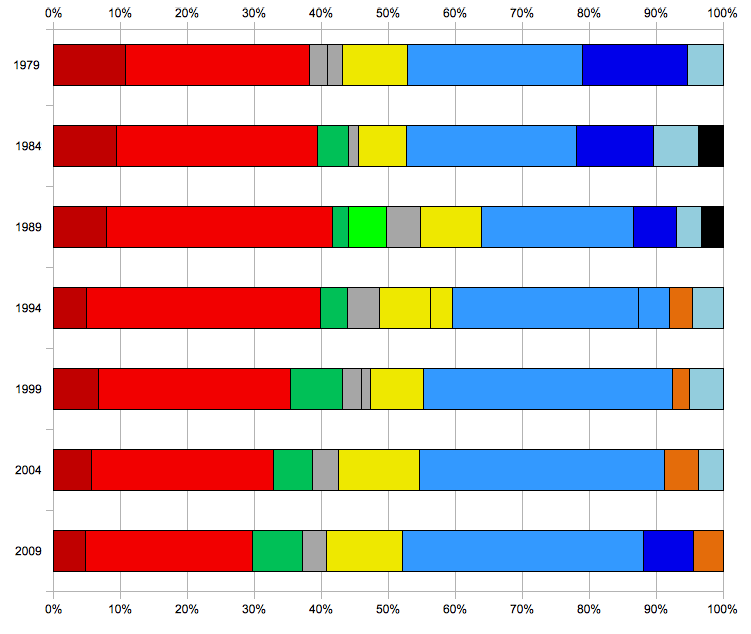 Election results since 1979
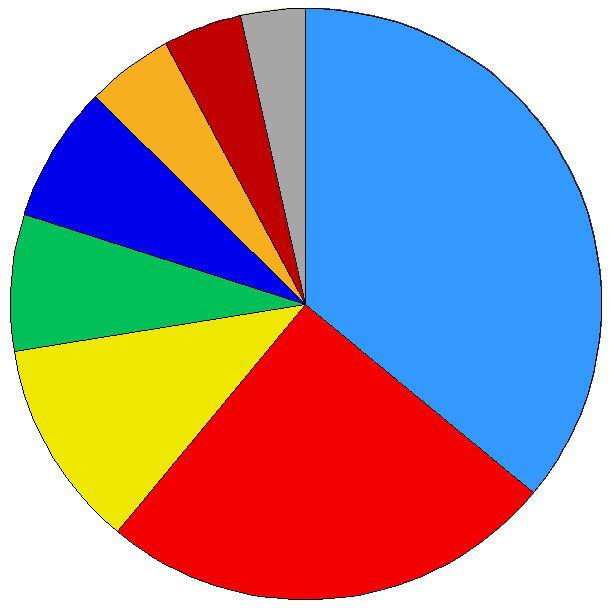 Political composition of the 7th parliament
 European flag outside the Commission
Measures should also be taken to make sure that the way rail transport is organized does not perpetuate the current fragmented state of this form of transport;
*a route-guarantee constraint, so that the introduction of new factors of competition does not put in doubt the continuity of transport links between peripheral (island) and central (mainland) areas.
The measures that had already been taken on transport liberalization have been adapted, in the way that they were applied, to the specific nature of each mode of transport. The common aim for each mode was to proceed from the provision of an international service (between two Member States) to cabotage (transport in another Member State).
First we are going to examine the carriage of goods by road. More specifically from 1 January 1993, a haulier established in a Member State of the Community may freely transport goods to another Member State. Until this date, such an operation would require special authorization in application of bilateral agreements or Community quotas, from that date on, the right to conduct this business was based on quality conditions, which transport operators must observe and which entitle them to receive a Community transport licence. However, such transnational activity must not result in serious disruption to the transport market and, for that reason, the Council introduced a surveillance system offering a safeguard mechanism against market disruption. In a single market, a haulage operator should also be able to carry out transport in another Member State (cabotage). This natural progression has given rise to fears of distortion of competition. For that reason the system of cabotage has been introduced gradually since 1 July 1990 in the form of progressive Community quotas and will come into force on 1 July 1998. The liberalization of the cabotage system was accompanied by the adoption of supporting arrangements on motorway taxes, thus allowing use of the infrastructure to be subject to taxation, but on a non-discriminatory basis.
In the resolutions of 24 October 1994 and 19 June 1995, the Council introduced the need to pursue completion of the internal market in this sector, as far as the removal of quantitative restrictions on market access and of price regulations is concerned. They also argued that a liberalized internal market requires harmonization of the conditions essential for fair competition and their more or less uniform application and enforcement.
From the other side we also have and the carriage of passengers by road. The passenger services from one Member State to another were free of constraints, the Community legislation made no provision for operators from one Member State to provide transport services in another Member State. More specifically the Council ,so as to apply the principle of the freedom to provide transport services, and following the Court of Justice's annulment of Regulation (EEC) 2454/92, adopted a new Regulation on cabotage . This Regulation defined the various types of passenger transport for which cabotage was possible and also announced the liberalisation of special and occasional regular services and other regular services in June 1999. Moreover in order to harmonise the conditions of competition for the carriage of goods and passengers by road, since the 1970s the Community took a series of measures to harmonise the conditions for admission to the occupation of national and international road haulage operator and to allow effective freedom of establishment for such operators. Also the Community had already taken, and will continue to take, certain measures in order to improve road safety.
Rail transport is also very important. The Community wishes to make it easier for the Community's railways to adapt to the demands of the single market and to make them more efficient. To help achieve this, it has proposed introducing an operating licence to provide uniform access to infrastructure and has established a system for ensuring that infrastructure capacity is allocated on a non-discriminatory basis and that users pay the full real cost of the facilities they use. In its White Paper of July 1996 the Commission set out a strategy to revitalise the Community's railways, notably by rationalising their financial situation, ensuring freedom of access to all traffic and public services and promoting the integration of national systems and social aspects. It has also legislated to ensure safety in the carriage of dangerous goods by rail.
After rail transport we have also the maritime transport which is by definition a liberalized activity. If it were not, nobody would benefit from the role this mode of transport plays in international trade. Only since 1 January 1993 that cabotage by sea started to be phased in, as agreed in 1992. The introduction of cabotage and the need for the Community to help improve the conditions for international maritime transport have resulted in the adoption of measures relating to competition policy, to the prevention of unfair pricing practices, to standards for ships engaged in the transport of dangerous goods and to working conditions. The conditions governing admission to the occupation have also been defined. The Community is also adopting legislation on maritime safety. As in the case of road and rail transport, the carriage of dangerous goods is one of the main causes for concern. In its communication of 13 March 1996, approved by the Council on 13 December of the same year, the Commission reiterated three priorities in the development of maritime policies: safety, maintenance of open markets and enhanced competitiveness.
In the field of the inland waterway transport, it benefited from the liberalisation of cabotage since 1 January 1993, the main effect of that was the end of the rota system which prevented companies employing these services from having a free choice of carrier.
The Community policy on liberalising air transport covered four main areas: market access, capacity control, fares and the issue of operating licences for companies. It was launched in 1980 and had been implemented in three stages, with Stage 3, the third air transport package, coming into force on 1 January 1993. A transitional period was laid down for air cabotage, which became reality only on 1 April 1997. The cornerstones of this process were:
*the introduction of a single air transport licence issued to air transport undertakings established in the Community;
*conditions for access to routes within the Community for air carriers;
*passenger fares including ways for the Commission to intervene directly in case of unfair pricing (predatory practices);
*freight services.
Liberalisation leaded to the creation of a genuine single market for air transport, so the Community harmonised many rules and Regulations for all airlines. In particular it had laid down technical standards and administrative procedures for fixing common standards for the airworthiness of aircraft, and had legislated on the mutual recognition of licences for people working in the civil aviation industry, allowing pilots to be recruited directly from any Member State. Lastly, the Community has laid down the procedures for applying competition rules to air carriers and to various types of agreement and concerted practice. Air safety is a further matter of concern to the Community, which had adopted a Directive laying down the ground rules for enquiries into air incidents in civil aviation. Lastly, in the White Paper "Freeing Europe's Airspace", the Commission advocates introducing a unified system of air traffic management.
After having analyzed all transport infrastructures it would be very useful to observe two comparison boards of those transport infrastructures in EU (European Union } and CES {Central European Countries} areas:
As we can see from 1990 to 2000 the total length of motorways increased by 26%, but only around 5% of total corresponds to the CEC. The relative share of transport infrastructure is higher in the CEC when it comes to the rail network. The share here is around 30% of the combined total for EU plus CEC. The total length of the inland waterway network for the CEC is less than 25% of that of the EU. For maritime freight transport the top 10 ports in the EU handle more than 5 times the total of the top 10 ports in the CEC.
From the following board we can have a clear image of the transport infrastructures with statistical information about every country more specifically:
According to the specific board in the EU three countries have the largest railway network, namely Germany, France and the United Kingdom. Concerning the motorway network, again Germany and France are in first and second position followed by Spain and Italy. As far as inland waterways are concerned, Germany, Finland, France and the Netherlands have much larger networks than most of the other countries.
Before summing up a quick view to the action programme of the EU shows us that the transport policy action programme sets out initiatives in three fundamental areas:
*improving quality by developing integrated transport systems based on advanced technologies which also contribute to environmental and safety objectives;
*improving the functioning of the single market in order to promote efficiency, choice and user-friendly provision of transport services while safeguarding social standards;
*broadening the external dimension by improving transport links between the European Union and third countries and promoting the access of EU operators to transport markets in other parts of the world.
Moreover, aware of the need to take action on infrastructure charges and the external costs of the various transport modes, the Commission had also submitted a Green Paper on fair pricing in transport. This paper aimed to improve the balance between road and other modes of transport by considering how the costs arising from pollution, congestion and accidents can be better taken into account when calculating transport costs.
To sum up nowadays, Member States continue to operate a system of reciprocal bilateral transport agreements with third countries, and this is likely to create substantial distortion. Initiatives in this area include the conclusion of the Council's work on mandates for establishing road and air transport links with the countries of Central and Eastern Europe, the follow-up to the mandate for air transport negotiations with the USA and action on shipping. The Commission from its position tries by taking actions to give the European Union a more prominent role within international transport organizations.
Transportation in the EU...
A technically and fundamentally sound piece.
The material presented in this paper is of good quality, making for good research material.
Good Job.
2 out of 2 people found this comment useful.