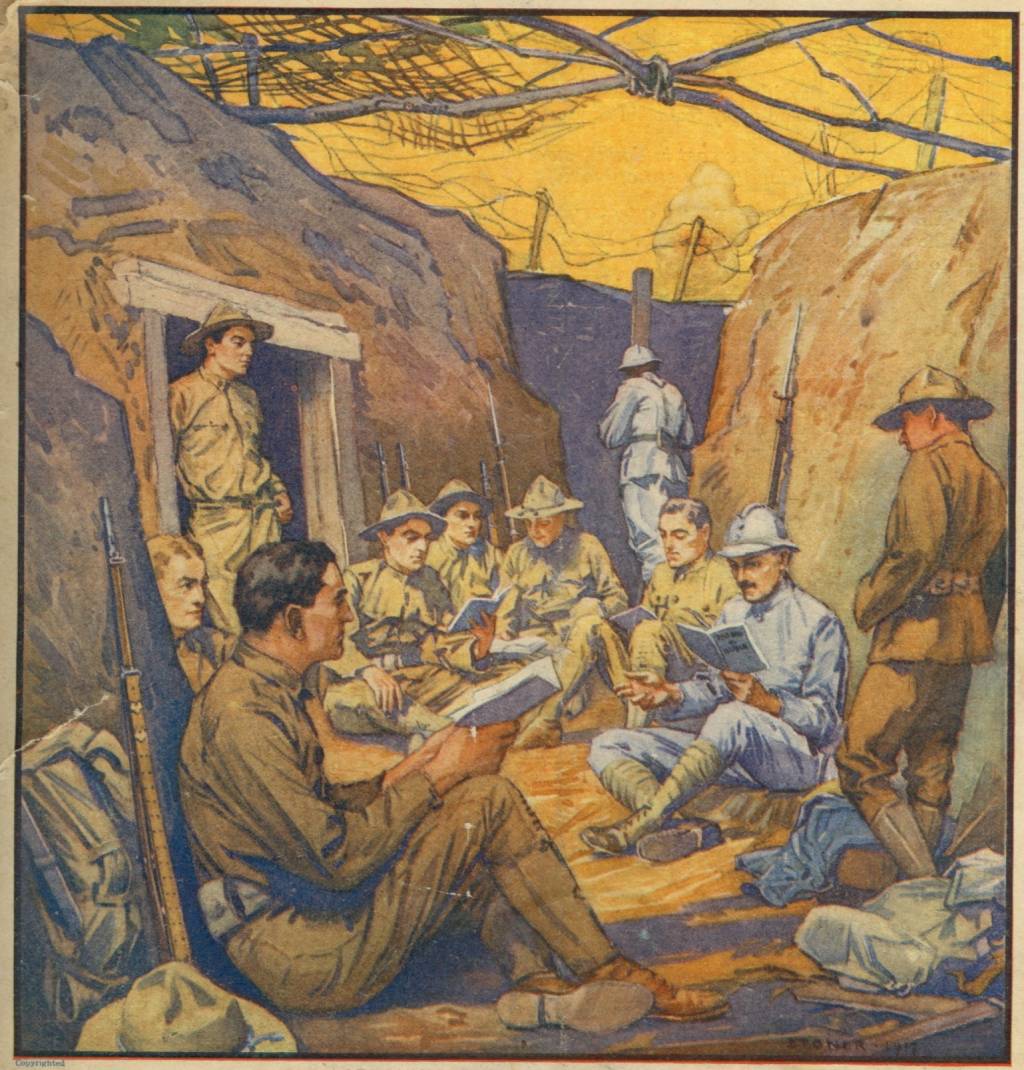
Trench Warfare: Characteristics of Life in the Trenches, and how propaganda played a role in trench warfare
World War One was a horrific event. The number of known dead has been placed at about 10,000,000 men. The main method of combat during the first world war a.k.a. the Great World War, was trench warfare. Trench warfare was one of the main reasons so many men died. It was a ruthless system of warfare, in which lines and lines of men were repeatedly mowed down, one after the other.
Life in the trenches, on the daily, was filled with horror, and death. Death was a constant companion to those serving in the line, even when no raid or attack was launched or defended against. In busy sectors the constant shellfire directed by the enemy brought random death, whether their victims were lounging in a trench or lying in a dugout (many men were buried as a consequence of large shell-bursts). Similarly, novices were cautioned against their natural inclination to peer over the parapet of the trench into no man's land. Many men died on their first day in the trenches as a consequence of a precisely aimed sniper's bullet. It has been estimated that up to one third of allied casualties on the Western Front were actually sustained in the trenches. Aside from enemy injuries, disease wrought a heavy toll.
The trenches were also a place full of disease, a part played largely by the rats.
Rats in their millions infested trenches. There were two main types, the brown and the black rat. Both were despised but the brown rat was especially feared. Gorging themselves on human remains, they could grow to the size of a cat.
Men, exasperated and afraid of these rats, would attempt to rid the trenches of them by various methods: gunfire, with the bayonet, and even by clubbing them to death.
Rats were...
Reviews of: "Trench Warfare: Characteristics of Life in the Trenches, and how propaganda played a role in trench warfare"
:
More World War I
essays:
Why did some men desert and refuse to obey orders in the Western Front, and were they treated too harshly? Looks at the results of shell shock and punishments in the trenches.
... to the same degree as life in the trenches. The soldiers would have seen the real terrors of war, witnessed the death and seen others around them break down in fear. The Generals ...
"Life in the Trenches" This essay gives a description of life in the trenches in WW1 and talks about how the government prevented the public from knowing the truth about the conditions.
... daily life for a soldier in the trenches. After the war was over there were many accounts from soldiers of the appalling conditions and the amount of death that occurred in the trenches. It was estimated that up to one third ...
Was Germany primarily responsible for the outbreak of the Great War?
... Themes in Modern European History 1890-1945', London 1992 Joll, James. 'Europe since 1870: an International History' 4th ed. England 1990. Joll, James. 'The origins of the First World War', London ...
World War 1: German Guilt.
... yet in this context, it is obvious that no one body can take sole responsibility for the events pre-cursive to the First World War. This ...
essay concerning the causes of world war one
... The First World War (London: Pimlico, 1999) KEIGER, J., France and the Origins of the World War (London: McMillan, 1983) WEHLER, H-U., The German Empire 1871-1918 (1985) WILSON, K., 'European Diplomacy 1871-1914', in PUGH, M, ed, A Companion ...
WW1 notes based on yr12 N.S.W syllabus.
... if the enemy got in shrapnel would hit walls not people, bullets would hit walls not people as well. Life in the trenches *3 ... enter the war. I t was targeted at unmarried men and gave the government an idea of how many men they had to work with if the war was ...
Essay on world war one.
... of the First World War, in the summer and early fall of 1914, German troops poured across neutral Belgium and into France behind the thunder of artillery, the lightning ...
How did the War change attitudes about how big a part a government should play in people's lives?
... and the First World War" John Turner (ed), (London, Unwin Hyman, 1988) J.M. Bourne "Britain and The Great War 1914/1918" (London, Edward Arnold, l989) A.L. Bowley, "Some Economic Consequences of the War" 1930 in Alan ...
Good essay
A nice tone to the essay with an emotional charge. The movie quote at the end should be explained. Some minor informalities in language use.
4 out of 4 people found this comment useful.