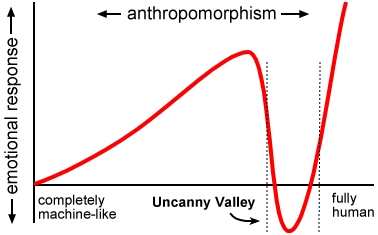
The uncanny, by Freud.
The uncanny is the subject of aesthetics because it has to do with a certain kind of feeling or sensation with emotional impulses. But in general aesthetics has neglected to study the uncanny, preferring to concentrate on beauty and generally on more positive emotions such as: the attractive, the sublime...etc. The uncanny is something fearful and frightening, and such as it has been neglected in the history of aesthetics. Freud will wed psychoanalytic and aesthetics modes of thought to develop his theory of the uncanny.
What is the uncanny?
Freud's definition = uncanny as the class of frightening things that leads us back to what is known and familiar.
Jentsch's conclusions:
1)Uncanny = fear of the unfamiliar
2)Uncanny = based on intellectual uncertainty
Freud will take issue with both of these cases.
The study of the German words, heimlich and unheimlich (homely/ unhomely)
Freud defines heimlich in two different meanings:
1)Heimlich = (a) belonging to the house, friendly, familiar, (b) tame (as in animals), (c) intimate, comfortable.
(a)Belonging to the house or family, or regarded as so belonging.
(b)Of animals: tame, companionable to man as opposed to wild. For example, 'Animals which are neither wild nor heimlich'
(c)Intimate, comfortable; the enjoyment of quiet content, arousing a sense of agreeable restfulness and security as in one within the four walls of his house 'Is it still heimlich to you in your country where strangers are felling your woods?' Many examples are applied on page (932).
2)Heimlich = concealed, secret, withheld from sight and from others; secretive, private. For example, to do something heimlich behind someone's back; to steal away heimlich; heimlich meetings and appointments...etc. Many examples are applied on page (933).
What from the perspective of the one who is "at home" is familiar, is to the outsider, the stranger. The...
More Psychological Theories & Authors
essays:
How useful is psychoanalysis when viewed from feminist perspectives? Identify and discuss the main criticisms that have been made of the work of Freud, as well as the main strengths.
... the history of the discipline but were of the utmost importance in the development and extension of the theory of psychoanalysis. The first individual is Helene Deutsch who, in 1918, became the first woman to join Freud's Vienna Psychoanalytic Society ...
The History of Freud and Psychoanalysis
... Philippe Pinel is also an extremely important precursor in the history of psychoanalysis. Pinel changed the way mentally ill patients were look ...
Freud View On The Nature Of Man
... Nature Is Inherently Bad There are many theories as to Human nature. One of Which exists, under the thoughts of a prominent philosopher, and founder of Psychoanalysis Sigmund Freud. His deductive argument, entails his conclusion that man is bad, or as ...
Psychology: Freud vs Skinner. The application of theorists in clinical practice.
... image of the self (Bethel, 2004). Although Freud's psychoanalytical theory is by no means the only model of the ... individual thought and behavior. He stated that these forces originate in the emotions of childhood ...
An overview of Psychological Theories of Crime
... beginnings of thought on law and society. Early thought operated off of a principle of moral ... major foray into psychology based scientific research was by Sigmund Freud. His psychoanalytic theory was the first complete personality theory while in its ...
Freud's View on Women
... the history of the discipline but were of the utmost importance in the development and extension of the theory. *2 The first individual is Helene Deutsch who, in 1918, became the first woman to join Freud's Vienna Psychoanalytic Society ...
A comparrison of the theories of Carl Rogers and Abraham Maslow.
... school of thought, which is referred to as Humanistic. Such an approach steers away from the idea that man is a robot, who is the total product of outside ... in psychology (including Freud). Like Carl Rogers, Abraham Maslow is widely regarded as one of the founders of the Humanistic Approach. While ...
Infant Temperament in Context of Evolutionary Theories of Emotion.
... different form Darwin's humble beginnings. Today, Evolutionary theorists believe that emotions are largely innate reactions to certain stimuli. Furthermore, most agree that these reactions developed before higher thought. Because of these two things, evolution has given humans a genetic code ...