The Unholy church. Who and how does Geoffrey Chaucer satirize in the Canterbury Tales and what is his opinion on the Church?
Religion in England during the fourteenth century was a dominant part of society and people's lives. Through The Canterbury Tales by Geoffrey Chaucer, people can try to comprehend what the people of England were like and how they lived their daily lives. Now is where the corruption and foul people of the church come in to play in The Canterbury Tales there are many religious characters: Monk, Friar, Pardoner, Nun, Prioress - the list continues on. Chaucer tells readers about the characters and how they live corrupt, lavish, extravagant, fraudulent lifestyles. The vast majority of clergy members, according to Chaucer, were corrupt and untrue to their vows.
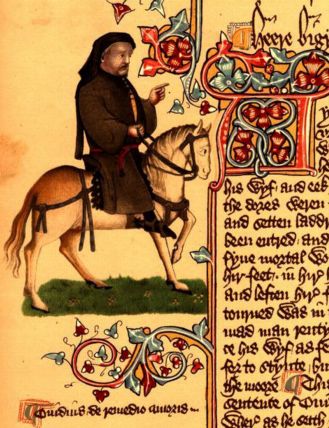
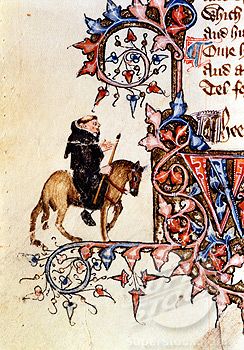
The first of these characters is the Monk; a man who one must remember has vowed to lead a life of poverty, chastity and obedience. It can immediately be seen that Chaucer is not partial to the Church and the clergy. The first two lines set the scene for the portrait; Chaucer starts by telling the reader that the Monk outshines all other monks "a fair for the maistrie" (165), this at first appears complimentary, though when one reads on one discovers that this monk outshines the other monks in his negligence of his duty to God. This "exceptional" monk is in fact a gluttonous, self-centered man, who would rather concentrate on hunting, for he "lovede venerie" (166), and increasing his chances of a career promotion. He also appears to contradict all of the aforesaid vows, for example his 'venerie' is not only hunting, an indulgent pursuit of a man certainly not living in poverty and obedience, but it is also an image of wealth. Chaucer tells us that this monk is the owner of a fine horse and when he is riding passers-by can hear the chapel bells and the bells on...
More "Canterbury Tales" by Geoffrey Chaucher
essays:
Whether or not Geoffrey Chaucer intended to retract "The Pardoner's Tale" in THE CANTERBURY TALES.
... I have chosen to read "The Pardoner's Tale," from The Canterbury Tales (294-392), by Geoffrey Chaucer. In the following, I will discuss the tale and give you my opinion on why I think Chaucer did not intend to retract ...
THE PRETENTIOUS AND THE PRECOCIOUS: The Canterbury Tales, Geoffrey Chaucer; Analysis of Monk and Oxford Cleric
... Geoffrey Chaucer's The Canterbury Tales proves his most famous work; it is indeed one of the most acclaimed works written during the Middle Ages. Authored in late fourteenth century England, The Canterbury Tales is a compilation of tales which ...
Discuss the Treatment of Fin' amors in Chaucer's Work.(Geoffrey Chaucer: The Canterbury Tales)
... 1988) Chaucer, Geoffrey, 'The Canterbury Tales', in The Riverside Chaucer, ed Larry D. Benson (Oxford: Oxford University Press,1988) Chaucer, Geoffrey, The Miller's Prologue and Tale, ed ...
Analysis of the knight the plowman and the physician in The Cantebury Tales by Geoffrey Chaucer
... Greedy Geoffrey Chaucer's classic, The Canterbury Tales, has great characters in it, which have modern day counterparts. In this poem, all of the characters stand ... and ethical, the Plowman differs very little from his devoted religious brother, since the Plowman "loved God best with all his ...
Fate in The Canterbury Tales: A Contemporary Discussion
... ideals. Geoffrey Chaucer's ideas are contemporary and centuries ahead of the time that he wrote The Canterbury Tales (Mr. Thorn's class lecture). He uses three characters to show three different ways to interpret the role of destiny. Because religion ...
The Canterbury Tales--Geoffrey Chaucer.....explains how Chaucer says that the Medeival Church is corrupt
... In The Canterbury Tales, Chaucer paints an interesting picture of the medieval church. The Christian ...
Humanity's ability to act foolish, a theme in "The Pardoner's Tale" from Chaucer's "The Canterbury tales"
... the corrupt clergy of Geoffrey Chaucer's time, selling indulgences, or the corrupt televangelists of today, auctioning off salvation to those who can afford it, this truth never seems to lose its validity. In Chaucer's famous work The Canterbury Tales ...
Geoffrey Chaucer and his "Canterbury Tales", a collection of twenty-four stories told by various people who are going on a religious pilgrimage to Canterbury Cathedral from London, England
... religious pilgrimage to Canterbury Cathedral from London, England (Kane 44). Prior to the actual tales, however, Chaucer offers the reader a glimpse of fourteenth century life by way of the General Prologue. In this prologue, Chaucer introduces all of the characters ...