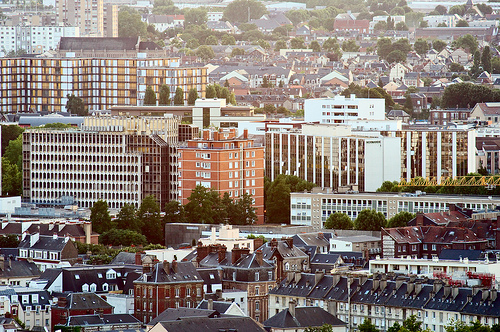
Urbanization of the Late Nineteenth Century
Rapid urbanization began in the 1870s as people flocked to the cities. These urban centers quickly overcrowded, and many were divided into business, residential, social and ethnic centers. Among this chaos, corruption thrived as political bosses ran the city for their own personal gain and power. It appeared as if the nation was modernizing too fast because they were unable to deal with problems of urbanization. The changes in urban America in the late nineteenth century therefore are viewed to be mostly negative.
The rapid increase of urbanization was partly due to the number of immigrants that flooded America. People from rural America also migrated to the cities during this period. They gave up farms to move to cities, hoping to make a better life. Most of all, the cities owed most of their population growth to the expansion of industry. As industry kept flourishing, more workers were needed. These jobs provided long and hard work for low wages to desperate immigrants. Conditions were horrible in the industry world and corrupt political officials were the only people who benefited, which was what separated the rich from the poor entirely in American society.

Jacob Riis was a social reformer who wrote a book that described the conditions of immigrant ghettos in New York City. He wanted to reform tenement housing and schools. He viewed the urbanization conditions for immigrants negatively. He described the tenements as rundown, filthy, and very overcrowded. In addition to the horrible conditions, the crime rate grew in those slums and many people became immoral.
Another problem that faced the cities was the traditional laissez-faire. Richard T. Ely opposed it because he believed that government interference in national economics was not harmful but helpful sometimes. He believed that turning away from the government completely had only harmed the...
More North American History
essays:
Developments in transportation, rather than in manufacturing and agriculture, sparked American economic growth in the first half of the nineteenth century. Assess the validity of this statement.
... economic growth in the first half of the nineteenth century. The cotton gin was just one of the few reasons in which the American economy grew at a rapid pace ...
THE MAIN CAUSES OF THE GREAT DEPRESSION BY PAUL ALEXANDER GUSMORINO THE THIRD
... more than that. The automobile had been central to the urbanization of the country in the 1920's because so many ... worker increased 32% in manufacturing8. During that same period of time average wages for manufacturing jobs increased only 8%9. Thus wages increased at ...
Were the industrial leaders of the early 20th century robber barrons?
... regulation led to unsafe and unhealthy work sites. In the late nineteenth century, more industrial accidents occurred in the United States than in ... and job instability. During economic recessions, many workers lost their jobs or faced sharp pay cuts (History Research Center, 1 ...
Causes of The Great Depression.
... more than that. The automobile had been central to the urbanization of the country in the 1920's because so many ... worker increased 32% in manufacturing(end note 8). During that same period of time average wages for manufacturing jobs increased only 8%(end note 9). Thus wages increased at ...
In The Significance of the Frontier in American History Frederick Jackson Turner says that there are certain traits of the west that influenced in the past and still do.
... attract population to the land thus, increasing its value. This was done in several ways one example was the, "head right" system which gave a certain amount of land to those who completed the journey to America through ...
In Search of the American Cowboy.
... 1850s and 1860s, eastern journalists and dime novels began shaping America's cowboy mythology. Literature portrayed the West as a place free from the corruption of civilization, and the frontiersman as "a kind of mythic ...
This is from a DBQ: Despite being settled by people of English origin, a difference in the development of the New England and Chesapeake regions occurred by 1700.
... America, Winthrop asserted, "we shall be as a city upon a hill the eyes of the people upon us." Winthrop visualized a community in which each person ...
In-Depth Analysis of the Unification of the American Colonies
... stratification increased significantly as immigrants began heading to America. The ...