US Dollar Domination Has To Go.
US Dollar Domination Has To Go
There is an economics-textbook myth that foreign-exchange rates are determined by supply and demand based on market fundamentals. Economics tends to dismiss socio-political factors that shape market fundamentals that affect supply and demand. The current international finance architecture is based on the United States' dollar as the dominant reserve currency. According to the Bureau of Public Debt "it accounts for 68 percent of global currency reserves, up from 51 percent a decade ago. Yet in 2000, the US share of global exports (US $781.1 billon out of a world total of $6.2 trillion) was only 12.3 percent and its share of global imports ($1.257 trillion out of a world total of $6.65 trillion) was 18.9 percent. World merchandise exports per capita amounted to $1,094 in 2000, while 30 percent of the world's population lived on less than $1 a day, about one-third of per capita export value" (Bureau of Public Debt Online).

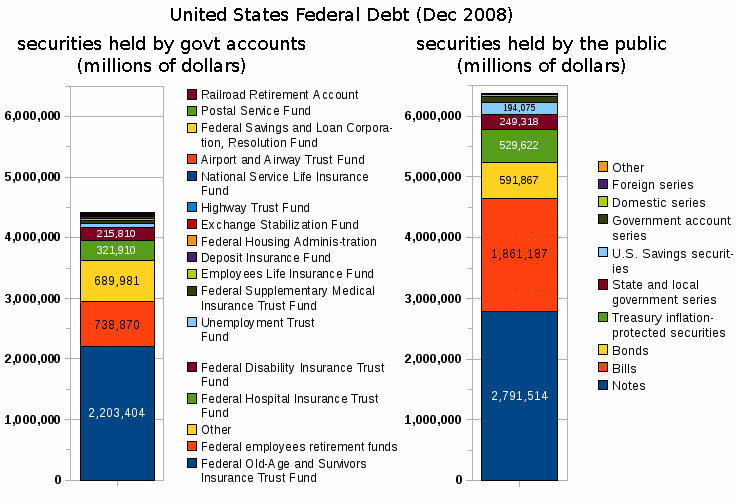
Ever since 1971 when president Richard Nixon took the dollar off the gold standard, the dollar has been a global monetary tool that the United States, and only the United States, can produce by fiat. The dollar is now a fiat currency. A flit currency is defined as a type of currency whose only value is that a government made a decreed that the money is a legal method of exchange (Wikipedia). The dollar is at a sixteen-year trade weighted high despite record US current-account deficits and the status of the US as the leading debtor nation. The United States national debt as of August 29, 2003 was $6.783 trillion against a gross domestic product of $9 trillion (Bureau of Public Debt).
World trade is now a game in which the US produces dollars and the rest of the world produces things...
More Economics
essays:
Supply and Demand Simulation
... the economic conditions of the society around it. The prices and quantity supplied adjusted according to the factors affecting the supply and demand. If ...
Supply and Demand Simulation
... Applying Supply and Demand Concepts. Retrieved May 18, 2006, from University of Phoenix, rEsource, Simulation, ECO360 - Economics for ...
Impact of Euro on Foreign Exchange rate risk
... 2003), International Financial Management, 7th Edition, Mason, Ohio : Thomson/South-Western. Laurence S. Copeland (2005), Exchange rates and international finance, 4th ...
Explain why supply and demand curves shift and how shifts cause changes in the market price
... given supply and demand curve for a certain good or service. This occurs when there is perfect competition in a perfectly competitive market. This is where the market is ...
Distinguish between an extension and a contraction and an increase and a decrease in supply and demand. What factors may cause such changes?
... a chart this is represented when the supply and demand curves intersect at the point where supply and demand are equal. The price at ... position and shape of the demand curve; such as the price of the product and tastes and preferences. The influences of the factors affecting demand on market demand are ...
Gasoline Prices and the Effect on the Supply and Demand of Other Goods and Services
... Prices and the Effect on the Supply and Demand of Other Goods and Services "A market force is an economic force that is given relatively free rein by society to work through the market." (Colander, 2004) As supply decreases ...
Supply and Demand – Good Life Property Management ECO 360, Economics for Business I
... apartment market is affected by supply and demand. Decisions regarding supply, demand and market equilibrium require careful consideration. Many factors affect supply and demand such as preference, expectations, income, and rental ...
How exchange rates are determined and their impact on the Australian economy
... the currency to increase demand and stabilise the price of the currency. In both these cases, the Reserve Bank attempts to maintain a healthy Australian currency by adjusting the supply and demand curve ...