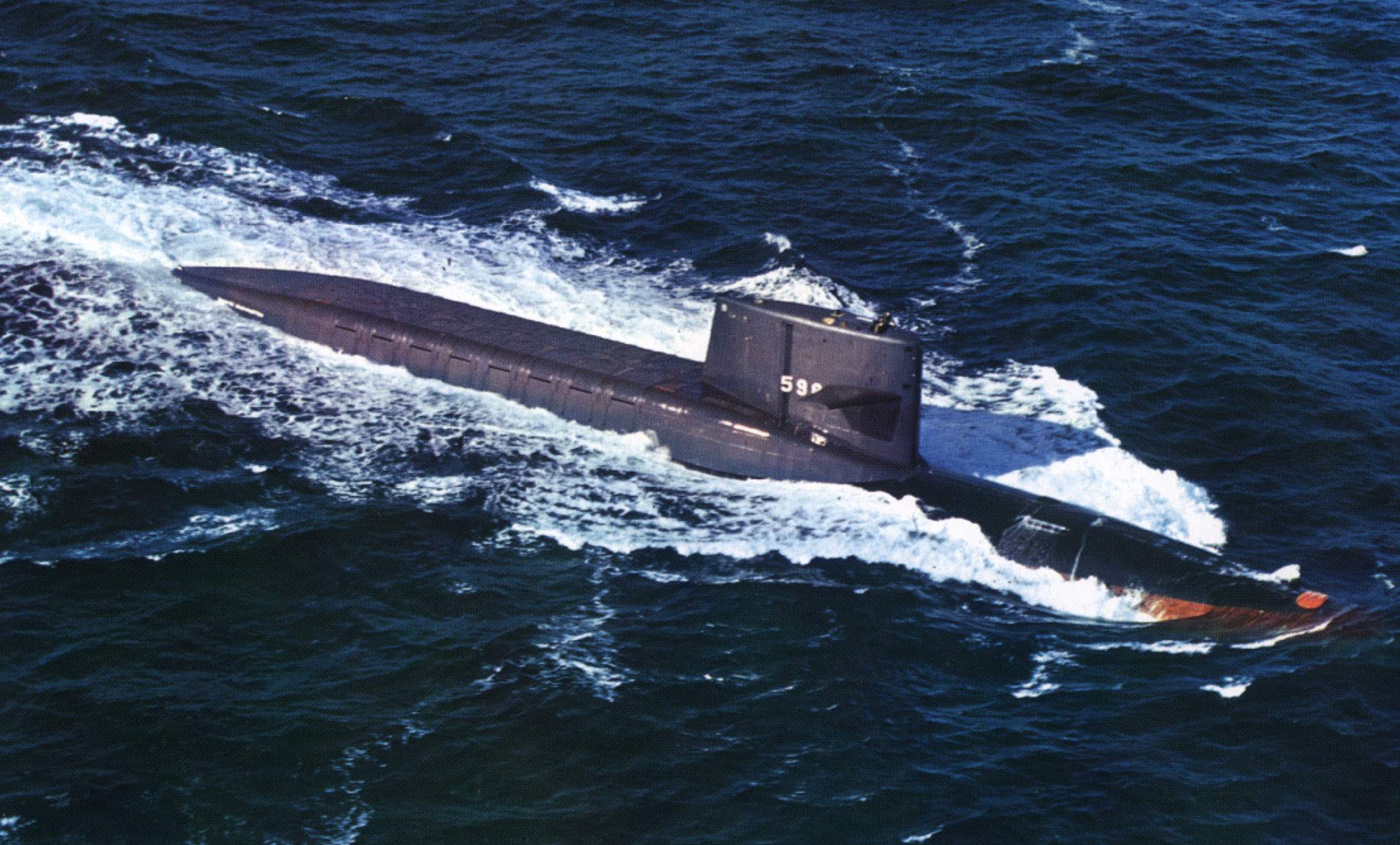
The USS George Washington (SSBN-598):Ballistic Missile Class Submarine
The USS George Washington (SSBN-598) was the lead ship of her class, and the first American ballistic missile submarine. The history of how this submarine came to be is quite interesting as it was originally intended to be a fast attack sub called a Skipjack. President Dwight Eisenhower signed for three ballistic missile submarines, and so the Scorpion (SSN-589) Skipjack was reconstructed by placing a 130 foot missile compartment in the middle (between the control navigation room, and the nuclear reactor compartment) and redoing the hull. From then on, it was dubbed the USS George Washington (the 2nd ship in the US to be named after our first president).
Her keel was laid down by the Electric Boat Division of General Dynamics in Groton, Connecticut in 1957. The sub has a length of about 382 feet and is driven by a S5W nuclear reactor. It weighs approximately 5959 tons surfaced, and 6709 tons submerged. It is crewed of 12 officers and 100 men, and its armaments consist of six 21-inch torpedo tubes and 16 Polaris missiles (submarine launched ballistic missiles). Her first mission was a missile test in 1960 in which, standing out in the Atlantic, successfully launched the first Polaris missile from a submerged submarine and in a message from the commanding officer to President Eisenhower "POLARIS - FROM OUT OF THE DEEP TO TARGET. PERFECT."
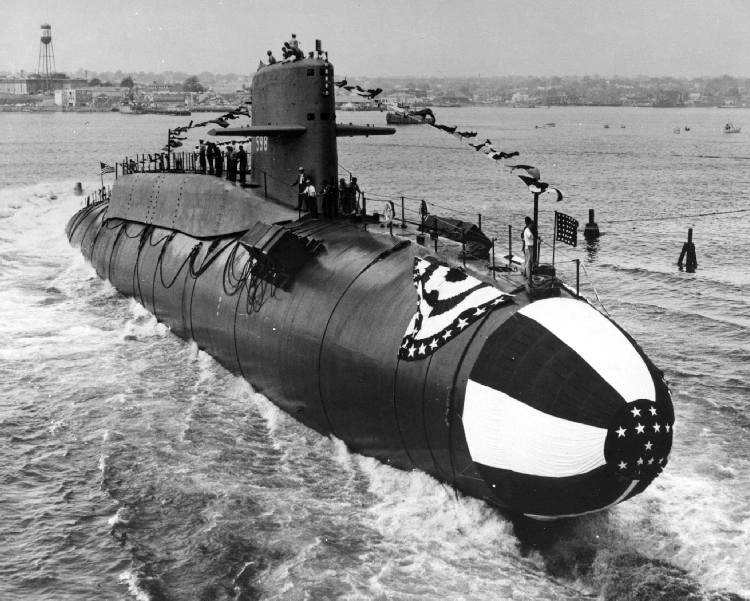
It launched three more test missiles before loading up her full complement of 16 Polaris Missiles, after which the ship was awarded the Navy Unit Commendation and she embarked on her first deterrent patrol. She completed patrols regularly until in 1980 SALT talks imposed limitations, and the missiles were removed, and ship was reclassified as an attack submarine. In 1981 she was shifted to the Pacific
In the Pacific however, the sub encountered...
More Engineering
essays:
The Airship, the ever-popular and ever-living king of the sky
... became useful for aerial observation, coastal patrol, convoying, and locating enemy submarines and mines, because of their abilities to hover over a ... Charles Renard and Arthur Krebs. It was driven by an electrically rotated propeller. The Brazilian aeronaut Alberto Santos-Dumont developed a series ...
Engineering processes in the wake of a catastrophe.
... turmoil. Though the immediate effect was upon those in New York and Washington, it soon became apparent how the effect has rippled thought the country, ... also need to make decisions based on areas that they have no control over, such as overall airport security. According to Bender (2001, p.36), ...
All about Civil Engineering.
... buildings of all types, bridges and specialized structures (power plants, nuclear reactors, television towers and radar facilities.) Wherever concrete, steel, aluminum or ... From the enormous platforms used to launch the Saturn V missile to the moon to the structural and environmental support systems ...
The feasibility of Ocean Thermal Energy Conversion in Australia
... challenge of positioning the system and the attachment of the submarine power cable to the floating plant. In order for floating ... and Buck argues that the rearing of marine organisms under controlled conditions benefits coastal communities by meeting increasing consumer demand for ...
The Application of Science to Engineering. Speaks of the law of electromagnetic induction, the telephone, the development of cement, and the development of steel
... improvement over the mechanical telegraph which required the use of a telescope and was much less effective. It encodes messages electrically, transmits them over facilities such as copper wire, coaxial cable, and fibre optics to their destination where they are decoded ...
Housing for the Homeless Write about applying engineering solutations to real world problems.
Notes: This essay is about using engineering techniques and applying them to a real world situation. I wrote about cost effective production, and inexpensive materials to engineer affordable, portable housing for the homeless. This was for a critical thinking class, called engineering problem ...
Quality What's the definition and how do you measure and improve it.
... areas of the operating system, such as disk I/O, inter-process control, and memory management are tested. The system integration test follows and is ... B being declared to have the better kernel. However, there is still room for improvement and utilizing the third and final approach is how. The ...
The Role of Graphics in Process Control
... to be considered as well. Typically, vessels such as storage tanks, mixers, reactors, distillation columns, heat exchangers, and furnaces are given a cool gray color ... viewed as an operator runs a chemical process from an automated control room. Much thought must be put into the creation of these ...