Utopian Society
Utopia
"Utopias have often been plans of societies functioning mechanically, dead structures conceived by economists, politicians and moralists; but they have also been the living dream of poets." (Marie Louise Berneri)
Utopia is a perfect society where everyone lives in bliss and there are never any problems. Everyone lives a happy and productive life to the fullest. Ruling government and laws are non-existent. No one ever commits crimes because there, it is non-existent. It has never been successful but it has been conceived and attempted. Factors such as society and government are to be considered in creating a utopian society. Whether society or government is more important to the concept of utopia is the question that has yet to be solved.
The word utopia was created by the English writer, Sir Thomas Moore. It is a mix of 2 Greek words, Eutopia (meaning 'good place') and Outopia (meaning 'no place'). It literally means a perfect place that can not exist. For centuries people have tried to perfect it and figure a way to accomplish it. Henry W.Targowski once said, "The word now conjures up the vision of an ideal society." When explaining his thoughts of Utopia and the word itself.
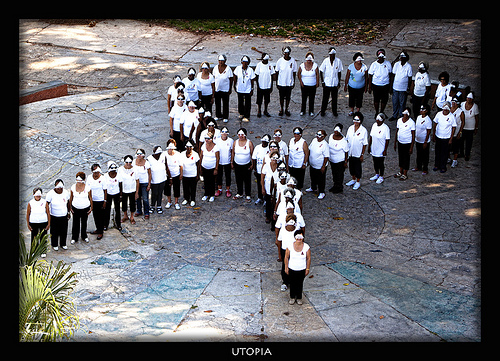
Life in a utopian society is very good and liberal. People have the choice to do anything that they would like. Citizens have assigned jobs after they turn 16 years old, prior to that would consist of education and children's play. People respect childhood and let the children live it to the fullest. All people have total freedom to do what they please. There are no restrictions on drugs and alcohol to anyone at any age. If a person grows up with the substances he/she would be less prone to abusing the substances.
I awoke with the sunrise and the...
More Political Theory
essays:
Thomas Moore's "Utopia" and Machiavelli's "The prince".
... commit crimes while they are still married such as adultery. Thomas Moore not only explained socialism that dealt with these different topics but the social aspects and opinions of the people in Utopia. He analyzed carefully and elaborated on how society ...
"Civil society: a critical view on liberal civil society"
... civil society "gains importance. According to Mary Caldor "civil society is no longer confined to the borders of the territorial state". From that point of view, today, the existence of civil society has ...
"Utopia" by Thomas More.
... languages. "Utopia" (which in Greek means "nowhere") is the name of a non-existent island ... the Utopians like nice smells. To average English people of the Sixteenth Century - living in squalor and misery. But to middle-class people like ourselves, our messy and fragmented society looks ...
Utopia Vs. Dytopia
... of Utopia. Utopia is an ideal place or society in which human beings realize a perfect existence. (Bookrags) The concept of Utopia was originated from Sir Thomas Mores Utopia, which ...
Plato and all about him
... his existence. Instead of developing a structure for a society that is faultless, Aristotle recommended that society should intrinsically attempt to employ the best system that it can accomplish. He felt that a utopia was nonrepresentational and frivolous. A utopian way ...
Karl Marx and the Authorship of communism
... operation, perfect moral commonwealth and sketched laws that would produce utopian societies." Swingewood echoes this sentiment, claiming that before Marx wrote his ...
Discuss the view that understandings of politics are always based on conceptions of human nature.
... particular society. This has led to liberals promoting natural rights and liberty as well as laissez-faire economics (or free market). Through the market mechanism economic life could be sorted out automatically. Competition would allow only the most efficient and productive ...
Karl Marx, A Summary of his Life
... the word "Marxist" to describe those who rely on Marx's conceptual language (e.g. mode of production, class, commodity fetishism) to understand capitalist and other societies, or ...