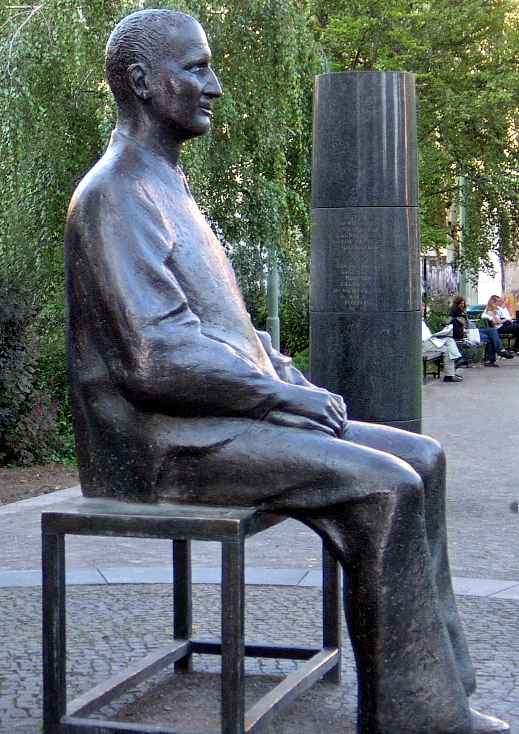
What were Bertolt Brecht's key aims in developing his Epic Theatre? Support your answers with evidence from his plays and theoretical writings.
Brecht's Epic Theatre was a break from the prevailing form of theatre - what Brecht called Dramatic Theatre. Epic theatre was a clearly different type of theatre and Brecht sought to make it popular - taking emphasis away from the dramatic theatre that he hated so. He truly believed that naturalism was unrealistic, as it created an ineffective barrier between the actors and the audience - a fourth wall -that made naturalistic theatre suggestive, not questioning. By defining his epic theatre he created a way to make watching plays a learning experience:
"Today when human character must be understood as the 'totality of all social conditions' the epic form is the only one that can comprehend all the processes, which could serve the drama as materials for a fully representative picture of the world."
Brecht wanted his Epic theatre to challenge the theatre of illusion that naturalism created. He wanted his audience to be alert and awake and to leave the auditorium with a challenge: to try and find the answers that his plays posed. He was so determined that his style of theatre shouldn't be just entertainment that he went to extraordinary measures. In the performances of 'Drums In The Night' banners were placed in the auditorium, which said, "stop that romantic staring" and "every man is best in his own skin". This was to de-romanticise the act of watching - the audience were supposed to observe, not fall into illusion. It was so effective that a critic remarked: "Overnight the 24-year-old poet Bert Brecht has changed the literary face of Germany." Another effect he used to create the observing of the audience was to use a narrator to break up the action. For example in 'The Caucasian Chalk Circle' a narrator is used. This served to distance the...
Reviews of: "What were Bertolt Brecht's key aims in developing his Epic Theatre? Support your answers with evidence from his plays and theoretical writings."
:
More Drama
essays:
Compare and contrast Brecht and Stanislavski's notions of acting and the role of the actor in the theatre
... will. Brechts Epic Theatre used varied means of conveying the verfremdungseffekt. He often had characters speaking in the third person or reading out stage directions. Sometimes he even used masks or makeup on the actors to draw the audience's ...
Compare and contrast Brecht and Stanislavski notions of acting and the role of the actor in the theatre
... will. Brechts Epic Theatre used varied means of conveying the verfremdungseffekt. He often had characters speaking in the third person or reading out stage directions. Sometimes he even used masks or makeup on the actors to draw the audience's ...
Epic Theatre, The Caucasian Chalk Circle, brought to life by German playwright, Bertolt Brecht
... exposing human nature and so had no educational value. He conjectured that his form of theatre was capable of provoking a change in society. Brecht's intention was to encourage the audience to ...
What were the changes in John Proctor's character throughout the play "The Crucible"? ( Arthur Miller)
... . The transition in Proctor's character was a great one, from a cheating man to a man that was true to himself and gained a newfound faith. At the end of the play, John Proctor learned to have more respect for ...
Text from a dramaturge notebook on the play "mother courage and her children" by Bertolt Brecht
... the audience of dramatic theatre it is as though they are looking into a room, the fourth wall of which having been magically been made invisible. However, this illusion is ...
As a designer in a production of Bertolt Brecht's 'Mother Courage and Her Children': "The anti-illusionistic devices in my play arouse curiosity and create understanding."
... epic theatre, Brecht wanted to show the effect of time and wear on objects and materials. I will encourage the actors to be as rough as they like with their costumes in dress rehearsals and onstage, to develop natural wear ...
Kabuki, the Japanese Art vs. Puccini´s Madame Butterfly.
... of the most thematic composers ever, using melodic themes to represent characters, setting, emotion, and ideas. Madama Butterfly imitates the style of ...
How did Henrik Ibsen's work develop in relationship to the conventions of Realist Theatre?
... conditions, Ibsen developed these social and political beliefs and questioned the society about these existing yet avoided problems through his plays. As his ideas correspond with the conventions of realist theatre, he is frequently recognised as a Realist or a Naturalist ...
Brecht's theater
great examples...great ideas that reflect upon who Brecht was and what were his intentions...your explanations expand to a great detail..good effort
0 out of 0 people found this comment useful.