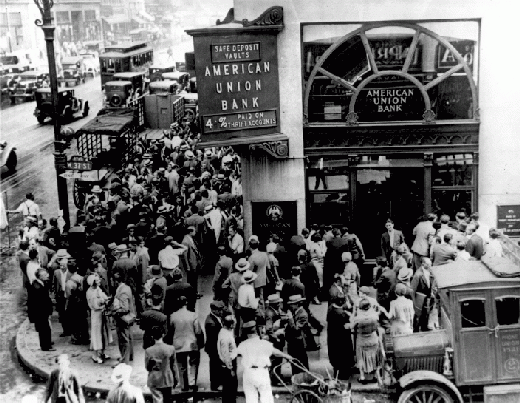
What were the causes & consequences of the Wall Street Crash?
1) The economic boom in the 1920s contributed to the Wall Street Crash. America at the beginning of the 1920s was a rich and prosperous country and improving all the time. America had been relatively unaffected by World War 1, this resulted in the factories of America selling goods to Europe to make huge profits. The people in America had a lot of money, especially those living in the city, which had good jobs. Even the farmers were getting a good income because the country could afford to purchase crops at a high rate. Most Americans were extremely happy and were enjoying their lives in contrast to Europe. They were living the American Dream. This is because most of the Americans had high salaries so they could afford to buy the latest equipment and the newest technologies. This was also the time when the loan and credit dealers began advertising all over the country. Banks also began advertising loans; because many residents were wealthy they could attract more, richer customers to their bank. This made a lot of poorer people jealous in the city and especially the farmers in the countryside. However by 1929 consumer durable industries began producing too much so therefore began losing money. Everyone had bought what they needed for their homes so they didn't buy more of the same goods but the industries continued producing because they thought they could sell their products. However it came as a huge nasty surprise to the factory owners and workers that their products were no longer wanted. This caused the factories to go bankrupt and shut down, which led to job losses and panic all over the stock-market. This is when The Americans knew that their happy lives were in peril.
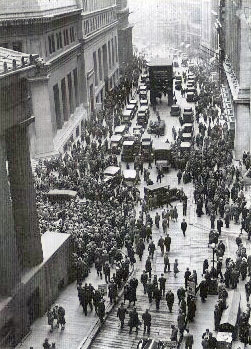
The reason why so many people suffered was...
More Economic History
essays:
The Federal Reserve and Money Supply If "taxation without representation" could rally the colonists against the British Crown in 1776, tight money and ruinous interest rates
... on the daily lives of most Americans in their "pursuit of happiness," of which their economic welfare is a major element. Since World War II, the Federal ...
The causes of current account deficit.
... other countries we have to pay interest rates and these are additions to the original dent, therefore they increase the debt ... balance of payments equipoise; non-submerged exchange rates can liberate economic policy and government allowing concentrating easily on likes internal issues ...
The great depression in terms of macroeconomics
... this time that America became officially involved in the second World War. Was it really WWII that ended the Depression? Ever since June 1938 the country had been on the incline (Carlstrom 3). Prosperity prevailed ...
Cause and Consequences of urbanization in Scotland
... accelerated the population growth (Devine, 1998, p48). The effect of industrialisation was economically good for the country, but with it came poverty. The majority of the working class lived in ...
The Background of Asian financial Crisis
... shock the Latin America and Europe. Also affect the world's top economic American. Until the end of 1999, most of Asian countries started to recover the economic. As early as 1996, the International ...
Labor in America: Growth of the Factory
... During World War II, labor cooperated with government and industry. Its spirit was expressed by John L. Lewis, president of the CIO. 'When the nation is attacked,' he said, 'every American must ...
The Fordist period.
... as the service sector. Building Societies and Banking and Finance and the Travel industry boomed. Computers and microelectronics were not limited to one country and ...
This essay describes the economic political cycles in the United States over the last 50 years in reference to Democratic and Republican parties
... his economic programs helped launched the U.S. into the longest sustained expansion since World War II. Responding to even more urgent demands, he wanted to resume Americas to ...