What were the First Three Mughals Benefiting Indian-Sub Continent With Art, Architecture, And Battle Tactics? Teacher said well written but too long.
The Mughal Empire was a large powerful empire that conquered and ruled most of the higher Indian subcontinent from 1526 to 1858. They originated from Mongolia and had different styles of art, architecture, and battle tactics compared to the south-east of Asia (Lal). Their battle tactics allowed them to conquer most of the southern lands as the fighters there had a very different approach that was not very strong against other styles of battling, while the Mughals used different weapons, such as rifles, and more further spread out battle tactics, which allowed them to defeat their opponents, because the people there did not know how to how to counter the Central Asian fighting style. After the Mughal Empire established itself, the Mughals started to introduce their own art and architecture, which was different from the current styles. The Indian and Mughal styles were beautiful and by combining them, the Mughals started to paint beautiful portraits, build spectacular buildings, and introduce a new style of art and architecture that would go on to change the art and architecture all over Asia.
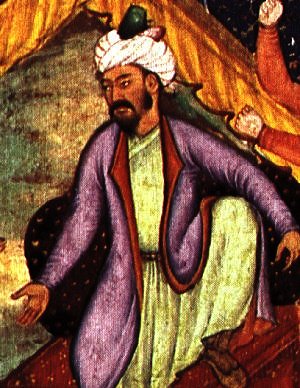
The First Mughal who Conquered IndiaThe first Mughal who came to India was called Babur. Babur could trace his ancestors back to both Genghis Khan and Timur. So he indeed had the perfect background to become a great leader. He inherited a small state called Ferghana from his father after he died in AD 1494 (Ganeri 18). He tried to invade India five times, due to the request of an Indian governor and on the fifth time, he finally defeated the head of the Delhi Sultanate, the powerful northern India rulers, Ibrahim Lodi (Ganeri 19). The Sultanates were Afghani chieftains. Although he had a much smaller army of 12,000 men, and the Delhi Sultanate had an army of 100,000 men...
Reviews of: "What were the First Three Mughals Benefiting Indian-Sub Continent With Art, Architecture, And Battle Tactics? Teacher said well written but too long."
:
More Asian History
essays:
Genghis Khan and the Making of the Modern World by Jack Weatherford
... advanced fighting techniques and ability to expand an empire so quickly. This may seem insignificant, but it gave way to many different innovations such as the invention of paper ... because of his wives. Over the time period of the whole Mongol empire, Genghis ...
Japanese Culture and it's relation to Buddhism
... traditions of Japanese culture. It became totally intertwined with Japanese art, with Zen influencing art and art influencing Zen. One of the strongly influential schools of art in Japan is the "one corner" style, originated ...
Zen Gardening
... importance of the arts, such as: painting, calligraphy, architecture, ceremonial tea drinking, and gardening. Other areas of Buddhism ... Sento and numerous others. Over time, the gardens have stayed true to the basic style, the only exception is Japan, many of their gardens have a lot of ponds and other ...
Many people are interested in the small island Sri Lanka;
... with different styles of clothing, as well as manufacturing clothes. Another important contribution is the hard- working, intelligent people of the Asian Indian culture who have acted as good examples and positive ...
Many people are interested in the small island Sri Lanka;
... with different styles of clothing, as well as manufacturing clothes. Another important contribution is the hard- working, intelligent people of the Asian Indian culture who have acted as good examples and positive ...
The cuases of the Showa Restoration In Japan
... models of parliamentary democracy. During this same period, railroads were constructed, a banking system was started and the samurai system was disbanded.Footnote12 Indeed, it seemed as if Japan had successfully made the transition to a western style industrialized ...
Civilizations in History, Genghis
... ablaze, and in the ensuing confusion the city was stormed." 1 Using ingenious tactics such as the one mentioned above, Mongolia had little trouble winning their battles against the most powerful known force of the time, China ...
Chinese History: Foundations Era-Early Modern Era
... their own way and ruled through periods of political centralization and disintegration; yet they also stayed the same due to the fact that silk continued as the backbone of the Chinese economy, Confucianism guided society for a vast period of time ...
Enjoyed reading
A lot of information and thought put into this it seems. Good job.
1 out of 1 people found this comment useful.