ASSIGNMENT - Why is a cell microscopic?
By Lachlan Bryant
This research assignment will discuss why cells are usually microscopic in size, given that they need to be able to exchange material with their surrounding environment.
The cell is highly organised with many functional units or organelles (Spurger).A membrane is a fluid mosaic which consists of proteins, lipids and carbohydrates which seperates the cell from it's surrounding environment or subdivides a cell into specialised regions or compartments (Watters). The membrane is specialised in that it contains the specific proteins and lipid components that it requires in order to fulfil the requirements needed by that organelle or cell. Membranes are vital for the integrity and function of a cell.
Lipids are the one class of large biological molecules that does not include polymers. They share one important chemical property: they have little or no affinity for water, so they are grouped together.
 Deutsch: Schematische Darstellung der Diffusionsvo...
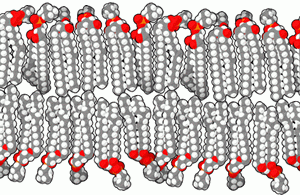 Schem of the lipid bilayer on viruses, i.e.
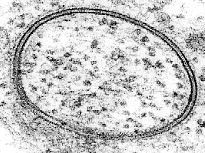 English: Annular Gap Junction Vesicle
Proteins are the most structurally complex molecules known, they also account for on average 50% of the dry weight of most cells. (Membranes online)
Membrane carbohydrates are usually branched oligosaccharides with fewer than 15 sugar units. Some of these are bonded to lipids covalently called glycolipids however the majority of them are covalently bonded to proteins called glycoproteins.
The cell membrane is a mixture of many different proteins, carbohydrates and lipids, embedded in the fluid matrix of the lipid bilayer. The lipid bilayer is the primary fabric of the membrane, and its structure creates a partially permeable membrane. (Hughes)`
This diagram shows the structure of a cell membrane. It refers to the glycolipids and glycoproteins which are the product of carbohydrates covalently bonding with lipids and proteins.
The cellular membrane has three basic properties, firstly a bilayer lipid membrane. Second, a lipid membrane and third, it's dynamic...