Woody Guthrie was born July 14, 1912 in Okemah, Oklahoma, a farming town that later experienced an oil boom in the 1920's. Guthrie's childhood was a heartbreaking experience. The family fell apart when Woody's mother, Nora, set her husband, Charley, on fire with a kerosene lamp. Charley survived and went to Pampa, Texas, to live with his sister, while Nora was institutionalized for the rest of her life. Woody's younger siblings went to Pampa while he and his older brother remained in Okemah. By the time Woody was 14, he was the leader of a gang that lived in an abandoned tin shack. When Woody was taken to see his mother for the last time, he realized that she did not recognize him. (Gale; "Guthrie, Woody (1912-1967)", American Decades. 2003)
In 1933, when Woody was 21, he married his best friend's sister, Mary Jennings. Unemployment was at an all-time high, and farmers struggled to make a living as crop prices dropped.
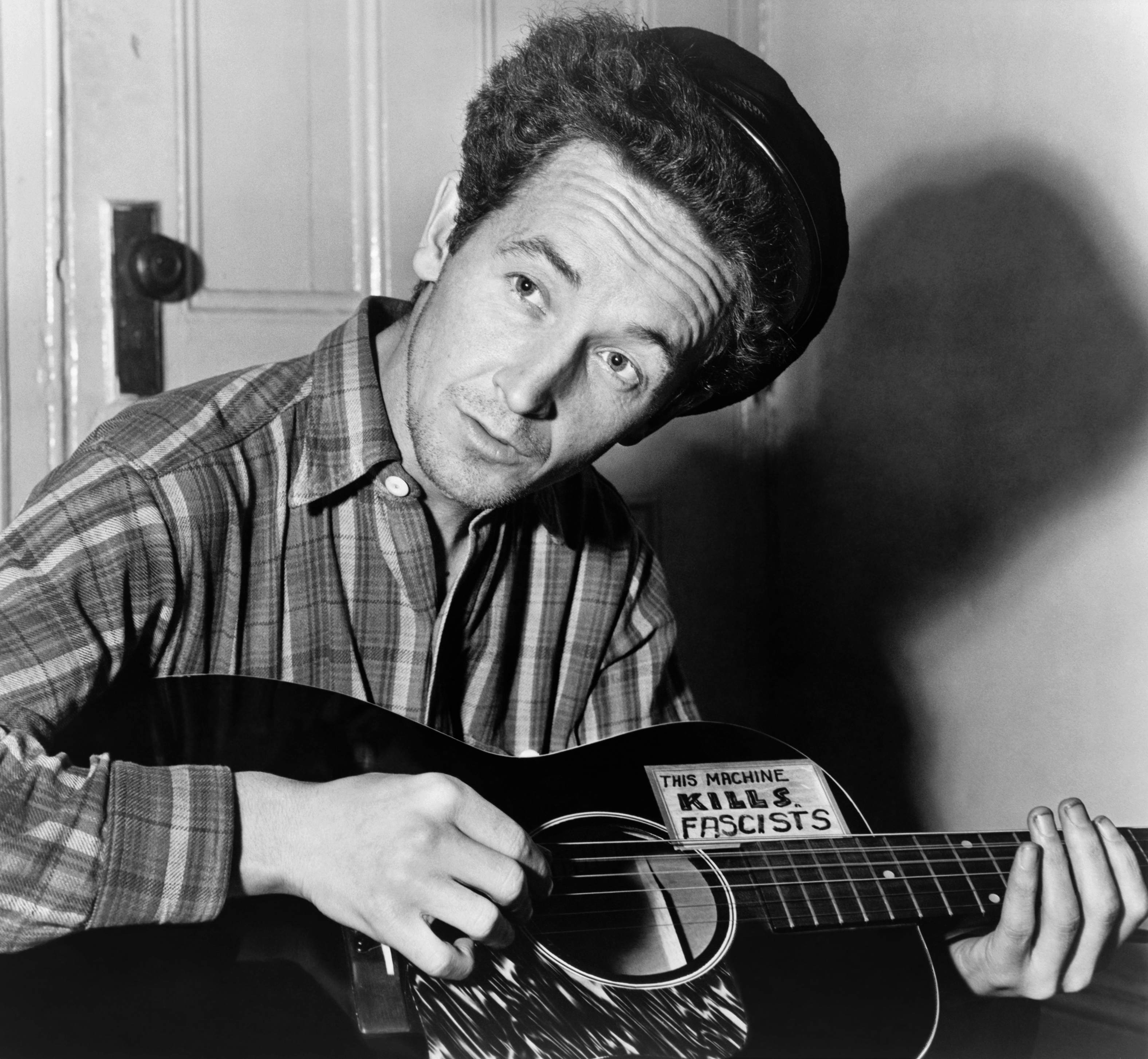 English: Woody Guthrie, half-length portrait, seat...
 The Very Best of Woody Guthrie
 Woody Guthrie's birthplace, Okfuskee County, OK
In 1935 the great dust storm called the "Black Blizzard" swept through Texas and left the land barren. Woody decided to move to Los Angeles, where his cousin Jack worked in the entertainment industry. (Gale; "Guthrie, Woody (1912-1967)", American Decades. 2003)
In the early 1930's,Woody founded his first band called the Corncob Trio in Pampa, Texas. They played traditional songs for local barn dances, for audiences whose appetite for country music was being whetted by the recent recording success of the first country music stars, the Carter Family and Jimmi Rodgers. (Gale; "Guthrie, Woody (1912-1967)", DISCovering World History. 2003)
Guthrie was always a drifter. In the late 1930's he traveled to California by jumping on trains and hitching rides, sleeping among migrants, dust bowl refugees, and hobos. These experiences became the basis for his stories and...